
See also:
The Principalities and Powers: The Invisible Rulers We Need To See
Are the Other “gods” of the Bible Real?
Do False Gods Still Rule the Nations?
In the book of Job, the adversarial spiritual being known as “Satan” tells the Lord that he has been “walking to and fro on the earth” (Job 1:7). Later, Scripture speaks even more plainly as Peter warns that “your adversary the devil prowls around like a roaring lion, seeking someone to devour” (1 Peter 5:8). Together, these passages teach two important truths. First, Satan is indeed active in the world. But second, he is not omnipresent. Unlike God, who fills heaven and earth, Satan is a created being – limited in power, space, and knowledge.
He cannot be everywhere at once, nor can he focus personally on every individual at all times. So if Satan is neither all-powerful nor omnipresent, how is his influence so widespread?
Scripture gives us the answer: he works through deception and manipulation, operating indirectly through both heavenly powers and earthly rulers.
Satan’s Delegated Powers
The Bible reveals that Satan rules through a network of subservient spiritual beings who carry out his will. Jesus refers to “the devil and his angels” (Matthew 25:41), and Revelation 12:9 says that “his angels were cast out with him.” These angels are real spiritual entities, operating under his command.
Satan also works through the rulers of the kingdoms of men. In Luke 4:5-7, he offered Jesus “all the kingdoms of the world,” declaring:
To you I will give all this authority and their glory, for it has been delivered to me, and I give it to whom I will. If you, then, worship me, it will all be yours.
That statement reveals that the nations of the world are, to a large degree, under Satan’s sway. When men reject God’s rule, they inevitably come under Satan’s. This is precisely why God warned Israel about seeking a human king.
And the Lord said to Samuel, ‘Obey the voice of this people in all that they say to you, for they have not rejected you, but they have rejected me from being king over them.”
1 Samuel 8:7
Every earthly government that operates apart from God’s law is part of this same pattern of rebellion. This is why Paul wrote:
For we do not wrestle against flesh and blood, but against rulers, against the authorities, against the cosmic powers over this present darkness, against the spiritual forces of evil in the heavenly places.
Ephesians 6:12
Observe that Paul does not say our battle is simply against Satan himself, but against rulers and authorities – lesser powers, both spiritual and earthly, who derive their authority from him.
From Babel onward, every attempt by man to unite and govern themselves apart from God has been viewed in Scripture as rebellion. Each successive empire that flowed from Babel – Egypt, Assyria, Babylon, Rome – follows that same pattern. Revelation 13:4 makes it clear that the “beast,” representing this kind of human government, receives “his power, throne, and authority” directly from “the dragon,” that is, from Satan.
And they worshiped the dragon, for he had given his authority to the beast, and they worshipped the beast, saying, ‘Who is like the beast, and who can fight against it?”
For this reason, we must learn to view earthly government itself as evidence of Satan’s ongoing rule in the world.
How This Pattern Appears in America
The United States of America is not exempt from this biblical pattern. The same spiritual forces that ruled over Babylon, Persia, and Rome still operate behind the scenes in modern nations.
Scripture teaches that the nations are not merely political realities, but spiritual ones as well. Deuteronomy 32:8-9 describes how, when God divided the nations, He “set the boundaries of the peoples according to the number of the sons of God,” indicating that each nation came under the oversight of its own spiritual being. Daniel 10 pulls back the curtain even further, showing us how the actions of earthly rulers reflect unseen interactions among heavenly “princes.” While Christians may differ on some of the interpretive details of these passages, what remains clear is that the nations operate under the influence of spiritual beings which stand in tension with God’s reign.
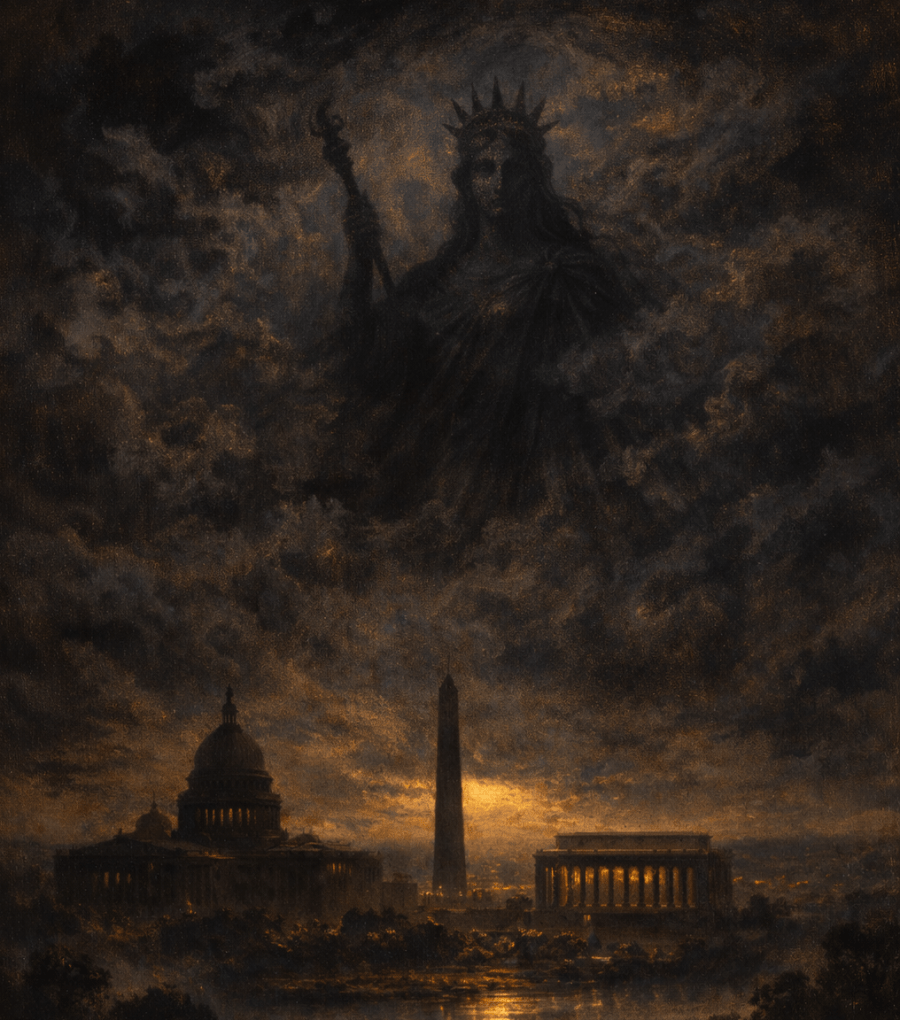
While these texts establish the reality of corrupt spiritual influences over the nations, we can also see this reality reflected in the symbols these cultures adopt for themselves. With this in mind, it’s worth noting how much of America’s national imagery draws straight from paganism. For instance, it is well known that the “D.C.” in “Washington D.C.” stands for the District of Columbia. But who is “Columbia”? Most people have never given it a second thought. Columbia was a mythical being created as a feminine personification of the spirit of America – often portrayed as a robed woman bearing a torch. The Statue of Liberty, in fact, was modeled after this image of Columbia.
Interestingly, the function of Columbia as the “spirit of America” closely resembles that of national deities in the ancient world. The Greeks personified their ideals in Athena, and the Romans embodied the power and destiny in the goddess Roma. In a similar way, Columbia was created to symbolize America’s ideals of enlightenment, liberty, and independence.
To be clear, this does not mean that Columbia is necessarily a literal goddess. We cannot identify her with any specific “principality or power” named in Scripture. Much like it would be impossible to prove that Athena and Roma accurately represent the actual spiritual rulers mentioned in Scripture, neither do we know any specific details about the actual spiritual entity that represents America. The image of Columbia can be easily explained as having arisen out of the Enlightenment-era admiration for Greek and Roman art and architecture. Scripture gives no detailed knowledge of the specific spiritual beings associated with modern nations, and it would be speculation to claim otherwise.
The existence of pagan symbols does not itself prove America’s corrupt spiritual allegiance; Scripture already does that. But the symbols arise from a culture’s imagination and reflect how a nation understands itself. In that sense, America’s pagan imagery mirrors what Scripture describes more broadly: every nation possesses a kind of spiritual “personality,” that is shaped by unseen powers that influence its values, priorities, and direction.
So while we cannot know the specific identities or characteristics of the spiritual beings who stand behind the nations, we can know what the Bible plainly teaches – that the nations of the world are ruled by spiritual powers that exist in rebellion to God.
The Rule of Satan
Here is what we know for certain from Scripture:
- Satan is the god of this world (2 Corinthians 4:4).
- He exercises his rule indirectly through spiritual and earthly principalities and powers (Ephesians 6:12).
- These powers exercise regional dominion, ruling over specific nations (Daniel 10:13, 20).
Just as the Sidonians had Ashtoreth, Moab had Chemosh, and Ammon had Molech (1 Kings 11:5-7), so too each modern nation operates under some spiritual power that mirrors what we see happening on earth.
When we see national symbols that mirror pagan forms, we should therefore take notice. The District of Columbia, the Washington Monument shaped like an Egyptian obelisk (a symbol of the sun god Ra), the Capitol city adorned with statues of Mars, the Lincoln Memorial modeled after a Greek temple – these are not insignificant. Even if their creators saw them as mere works of art, they are still pagan in origin and should remind every Christian of the deeper reality Scripture describes: America, like every other earthly nation, is under the rule of Satan and his principalities and powers.
For this reason, it should not surprise us that America is marked by constant warfare, widespread violence and division, deceptive and destructive economic policies, and the slaughter of millions of innocent children through abortion. These are the natural fruits of a kingdom ruled by Satan – the one who “comes only to steal and kill and destroy” (John 10:10). He steals through inflation and taxation, kills through war and violence, and destroys through corruption of truth and life itself.
The Christian Response
First, Christians must recognize that “the whole world lies under the sway of the wicked one” (1 John 5:19). Satan works through both the earthly and spiritual rulers of the nations, deceiving them and spreading his lies. Revelation 13:14 and 20:3, 8 describe him as “the deceiver of the nations.”
Therefore, earthly governments – no matter how moral or democratic they may appear – remain part of the same system that rejects Christ’s kingship.
If these things are true – and Scripture insists they are – then uncomfortable questions inevitably follow. Christians must not confuse patriotism with faithfulness to Christ, or loyalty to a nation with allegiance to the kingdom of God.
How can any Christian pledge allegiance to a kingdom ruled by powers in rebellion against Christ? Why would a follower of Jesus devote his life to the service of a government that refuses His kingship? And how would a disciple of the Prince of Peace take up arms in defense of a nation whose authority arises from rejection of God’s rule?
For the time being, Satan continues to deceive the nations. Yet his rule is neither absolute nor enduring. Because of the gospel, his defeat is certain. “Then comes the end,” Paul writes, “when He delivers the kingdom to God the Father after destroying every rule and every authority and power” (1 Corinthians 15:24).
Christ alone possesses “all authority in heaven and on earth” (Matthew 28:18). Therefore, the hope of every Christian must never be tethered to the doomed authorities of this world, but anchored in “the kingdom of our Lord and of His Christ” (Revelation 11:15).
Every nation bears the marks of spiritual rebellion, but only one kingdom stands eternal – the kingdom of Christ. America, like all the nations in history, will rise and fall. Its monuments will eventually crumble. But the throne of Christ will never be shaken.
Our task as Christians is not to try to reform the Satanic kingdoms of this world into slightly more Christian versions of themselves, but to bear witness to a greater kingdom – to “proclaim the excellencies of Him who called you out of darkness into His marvelous light” (1 Peter 2:9). Our allegiance belongs to Christ alone.

 The Christian Exile