
Man standing at a fork in the road with signs pointing to Jesus the way of mercy and Roma the power of empire

Why Christians Keep Talking Past Each Other About Patriotism

When I published my recent article, “The Case Against Christians Saying the Pledge of Allegiance,” I expected some pushback. Whenever this subject comes up, the same pattern emerges. One person says, “Jesus is Lord. Our allegiance should be to Him. Our citizenship is in heaven. Do not trust in princes.” Then come the replies:

“You can love your country and love Jesus too.”

“Our ultimate allegiance belongs to God, but that allegiance must be expressed through earthly relationships. Patriotism is an extension of love for neighbors, and as such it is an expression of our loyalty to God.”

“There’s nothing wrong with loving your country, as long as God comes first.”

Both sides affirm that Jesus should be the object of our highest devotion, yet neither convinces the other when it comes to the implications on what this devotion should mean for a Christian’s relationship to their earthly nation.

So how do we move past this stalemate? I don’t think the problem is that either side is being unreasonably stubborn. I think the deeper issue is that we’re operating within two completely different categories of allegiance. Until we recognize and name those two categories, we’ll continue talking past each other.

Scripture Recognizes Properly Ordered Allegiances

The Bible is not opposed to any and every earthly loyalty that may exist outside of our allegiance to God. In fact, there are many relationships where such loyalty is not only permitted, but is commanded.

These other loyalties can be viewed as proper and good, just as long as they are properly ordered beneath our ultimate devotion to God. These loyalties should never challenge our allegiance to Christ. Instead, they become expressions of it. If, however, any of these loyalties do become exalted in our lives to the point that they conflict with our allegiance to Christ, they should be set aside. The loyalties are good, so long as our ultimate allegiance is to Christ.

Marriage provides perhaps the clearest example. Husbands are expected to love their wives the way Christ loves the church (Ephesians 5:25), and wives owe that same covenant faithfulness to their husbands. Yet Jesus also teaches that our devotion to Him must surpass even our devotion to our own families. He speaks hyperbolically of “hating” father, mother, wife, children, and even one’s own life by comparison to the love we have for Him (Luke 14:26), before concluding that anyone who is unwilling to renounce all he has cannot be His disciple (14:33).

But does this mean that loyalty to one’s spouse is wrong? Of course not! A husband’s devotion to his wife is itself an act of obedience to God. Only when loyalty to one’s spouse would require disobedience to Christ does conflict arise. Marital faithfulness is good precisely because it remains a properly ordered expression of our ultimate allegiance to God.

The same can be said of numerous other earthly relationships. Children honor their parents because God commands it (Exodus 20:12). Bondservants were expected to be loyal to their masters (Ephesians 6:5-8). Christians should be loyal friends. They should be loyal to their local congregation. In each of these examples, earthly loyalties are not abolished by allegiance to Christ. In fact, it can be said that many earthly loyalties should actually grow stronger because of it.

Many Christians place patriotism in this same category. They believe that loyalty to one’s country functions much like loyalty to family, church, or employer. I’ve even seen the comparison drawn between patriotism and one’s loyalty to their favorite sports team. The point is, Christians can have legitimate secondary allegiances, just as long as they never replace or weaken one’s devotion to Christ.

Whether or not patriotism properly fits in this first category is a discussion for another article. For now, I simply want to stress that Scripture clearly teaches that some loyalties can coexist peacefully beneath our supreme allegiance to God.

But not every relationship, and not every loyalty fits in this first category.

Scripture Also Describes Mutually Exclusive Allegiances

Consider the first of the ten commandments:

You shall have no other gods before me.

Exodus 20:3

I’ve often heard idolatry defined as “putting something ahead of God.” That definition is actually too weak. God wasn’t saying, “If you worship Baal, just make sure I remain your favorite.” The next verses make it clear what God had in mind:

You shall not make for yourself a carved image, or any likeness of anything that is in heaven above, or that is in the earth beneath, or that is in the water under the earth. You shall not bow down to them or serve them, for I the LORD your God am a jealous God.

Exodus 20:4-5

The LORD wasn’t asking Israel to rank Him above other gods. He demanded that they abandon the others altogether.

This same emphasis is repeated throughout the Old Testament. Joshua didn’t urge Israel to love the LORD a little more than the gods of the Amorites. He told them, “Choose this day whom you will serve” (Joshua 24:15). Likewise, Elijah challenged Israel on Mount Carmel, “If the LORD is God, follow him; but if Baal, then follow him” (1 Kings 18:21). Neither prophet suggested that Israel could simply rank the LORD above other gods. They both demanded exclusive allegiance.  

These same kinds of mutually exclusive relationships come into focus in the New Testament as well. Jesus described God and Mammon as two mutually exclusive masters.

No man can serve two masters, for either he will hate the one and love the other, or else he will be devoted to the one and despise the other. You cannot serve God and money.

Matthew 6:24-25

Paul does the same when he contrasts righteousness with lawlessness, light with darkness, Christ with Belial, and God’s temple with idols:

Do not be unequally yoked with unbelievers. For what partnership has righteousness with lawlessness? Or what fellowship has light with darkness? What accord has Christ with Belial? Or what portion does a believer share with an unbeliever? What agreement has the temple of God with idols? For we are the temple of the living God.

2 Corinthians 6:14-16

None of these relationships are “properly ordered.” They are fundamentally incompatible.

Some of the strongest language used to describe mutually exclusive relationships comes from the book of James:

You adulterous people! Do you not know that friendship with the world is enmity with God? Therefore whoever wishes to be a friend of the world makes himself an enemy of God. Or do you suppose it is of no purpose that Scripture says, “He yearns jealously over the spirit that he has made to dwell in us?

James 4:4-5

James doesn’t write, “Make sure your love for the world doesn’t surpass your love for God.” Instead, he compares friendship with the world to adultery.

Think for a moment about that comparison. Suppose for a moment a husband came home one night and told his wife, “I have a new girlfriend, but don’t worry. You’re still my highest priority. My relationship with this other woman is properly ordered under my ultimate commitment to you. If the two ever come into conflict, I’ll choose you.”

No faithful wife would accept that explanation. Clearly, some relationships are intended to be absolutely mutually exclusive. The problem isn’t that the marriage came second. The problem is that a rival relationship exists at all.

And that’s precisely the image that James chooses to describe how Christians should relate to the world. Yes, some relationships can be properly ordered under our ultimate allegiance to Christ. But others cannot. Some relationships must be abandoned altogether.

How Do We Know Which Category a Relationship Belongs In?

How then do we determine which relationships belong in each category?

We must start with Scripture. Does God authorize or command the relationship as an expression of obedience to Him? Or does Scripture portray the relationship as a rival that competes for the devotion that belongs to God alone?

Once again, we find the marriage illustration to be helpful. A husband and a wife may share countless other loyalties. They can be loyal to their children, employers, friends, hobbies, etc. Some of those other loyalties may even serve to strengthen the marriage!

But another romantic relationship is different. It cannot be placed lower on the priority list. Why? Because the other lover presents a rival claim. The other lover will never be content to remain in second place. The rival relationship will continue to demand more and more affection, until the marriage is destroyed.

Not every relationship belongs in the same category. We must exercise wisdom. If a relationship in any way whatsoever presents itself as a rival to what rightfully belongs to God, it cannot be “properly ordered.” It must be set aside completely.

This Is Where Discussions of Christianity and Patriotism Get Stuck

This is, I believe, why discussions about Christianity and patriotism often reach an impasse. Those who defend patriotic expressions place them in the first category. To them, love of country resembles love of family or love of neighbors. They see it as a legitimate secondary loyalty, provided Christ remains first.

Meanwhile, those who object to pledging allegiance to earthly kingdoms place patriotism in the second category. They see earthly kingdoms as rivals to the Kingdom established by Christ. They see Caesar’s claim to the title of “Lord” as mutually exclusive with Jesus’s claim to the same title. If that understanding is correct, then patriotism absolutely cannot be viewed as a properly ordered secondary allegiance.

Notice where the real disagreement lies. It is not whether Jesus is Lord. It is not whether Christians should seek first the Kingdom of God. It is not whether Christ deserves our highest allegiance. Virtually all Christians agree on these points.

The real question is “Which category do earthly kingdoms belong in?” Should they resemble our relationship to family, employers, or love for neighbor? Or should they be viewed as rival allegiances that compete with our devotion owed to our King?

That is the question I want to explore next.
The Case Against Christians Saying the Pledge of Allegiance

Several years ago, I stopped saying the Pledge of Allegiance. I haven’t always objected to saying the Pledge. For years, I never questioned it. The Pledge was never preached against or discussed in Bible classes. Most Christians I knew joined in without hesitation. I was right there with them.

I never viewed the Pledge as a declaration of ultimate allegiance to government institutions. I knew governments often did ungodly things. Instead, I thought of myself as pledging allegiance to the good things the flag was supposed to represent: “liberty and justice for all” and “one nation under God.” As long as America stood for godly values, I could support her, while maintaining my ultimate allegiance to God alone.

Refusing to say the Pledge even felt disrespectful. Scripture commands Christians to honor governing authorities. As Paul writes:

Pay to all what is owed to them: taxes to whom taxes are owed, revenue to whom revenue is owed, respect to whom respect is owed, honor to whom honor is owed.

Romans 13:7

Even now, though I no longer recite the Pledge, I still believe we must remain respectful. I am not suggesting that Christians should become anti-American activists or stage disruptive protests at sporting events. You can respectfully stand, remove your hat, and yet remain silent without placing your hand over your heart.

If you currently say the Pledge, I think I understand your perspective. But I do want to encourage you to think about what you’re saying. The more I did, the more convinced I became that the Pledge of Allegiance is fundamentally out of step with the gospel.

A Pledge is a Big Deal

Consider those first two words: “I pledge.”

A pledge is a promise, an oath, and a commitment of loyalty. That should immediately capture a Christian’s attention, especially in light of Jesus’ words during the Sermon on the Mount:

Again you have heard that it was said to those of old, ‘You shall not swear falsely, but shall perform to the Lord what you have sworn. But I say to you, Do not take an oath at all… Let what you say simply be ‘Yes’ or ‘No’; anything more than this comes from evil.

Matthew 5:33-37

While Christians have long debated whether Jesus was forbidding every formal oath or simply emphasizing the importance of absolute truthfulness, it is clear that promises and vows are serious spiritual matters. We should never make oaths casually, simply because tradition expects it or because everyone else is reciting them. If we’re going to pledge something, we ought to first pause and examine whether the oath is one we can truly keep.

What Does Biblical Faith Actually Mean?

Consider the biblical concept of faith. The Greek word translated as “faith” is pistis.

In modern culture, faith is often reduced to mere intellectual agreement. The confession, “I believe that Jesus Christ is the Son of God” is frequently treated as simply giving mental assent to the truth of that statement. Sometimes, faith is even treated as the blind opposite of evidence.

That is not how the Bible uses the term. James reminds us that “even the demons believe – and shudder!” (James 2:19). Throughout Scripture, true faith is inseparable from faithfulness, loyalty, or even, allegiance.

We see this clearly in Hebrews 11:

  • By faith, Noah built an ark.
  • By faith, Abraham left his homeland.
  • By faith, Moses rejected Pharaoh’s court.
  • By faith, Israel marched around Jericho.

Faith is never presented as mere belief. It is demonstrated through loyalty, and loyalty includes acts of loyalty. Paul frames the entire book of Romans around “the obedience of faith” (Romans 1:5; 16:26). This phrase has proved quite tricky for those who think of faith as the opposite of works, but it makes perfect sense when we understand pistis as loyalty or allegiance.

This definition matches how the word was used at that time. For instance, in the historical book of 1 Maccabees, King Demetrius praises the Jewish people for maintaining their pistis:

Since you have kept your agreement with us and have continued your friendship with us, and have not sided with our enemies, we have heard of it and rejoiced. And now continue still to keep faith with us, and we will repay you with good for what you do for us.

1 Maccabees 10:25-27

King Demetrius was not thanking the Jews for believing he existed. He was thanking them for remaining politically loyal. In the ancient world, pistis meant allegiance.

The Gospel Calls for Allegiance to a King

Paul opens Romans by summarizing the gospel as a message “concerning [God’s] Son, who was descended from David” (Romans 1:3). This detail matters. David was Israel’s king and Jesus is presented as the One who has inherited his promised throne.

Therefore, Paul’s mission was to bring about “the obedience of faith among all the nations” (Romans 1:5). If faith means allegiance, then the gospel is a summons to people of all nations to give their loyalty to King Jesus.

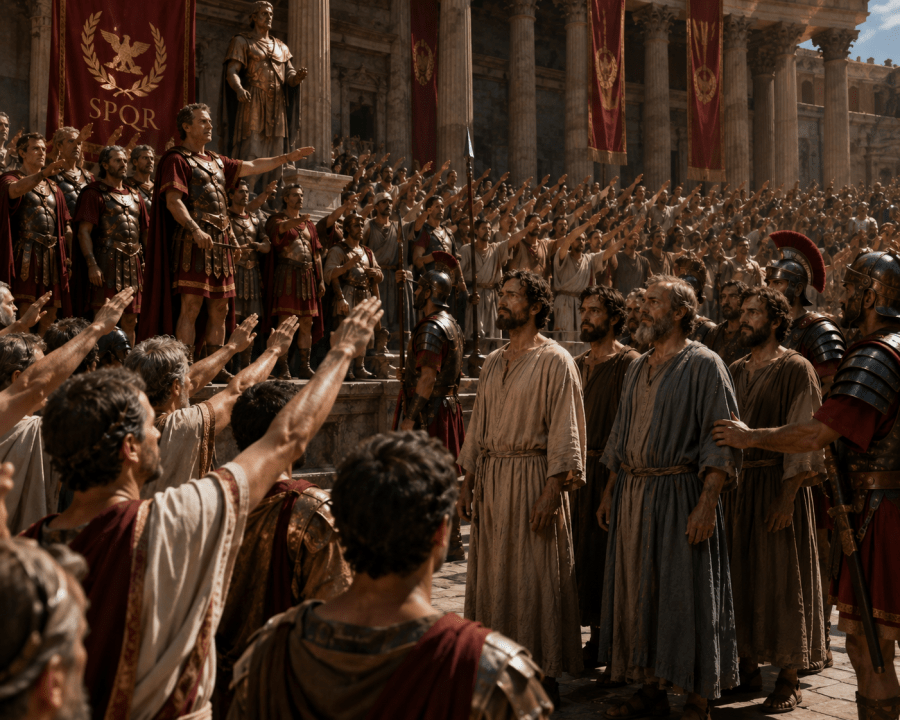
The central Christian confession is that “Jesus is Lord(Romans 10:9). In the Roman world, “Lord” (Kyrios) was not merely a theological title. It was primarily a political term. To publicly confess Jesus as Lord was to implicitly declare that Caesar was not. That is why the early Christians were routinely accused of political treason:

They dragged Jason and some of the brothers before the city authorities, shouting, “These men who have turned the world upside down have come here also… and they are acting against the decrees of Caesar, saying there is another king, Jesus.”

Acts 17:6-7

The early Christians were not revolutionaries, but they boldly announced that Jesus held all authority in heaven and on earth (Matthew 28:18). When this message was proclaimed throughout all nations, it was understood as a transfer of allegiance away from the competing authorities of those nations, to a life of loyalty to the commands of Jesus.

In fact, one of the reasons why baptism was so important is because it served as a pledge of allegiance. Peter describes baptism as:

…not as a removal of dirt from the body but as an appeal [or pledge, NIV] to God for a good conscience, through the resurrection of Jesus Christ.

1 Peter 3:21

The word translated as “appeal” or “pledge” (eperotema) was used to refer to one’s formal answer, agreement, or vow to the terms of a legal contract. Baptism is a binding pledge of total loyalty made to God. If you are a Christian, you have already pledged your allegiance to a King.

Can Christians Have Dual Allegiance?

This brings us to the core issue: Can a Christian pledge allegiance to Christ and simultaneously pledge allegiance to the flag of an earthly kingdom?

Scripture has much to say about how Christians should relate to the governments. We are to submit to them (Romans 13:1-7), obey their laws (Titus 3:1), and pray for them (1 Timothy 2:1-2). Jeremiah even encouraged the Jewish exiles to “seek the welfare of the city where I have sent you into exile” (Jeremiah 29:7). Christians are to be good and peaceful citizens.

However, Jesus also taught that no one can serve two masters (Matthew 6:24). He demanded loyalty greater than even our loyalty to our family (Luke 14:26). When the apostles were ordered to stop preaching Christ, they replied, “We must obey God rather than men” (Acts 5:29). When forced to choose, their loyalty was undivided.

Revelation’s Warning About Political Powers

The book of Revelation drives this point home with vivid imagery. John depicts the monstrous powers of political entities as “beasts” who were demanding absolute devotion. This image is drawn directly from Daniel 7.

John warned that those who “followed the beast” were, in reality, worshiping the dragon who empowered it with authority (Revelation 13:3-4). The beast promised safety, economic prosperity, and national peace. Yet, John does not advise Christians to pledge their allegiance to the good things these kingdoms stand for. Instead, he offers a sharp warning:

Come out of her, my people,
lest you take part in her sins,
lest you share in her plagues.

Revelation 18:4

According to the book of Revelation, you cannot give your loyalty both to the Lamb and the Beast. One loyalty wholly excludes the other.

The Witness of the Early Martyrs

The final piece that reinforced this conviction for me came from reading about the early Christian martyrs. For the first three centuries, one of the primary reasons Christians were persecuted is because they refused to swear oaths of loyalty to Caesar.

When Polycarp, a disciple of the apostle John, was arrested, Roman officials offered him freedom if he would simply “swear by the fortune of Caesar.” Polycarp refused. Instead he answered:

“Eighty and six years have I served Him, and He never did me any injury: how then can I blaspheme my King and my Savior?”

The Martyrdom of Polycarp 9

For Polycarp, pledging loyalty to Caesar was equivalent to blaspheming Christ. You can read the entire account here.

Similarly, during the trial of the Scillitan Martyrs in AD 180, a Christian named Speratus was pressured to swear allegiance to the emperor. He answered:

I do not acknowledge the authority of this world, but rather I serve that God whom no one has seen or can see with these eyes. I have never been guilty of theft, but whenever I buy, I pay the tax, because I acknowledge my Lord, the King of Kings, and ruler of all peoples.

The Acts of the Scillitan Martyrs

Speratus recognized Caesar’s legal authority, but he was executed because he refused to vow his allegiance to him. An additional Scillitan martyr named Donata likewise refused to pledge to Caesar with the following words:

Honor to Caesar in his capacity as Caesar, but fear to God.

You can read the entire first hand account of these martrys here.

Is reciting the Pledge of Allegiance a perfect parallel to what these Christians were being asked to do? Probably not. Romans often demanded sacrifices to pagan gods along with those pledges. Nobody is asking Americans to worship false gods along with the Pledge.

Even so, when you read about these early Christian martyrs, their objections focused not on Rome’s worship of other gods, but in the vow of allegiance to any king other than King Jesus. The ancient Christians viewed themselves as citizens of a heavenly kingdom. They honored earthly rulers, but because of their devotion to Jesus, they absolutely refused to swear vows of allegiance to them, even at the expense of their lives.

A Different Kingdom

Christians should respect their leaders, pray for them, and obey them whenever doing so does not require disobedience to God. But pledging allegiance is something different. It is a declaration of loyalty. As Christians, we have already made that declaration. Jesus is our King. The church’s mission is not to point people to America as the source of liberty and justice, but to point them to Jesus Christ as the true Savior of the world.

For that reason, I can no longer say the Pledge of Allegiance. If you are a Christian, I invite you to consider doing the same.