
The Case for Patriotism as a Mutually Exclusive Allegiance

This article grows out of my previous articles, “The Case Against Christians Saying the Pledge of Allegiance” and “Why Christians Keep Talking Past Each Other About Politics.” In the latter, I argued that Scripture recognizes two different categories of allegiance.

The first category is the kind of allegiances that can be properly ordered beneath our ultimate allegiance to Christ. A Christian can be loyal to his wife, faithful to his employer, honor his parents, and love his neighbors without compromising his devotion to Christ. As long as these allegiances are properly ordered, they can even be expressions of our loyalty to Christ.

The second category is the kind of allegiance that are inherently rivalrous. Idolatry is not avoided by simply putting God as the highest-ranking among various gods whom we serve. Adultery is not made acceptable by simply loving another woman a little less than your wife. James describes friendship with the world in this second category when he labels it as adultery (James 4:4). Some allegiances cannot be properly ordered, but must be avoided entirely.

The question, then, is where patriotic allegiance belongs. Is allegiance to an earthly kingdom something that can be properly ordered beneath our allegiance to Christ, or is it inherently rivalrous, and thus to be avoided altogether?

In my previous article, I examined the case for the former. Here I want to make the case for the latter. I believe allegiance to an earthly kingdom is fundamentally incompatible with allegiance to Christ. Here’s why:

1 .Because of the Origin, Nature, and Destiny of Earthly Kingdoms

When Paul wrote Romans 13, the Roman Empire was not the first earthly kingdom God’s people had ever encountered, nor would it be the last. Before Rome there had been Greece, Persia, Babylon, Assyria, Egypt, and the various nations of Canaan. Each of these kingdoms had exercised power over God’s people at various points in history. And each eventually fell. Rome was powerful, but Rome was simply one kingdom in an unbroken chain of successive earthly powers.

The origin of each of these earthly kingdoms reaches all the way back to Genesis 10-11 and the events surrounding Babel. It was there that mankind was divided and scattered into the nations of the earth. These first nations were formed in the context of, and as the result of, rebellion against God.

But alongside the story of these earthly kingdoms, Scripture also tells the story of God’s kingdom. From the shadow of Babel, God called Abraham. From his family he established the nation of Israel as His own possession. Israel was not just one nation among many. They were God’s holy nation, and as such, they were set apart from the ways of the nations that surrounded them.

Throughout the Old Testament, the pagan nations of Egypt, Canaan, Assyria, Babylon, and others are continually found to be in conflict with Israel. But the prophets offered hope of a coming kingdom which would triumph over all the other kingdoms of the world. It would be through this coming kingdom that God’s blessings would ultimately be extended even to the Gentiles.

Daniel 2 provides one of the clearest pictures of this expectation. The kingdoms that held, and would soon hold dominion over the world are represented by a great statue. This statue is then crushed in pieces and destroyed by a stone “cut out by no human hand” (Daniel 2:34). Daniel then explains this dream by stating, “The God of heaven will set up a kingdom that shall never be destroyed” (Daniel 2:44). Notice that the coming Kingdom would not merely stand alongside the statue, or even form the new head for the statue. The coming kingdom would ultimately break in pieces and destroy the other kingdoms.

The contrast becomes even clearer in Daniel 7. The kingdoms of the world are portrayed as beasts, but in contrast to these beasts comes “one like a son of man” who receives an everlasting kingdom that would rule over “all peoples, nations, and languages” (Daniel 7:13-14). The dominion of the beasts is ultimately taken away and destroyed, while the kingdom of the son of man would hold dominion forever (Daniel 7:26-27).

The conflict between these kingdoms and God’s people continues to be apparent throughout the whole New Testament. From Jesus’ birth to the cross, to the persecutions in Acts, to the “beasts” and “Babylon” of the book of Revelation, these earthly kingdoms consistently present themselves as enemies of Christ and kingdom. But just as we see in Daniel, the New Testament likewise speaks of their future destruction at Christ’s return (cf. 1 Corinthians 15:24; Revelation 11:15).

The bottom line is this: from Genesis through Revelation, earthly kingdoms are continually portrayed as entities that are inherently rivalrous with Christ’s reign. They were born in rebellion against, exist in conflict with, and are destined for destruction at the hands of God’s Kingdom. This understanding is foundational for understanding what the Bible says about how God’s people relate to earthly kingdoms.

2. Because Israel Was Forbidden From Yoking Itself to Earthly Kingdoms

How, then, were the citizens of God’s holy nation, Israel, commanded to relate to the pagan nations that surrounded them? They were forbidden to form alliances with those nations and their gods.

God told Israel in Exodus 23:32, “You shall make no covenant with them and their gods.” The same warning appears repeatedly throughout the Old Testament (Exodus 34:12-16; Deuteronomy 7:1-6; Joshua 23:12-13). Their covenant relationship with the LORD prohibited them from allying themselves with rival kingdoms and their gods.

Israel was warned repeatedly against trusting foreign nations for security and deliverance. When Israel looked to Egypt for military protection, Isaiah condemned them:

Woe to those who go down to Egypt for help
and rely on horses,
who trust in chariots because they are many
and in horsemen because they are very strong,
but do not look to the Holy One of Israel or consult the LORD!

Isaiah 31:1

The problem was not simply that Israel was trusting Egypt too much and God too little. By the very act of seeking security from Egypt, they were failing to trust the LORD.

The prophets even described Israel’s alliances with pagan nations as adultery, portraying Israel as an unfaithful wife chasing after other men (cf. Ezekiel 16 & 23). This helps explain James 4:4: “You adulterous people! Do you not know that friendship with the world is enmity with God?” When James warns the church of adultery, he is drawing upon this Old Testament picture of God’s people pursuing alliances with pagan powers.

Israel belonged to God, yet they lived among other kingdoms that did not. The kingdoms of the world were of a different nature, and Israel was forbidden to yoke itself to them.

3. Because Jesus Established a Kingdom

This brings us to the ministry of Jesus. The central message of Jesus’ forerunner, John the Baptist, was summarized as: “Repent, for the kingdom of heaven is at hand” (Matthew 3:2). Likewise, Jesus proclaimed, “The time is fulfilled, and the kingdom of God is at hand; repent and believe in the gospel” (Mark 1:15).

Jesus did not come to teach people how to create new and improved versions of the kingdoms that already existed. He was given numerous opportunities to seize earthly political power, but he refused this option each and every time (Luke 4:5-8; John 6:14-15). And He commanded his disciples to do the same (Luke 22:25-26). Instead of working with and through the powers these kingdoms offered, He came announcing the arrival of an entirely new kingdom, the kingdom of God.

And this kingdom had a King. One of Jesus’ favorite ways of referring to Himself was “the Son of Man,” drawing directly from Daniel 7, where the Son of Man receives an everlasting kingdom over “all peoples, nations, and languages.” That’s why He announced at His ascension, “All authority in heaven and on earth has been given to me” (Matthew 28:18).

This is also why “Jesus is Lord” became the central confession of the early church. This was more than simply a statement about Jesus’ divinity. It was a declaration of His reign. Christians were proclaiming that Jesus, not Caesar, was Lord.

This helps explain the accusation made against the Christians in Thessalonica:

They are all acting against the decrees of Caesar, saying there is another king, Jesus.

Acts 17:7

The charge was accurate. Christians were proclaiming another King. And if we have given our allegiance to Jesus as King, we cannot simultaneously give our allegiance to rival kings.

4. Because of the Spiritual Dimension Behind Earthly Kingdoms

Scripture also presents earthly political powers as part of a larger spiritual conflict. Deuteronomy, Daniel, and many of the Psalms associate earthly kingdoms with spiritual powers that stand behind them (cf. Deuteronomy 32:8; Daniel 10; Psalm 82). Paul says that Christians should wrestle against these “rulers,” “authorities,” and “cosmic powers” (Ephesians 6:12). The book of Revelation even says that these earthly kingdoms receive their authority from the “dragon” (Revelation 13:2). These passages reinforce the biblical picture of earthly kingdoms existing within a world in rebellion against God. Recognizing the reality of these rebellious principalities and powers explains why it is appropriate to compare allegiance to these kingdoms to the sin of idolatry.

5. Because of the Early Christian Martyrs

The early Christians understood the importance of refusing allegiance to these earthly kingdoms. As I documented previously, Christians in the early centuries refused to swear allegiance to Caesar, even when doing so cost them their lives. Polycarp’s response perhaps says it best: “How then can I blaspheme my King who saved me?” Polycarp understood that swearing allegiance to Caesar was incompatible with his loyalty to Christ. He could not give Caesar even a lesser allegiance, for he served Christ as King. Because he already belonged to that King, he could not give allegiance to another.

What About Romans 13?

Of course, many will continue to point to Romans 13, 1 Peter 2, 1 Timothy 2, as well as Jesus’ command to “render to Caesar what is Caesar’s.” And they are right to do so. These are important passages that teach Christians to submit to governing authorities. We are commanded to pay taxes, honor rulers, pray for them, and obey the law, provided that obedience to those authorities does not conflict with our obedience to Christ.

But none of these passages teach allegiance to earthly rulers. Submission is not the same thing as allegiance. Submission is something we do because of our allegiance, but in each of these passages, the allegiance in view is allegiance to God. We submit to earthly rulers, not because we have pledged loyalty to them, but because we have pledged loyalty to God.

Just as Romans 13 teaches, we trust that God is properly ordering earthly kingdoms and using them as His ministers to accomplish His purposes. Paul says that God uses governing authorities to execute wrath on wrongdoers, building on how God used kingdoms such as Egypt, Assyria, and Babylon to accomplish His purposes in the Old Testament.

But God’s ability to use these kingdoms for good is not contingent on those kingdoms willingly and knowingly giving him their submissive obedience (cf. Isaiah 10:5-15; Habakkuk 1:9-11). None of these passages teach that God expects his people to become part of these kingdoms. We can submit to government without belonging to it. We can, and must, submit to these kingdoms, but we cannot pledge our allegiance to them.

We have pledged our allegiance to another king. Jesus is Lord. We should honor earthly rulers, obey their laws, and pray for those in authority. But we must never confuse submission with allegiance to rulers and kingdoms that are inherently rivalrous with Christ and His kingdom. Because we have pledged our allegiance to Christ, and because we recognize these earthly powers as rivals to Christ and His kingdom, we cannot give our allegiance to these rival kingdoms.
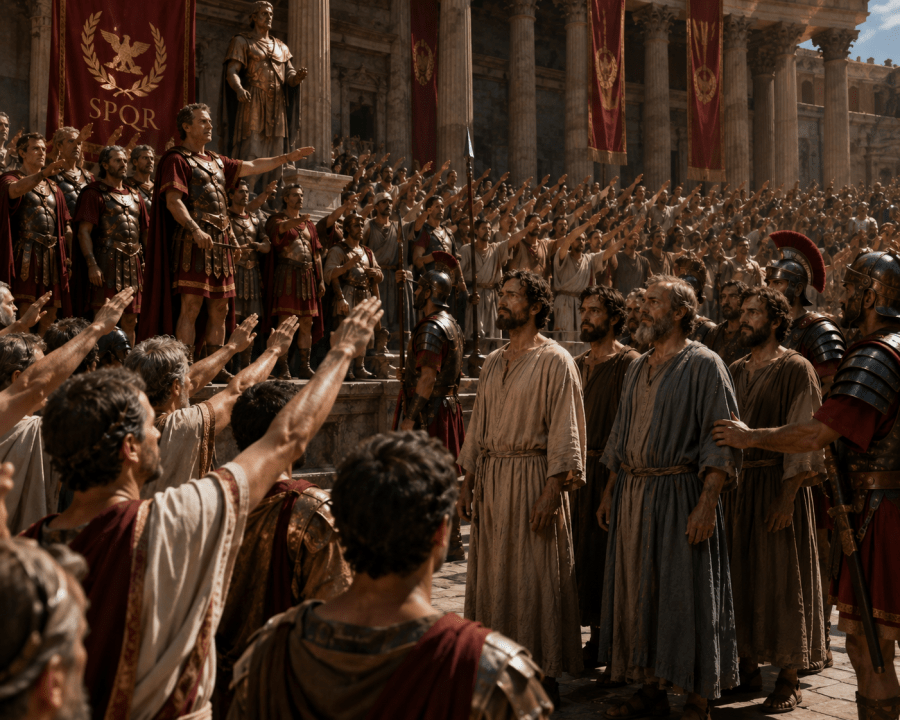

The Case Against Christians Saying the Pledge of Allegiance

Several years ago, I stopped saying the Pledge of Allegiance. I haven’t always objected to saying the Pledge. For years, I never questioned it. The Pledge was never preached against or discussed in Bible classes. Most Christians I knew joined in without hesitation. I was right there with them.

I never viewed the Pledge as a declaration of ultimate allegiance to government institutions. I knew governments often did ungodly things. Instead, I thought of myself as pledging allegiance to the good things the flag was supposed to represent: “liberty and justice for all” and “one nation under God.” As long as America stood for godly values, I could support her, while maintaining my ultimate allegiance to God alone.

Refusing to say the Pledge even felt disrespectful. Scripture commands Christians to honor governing authorities. As Paul writes:

Pay to all what is owed to them: taxes to whom taxes are owed, revenue to whom revenue is owed, respect to whom respect is owed, honor to whom honor is owed.

Romans 13:7

Even now, though I no longer recite the Pledge, I still believe we must remain respectful. I am not suggesting that Christians should become anti-American activists or stage disruptive protests at sporting events. You can respectfully stand, remove your hat, and yet remain silent without placing your hand over your heart.

If you currently say the Pledge, I think I understand your perspective. But I do want to encourage you to think about what you’re saying. The more I did, the more convinced I became that the Pledge of Allegiance is fundamentally out of step with the gospel.

A Pledge is a Big Deal

Consider those first two words: “I pledge.”

A pledge is a promise, an oath, and a commitment of loyalty. That should immediately capture a Christian’s attention, especially in light of Jesus’ words during the Sermon on the Mount:

Again you have heard that it was said to those of old, ‘You shall not swear falsely, but shall perform to the Lord what you have sworn. But I say to you, Do not take an oath at all… Let what you say simply be ‘Yes’ or ‘No’; anything more than this comes from evil.

Matthew 5:33-37

While Christians have long debated whether Jesus was forbidding every formal oath or simply emphasizing the importance of absolute truthfulness, it is clear that promises and vows are serious spiritual matters. We should never make oaths casually, simply because tradition expects it or because everyone else is reciting them. If we’re going to pledge something, we ought to first pause and examine whether the oath is one we can truly keep.

What Does Biblical Faith Actually Mean?

Consider the biblical concept of faith. The Greek word translated as “faith” is pistis.

In modern culture, faith is often reduced to mere intellectual agreement. The confession, “I believe that Jesus Christ is the Son of God” is frequently treated as simply giving mental assent to the truth of that statement. Sometimes, faith is even treated as the blind opposite of evidence.

That is not how the Bible uses the term. James reminds us that “even the demons believe – and shudder!” (James 2:19). Throughout Scripture, true faith is inseparable from faithfulness, loyalty, or even, allegiance.

We see this clearly in Hebrews 11:

  • By faith, Noah built an ark.
  • By faith, Abraham left his homeland.
  • By faith, Moses rejected Pharaoh’s court.
  • By faith, Israel marched around Jericho.

Faith is never presented as mere belief. It is demonstrated through loyalty, and loyalty includes acts of loyalty. Paul frames the entire book of Romans around “the obedience of faith” (Romans 1:5; 16:26). This phrase has proved quite tricky for those who think of faith as the opposite of works, but it makes perfect sense when we understand pistis as loyalty or allegiance.

This definition matches how the word was used at that time. For instance, in the historical book of 1 Maccabees, King Demetrius praises the Jewish people for maintaining their pistis:

Since you have kept your agreement with us and have continued your friendship with us, and have not sided with our enemies, we have heard of it and rejoiced. And now continue still to keep faith with us, and we will repay you with good for what you do for us.

1 Maccabees 10:25-27

King Demetrius was not thanking the Jews for believing he existed. He was thanking them for remaining politically loyal. In the ancient world, pistis meant allegiance.

The Gospel Calls for Allegiance to a King

Paul opens Romans by summarizing the gospel as a message “concerning [God’s] Son, who was descended from David” (Romans 1:3). This detail matters. David was Israel’s king and Jesus is presented as the One who has inherited his promised throne.

Therefore, Paul’s mission was to bring about “the obedience of faith among all the nations” (Romans 1:5). If faith means allegiance, then the gospel is a summons to people of all nations to give their loyalty to King Jesus.

The central Christian confession is that “Jesus is Lord(Romans 10:9). In the Roman world, “Lord” (Kyrios) was not merely a theological title. It was primarily a political term. To publicly confess Jesus as Lord was to implicitly declare that Caesar was not. That is why the early Christians were routinely accused of political treason:

They dragged Jason and some of the brothers before the city authorities, shouting, “These men who have turned the world upside down have come here also… and they are acting against the decrees of Caesar, saying there is another king, Jesus.”

Acts 17:6-7

The early Christians were not revolutionaries, but they boldly announced that Jesus held all authority in heaven and on earth (Matthew 28:18). When this message was proclaimed throughout all nations, it was understood as a transfer of allegiance away from the competing authorities of those nations, to a life of loyalty to the commands of Jesus.

In fact, one of the reasons why baptism was so important is because it served as a pledge of allegiance. Peter describes baptism as:

…not as a removal of dirt from the body but as an appeal [or pledge, NIV] to God for a good conscience, through the resurrection of Jesus Christ.

1 Peter 3:21

The word translated as “appeal” or “pledge” (eperotema) was used to refer to one’s formal answer, agreement, or vow to the terms of a legal contract. Baptism is a binding pledge of total loyalty made to God. If you are a Christian, you have already pledged your allegiance to a King.

Can Christians Have Dual Allegiance?

This brings us to the core issue: Can a Christian pledge allegiance to Christ and simultaneously pledge allegiance to the flag of an earthly kingdom?

Scripture has much to say about how Christians should relate to the governments. We are to submit to them (Romans 13:1-7), obey their laws (Titus 3:1), and pray for them (1 Timothy 2:1-2). Jeremiah even encouraged the Jewish exiles to “seek the welfare of the city where I have sent you into exile” (Jeremiah 29:7). Christians are to be good and peaceful citizens.

However, Jesus also taught that no one can serve two masters (Matthew 6:24). He demanded loyalty greater than even our loyalty to our family (Luke 14:26). When the apostles were ordered to stop preaching Christ, they replied, “We must obey God rather than men” (Acts 5:29). When forced to choose, their loyalty was undivided.

Revelation’s Warning About Political Powers

The book of Revelation drives this point home with vivid imagery. John depicts the monstrous powers of political entities as “beasts” who were demanding absolute devotion. This image is drawn directly from Daniel 7.

John warned that those who “followed the beast” were, in reality, worshiping the dragon who empowered it with authority (Revelation 13:3-4). The beast promised safety, economic prosperity, and national peace. Yet, John does not advise Christians to pledge their allegiance to the good things these kingdoms stand for. Instead, he offers a sharp warning:

Come out of her, my people,
lest you take part in her sins,
lest you share in her plagues.

Revelation 18:4

According to the book of Revelation, you cannot give your loyalty both to the Lamb and the Beast. One loyalty wholly excludes the other.

The Witness of the Early Martyrs

The final piece that reinforced this conviction for me came from reading about the early Christian martyrs. For the first three centuries, one of the primary reasons Christians were persecuted is because they refused to swear oaths of loyalty to Caesar.

When Polycarp, a disciple of the apostle John, was arrested, Roman officials offered him freedom if he would simply “swear by the fortune of Caesar.” Polycarp refused. Instead he answered:

“Eighty and six years have I served Him, and He never did me any injury: how then can I blaspheme my King and my Savior?”

The Martyrdom of Polycarp 9

For Polycarp, pledging loyalty to Caesar was equivalent to blaspheming Christ. You can read the entire account here.

Similarly, during the trial of the Scillitan Martyrs in AD 180, a Christian named Speratus was pressured to swear allegiance to the emperor. He answered:

I do not acknowledge the authority of this world, but rather I serve that God whom no one has seen or can see with these eyes. I have never been guilty of theft, but whenever I buy, I pay the tax, because I acknowledge my Lord, the King of Kings, and ruler of all peoples.

The Acts of the Scillitan Martyrs

Speratus recognized Caesar’s legal authority, but he was executed because he refused to vow his allegiance to him. An additional Scillitan martyr named Donata likewise refused to pledge to Caesar with the following words:

Honor to Caesar in his capacity as Caesar, but fear to God.

You can read the entire first hand account of these martrys here.

Is reciting the Pledge of Allegiance a perfect parallel to what these Christians were being asked to do? Probably not. Romans often demanded sacrifices to pagan gods along with those pledges. Nobody is asking Americans to worship false gods along with the Pledge.

Even so, when you read about these early Christian martyrs, their objections focused not on Rome’s worship of other gods, but in the vow of allegiance to any king other than King Jesus. The ancient Christians viewed themselves as citizens of a heavenly kingdom. They honored earthly rulers, but because of their devotion to Jesus, they absolutely refused to swear vows of allegiance to them, even at the expense of their lives.

A Different Kingdom

Christians should respect their leaders, pray for them, and obey them whenever doing so does not require disobedience to God. But pledging allegiance is something different. It is a declaration of loyalty. As Christians, we have already made that declaration. Jesus is our King. The church’s mission is not to point people to America as the source of liberty and justice, but to point them to Jesus Christ as the true Savior of the world.

For that reason, I can no longer say the Pledge of Allegiance. If you are a Christian, I invite you to consider doing the same.

How Should a Christian Approach the Issue of Illegal Immigration and Deportations?

Earlier this week a Christian friend sent me the following request for an article:

I’ve seen lots of liberals and conservatives arguing over deportations. There are lots of emotions on both sides, and I haven’t had the chance to think through it. Can you write an article on the subject of how a Christian should approach the issue of illegal immigration and deportations?

This is an important question, and yes, it is often an emotionally charged issue. As Christians, we must ensure that our perspective is shaped by Scripture rather than political partisanship. To do that, we need to carefully consider a few key biblical principles.

What Does the Bible Say About Immigration in General?

Before addressing the more complex issue of illegal immigration, it’s important to remember what the Bible says about immigrants – often referred to in Scripture as “sojourners” or “foreigners.” On this, the Bible is clear. Immigrants must be treated with kindness and fairness. This begins with God’s commands to Israel in the Old Testament. Many foreigners in Israel were there for economic reasons, much like many immigrants today. God explicitly and repeatedly commanded Israel to treat them well.

You shall not wrong a sojourner or oppress him, for you were sojourners in the land of Egypt.

Exodus 22:21

When a stranger sojourns with you in your land, you shall not do him wrong. You shall treat the stranger who sojourns with you as the native among you, and you shall love him as yourself, for you were strangers in the land of Egypt: I am the LORD your God.

Leviticus 19:33-34

He [The LORD] executes justice for the fatherless and the widow, and loves the sojourner, giving him food and clothing. Love the sojourner, therefore, for you were sojourners in the land of Egypt.

Deuteronomy 10:18

Furthermore, Israel was commanded not to return runaway slaves to their masters.

You shall not give up to his master a slave who has escaped from his master to you. He shall dwell with you, in your midst, in the place that he shall choose, within one of your towns, wherever it suits him. You shall not wrong him.

Deuteronomy 23:15-16

While this passage does not explicitly refer to foreigners in particular, and arguably does not provide a direct parallel to illegal immigration, this shows that in the case of slavery, when certain individuals escaped difficult circumstances and found refuge in another land, God desired his people to prioritize hospitality over their legal (or rather “illegal”) status.

The New Testament does not speak as directly to the issue of immigration. We do, however, see in the parable of the Good Samaritan that our neighbor is defined as whoever we love and provide care for, regardless of their nationality (Luke 10:25-37). Among those who have been baptized into Christ, “There is neither Jew nor Greek” for they are all “one in Christ” (Galatians 3:28). Christians are even commanded to love their enemies, providing for their needs (Romans 12:20).

Therefore it is plain to see that God expects Christians to love, do good, and care for others, including immigrants. This stands in stark contrast to the harsh and vindictive attitudes that are often prevalent in the world around us, and sometimes influence public policy. Our primary concern should be to reflect Christ’s love when we interact with people, regardless of their nationality or legal status.

Does This Mean Christians Should Oppose Deportations?

This is where the discussion becomes more complex. The thing is, at least among the vast majority of Christians, there is little debate about how Christians are expected to personally treat immigrants in general. The question of illegal immigration and deportation requires careful consideration of additional biblical principles.

First, while Israel was commanded to care for foreigners within its borders, they were never given the responsibility to change the immigration policies of surrounding nations. The prophets often rebuked Israel for mistreating immigrants (Malachi 3:5; Ezekiel 22:7, 29; Jeremiah 7:5-7, etc), but they never once rebuked Israel for failing to make other nations more hospitable to foreigners. There was no command for Israel to use its power, wealth, or alliances to change the policies of the ungodly Gentile nations.

This is not because God was not concerned with the injustices of other nations, but because he desired Israel to demonstrate his wisdom to those other nations by following his law (Deuteronomy 4:5-8), not by directly seeking to reform other nations’ policies. As Gentiles, such as Rahab (Joshua 2:11), Ruth (Ruth 1:16), or Naaman (2 Kings 5:15) came to recognize the wisdom and power of the Lord, they were drawn to leave their former allegiances, and were welcomed as they embraced Israel and their God.

Similarly, in the New Testament, Jesus and the apostles also never attempted to change Roman public policy, even though Rome was guilty of many injustices. The closest Jesus came to commenting on Roman law was when He was asked about paying taxes to Caesar (Matthew 25:15-22), and even then, He turned the question around into an opportunity to teach people about the importance of giving their allegiance to God. If Jesus had desired to change Roman public policy, He had the opportunity when Satan offered Him “all the kingdoms of the world” and all their “authority and glory” (Luke 4:5-7). Yet Jesus rejected this as a temptation.

Likewise, the apostles never campaigned to change Roman policies. The early church was known for “turning the world upside down” (Acts 17:6), but not through political activism. Instead, they focused on living a radically distinctive lifestyle, as salt and light (Matthew 5:13-17), faithfully following Christ’s commands while submitting to governing authorities (Romans 13:1-7; 1 Peter 2:13-17).

Would Jesus and the apostles be concerned with how Christians treat immigrants? Absolutely. If Jesus and his apostles were around today, would they have opinions about immigration laws and their enforcement? It wouldn’t surprise me. But just as we see in the example of Jesus himself, and in the example of the early church, our focus should be on living out the gospel, proclaiming our allegiance to a different Lord, and maintaining citizenship in a heavenly country, not political reform of earthly kingdoms.

How Should Christians Handle Situations Involving Illegal Immigrants?

Since the Bible calls us both to love immigrants and to submit to governing authorities (Romans 13:1-7), we must proceed wisely, carefully considering each of these obligations.

  • Show Love and Compassion to Immigrants, Regardless of Legal Status.

This is especially important if we find ourselves counseling immigrants who have become Christians, and have begun to wrestle with the implications of their illegal status.

If a brother or sister is poorly clothed and lacking in daily food, and one of you says to them, “Go in peace, be warmed and filled,” without giving them the things needed for the body, what good is that?

James 1:16-17

We must avoid harsh, vindictive attitudes toward those who are in difficult situations, even if those difficult situations are brought on by their own choices.

  • Recognize that God Appoints Governing Authorities for a Reason

In Romans 13:1-7, Paul commands the Christians in Rome to remain subject to the governing authorities. He states that “there is no authority except from God, and those that exist have been instituted by God.” He teaches them that God appoints the authorities as His ministers for their good, and as an avenger to carry out His wrath on wrongdoers. As governments bear the sword enforcing their policies, they do not do so in vain. God has a purpose for them.

It’s important to remember that Romans was written while the wicked Nero reigned as emperor. This passage is not suggesting that God endorsed Nero’s numerous unjust uses of the sword. It simply reminds us that “all things work together for good, for those who are called according to his purpose” (Romans 8:28). This means that even bad things, such as tribulation, distress, persecution, famine, nakedness, danger, or sword (Romans 8:35) can work together “for good.” In the same way, God uses the governing authorities, even the wicked and unjust ones like Nero for the good of His children.

  • Encourage Submission To Laws Where Possible

Since we recognize that God has a purpose for the governing authorities, we should submit to their authority. The only exception to this rule would be if obedience to God necessitates disobedience to their commands (cf. Acts 5:29).

If an illegal immigrant becomes a Christian, we should encourage them to consider what submission to governing authorities looks like in their situation. Some cases may require difficult decisions. Each situation should be handled with wisdom and compassion, and a desire to please our Lord in everything He has required of us. Ultimately we are to subject ourselves to human institutions, and to those who enforce their laws, not because we view ourselves as their servants, but because it is the will of God (1 Peter 2:13-17).

For example, I once knew a young man who confessed to his close friends that he was brought to the U.S. illegally as a child. After this young man became a Christian, and after much prayer and counsel, he decided the right thing to do was to return to his home country as soon as arrangements could be made. It was a difficult decision, but he made it out of a desire to live faithfully. Each case is unique. It is important to surround fellow Christians with wise counsel and prayer.

  • Avoid Unnecessary Involvement in Enforcement

It is important to remember that while governing authorities do not bear the sword in vain (Romans 13:4), God has called us as Christians to live peaceably with all, providing for physical needs when they are present (Romans 12:18-21). Christians are not called to act as enforcers of immigration law. I do not find anything in Scripture that would require Christians to be snooping around, asking unnecessary questions, calling tip-lines, or otherwise trying to expose someone’s illegal status. God has appointed governing authorities to bear the sword, and he has not given that responsibility to His children.

So, What Is the Christian Perspective on Illegal Immigration?

In short, Christians are called to live as citizens of another kingdom (Philippians 3:20) while respecting the earthly authorities under which we live.

  • We should love and care for immigrants (Luke 10:25-37)
  • We should submit to governing authorities as much as possible (Romans 13:1-7)
  • We should be distinct from the world, in that we must not be vindictive or harsh, but instead show the character of Christ (Colossians 3:12-14)
  • We should not become obsessed with political activism, remembering that our mission is to seek first God’s kingdom, and to proclaim the supreme authority of His Son (Matthew 6:33; 28:19-20).

As strangers and exiles in this world (1 Peter 2:11), we must let our ultimate allegiance to Christ shape how we engage complex issues like illegal immigration. We are neither enforcers of government policy, nor the enemies of the governing authorities. Our primary mission to to bring the light of Christ into every dark corner of this world, drawing as many as possible out of the domain of darkness into the Kingdom of His beloved Son (Colossians 1:13).

How Earthly Kingdoms Stand Against Christ

Throughout Scripture, earthly kingdoms, such as Egypt, Canaan, Assyria, Babylon, and Rome, consistently oppose God’s kingdom. From Nimrod’s Babel to the “Babylon” in Revelation, this continual theme deserves consideration. What about today? How should Christians view and relate to the earthly nation in which they live?

What is an “Earthly Kingdom”?

The word “kingdom” is now seldom used to refer to modern political dominions, with terms such as “nations,” “countries,” or “states” being more common. Here, I use the phrase “earthly kingdom” to distinguish these political dominions from the heavenly kingdom over which Christ reigns as King.

Christians should take no issue with the idea of a “king,” or “kingdom” in general. Calling Jesus “Christ” means acknowledging Him as God’s anointed King, the world’s true Lord. Christians are not anarchist. In a sense, Christians are monarchist, submitting to Christ’s rightful reign and seeking first His kingdom.

While the preceding article “What Jesus Talked About the Most” focuses on Christ’s Kingdom, this article examines the other earthly dominions which are governed by earthly rulers. How should Christians, citizens of the heavenly Kingdom, think about and relate to earthly nations and their rulers?

Who Do Earthly Kingdoms Serve?

When Jesus spent forty days in the wilderness, the devil tempted him:

And the devil took him up and showed him all the kingdoms of the world in a moment of time, said to him, “To you I will give all this authority and their glory, for it has been delivered to me, and I give it to whom I will. If you, then, will worship me, it will all be yours.”

Luke 4:5-7

The devil claimed that he had authority over all the kingdoms of the world, and the ability to give those them to whom he wanted. Interestingly, Jesus never disputed this claim. Notice Jesus’s response:

You shall worship the Lord your God, and him only shall you serve.

Luke 4:8

That’s it. Jesus did not dispute the devil’s ability to make good on his offer. If Jesus did not recognize Satan’s capacity to do so, the offer would not have been a genuine temptation as the text portrays it to be.

In fact, everything else the New Testament says about Satan’s authority over earthly kingdoms supports the Devil’s claim. Satan is elsewhere described as “the ruler of this world” (John 12:31; 14:30; 16:11), “the god of this world” (2 Cor. 4:4), and the “prince of the power of the air” (Eph. 2:2). John states that “the whole world is under the power of the evil one” (1 John 5:9).

In Revelation, the “beast” worships the Dragon, from which the beast had received it’s authority (Rev. 13:4). The Dragon is identified as the Devil and Satan (Rev. 12:9). This “beast” is an image of earthly kingdoms from the book of Daniel and is identified with “Babylon,” or more precisely, those who in John’s day were exercising Babylonian type authority (Rev. 17:1-9). This “Babylon” is described as a “dwelling place for demons” (18:2), and Christians are warned to “come out of her” (18:4). “Babylon” and the other earthly kings and nations under her deception are ultimately judged and destroyed (Rev. 18:9, 23).

One of the primary ways Satan influences the world is through giving authority to earthly kingdoms, which are described as worshiping him, and are under his dominion.

How Do Earthly Kingdoms Maintain Power?

Earthly governments maintain power through top-down authority, coercing behavior through the threat of violence. As Paul noted, they “do not bear the sword in vain,” ruling through violence or its threat to punish those who would oppose them. Civil laws carry weight because disobedience is punished with fines, imprisonment, pain, or death. Without the threat of punishment, civil laws are powerless.

Jesus frequently contrasted His kingdom with the ways of earthly ones. While earthly kingdoms are described as persecutors, Jesus’s kingdom belongs to the poor in spirit, meek, merciful, and peacemakers.

Blessed are those who are persecuted for righteousness sake, for theirs is the kingdom of heaven.

Matthew 5:10

While earthly rulers “lord it over” and “exercise authority” over others, the greatest in Jesus’s kingdom is a servant.

You know that those who are considered rulers of the Gentiles lord it over them, and their great ones exercise authority over them. But is shall not be so among you. But whoever would be great among you must be your servant.

Mark 10:42-43a

While subjects of earthly kingdoms fight for the success of those kingdoms, Jesus’s Kingdom is seen as “not of this world” due to their refusal to fight.

If my kingdom were of this world, my servants would have been fighting, that I might not be delivered to the Jews. But my kingdom is not of this world.

John 18:36

Earthly kingdoms are by their very nature violent, relying on the power of the sword to gain and maintain the power to lord over others. Without the power of death, earthly rulers would be unable to enforce even the most basic laws.

How Do Earthly Kingdoms Oppose God?

When people assert the right to rule over mankind, they claim authority which God has reserved for His Son. As Isaiah prophesied, the government rests on His shoulders, with an authority and dominion that is without end.

For to us a child is born,
to us a son is given
and the government shall be upon his shoulder…
Of the increase of his government and of peace
there will be no end.

Isaiah 9:6-7a

Jesus confirms this authority, stating, “All authority in heaven and on earth has been given to me” (Mt. 28:18). Earthly kingdoms exist because they do not recognize this authority. Instead of submitting to God’s rightful authority, they exalt themselves. Babylon’s attitude of self-exaltation is described by Isaiah as a rivalry the rightful authority of the Most High.

You said in your heart,
“I will ascend to heaven;
above the stars of God
I will set my throne on high;
I will sit on the mount of assembly
in the far reaches of the north;
I will ascend above the height of the clouds;
I will make myself like the Most High.

Isaiah 14:13-14

When Israel asked for a king like the nations, this too was recognized as a rejection of God’s reign (1 Sam. 8:7). Jeremiah likewise warned them against learning the “ways of the nations” (Jer. 10:2) reminding them that there is no king like the LORD.

 Who would not fear you, O King of the nations?
For this is your due;
for among all the wise ones of the nations and in all their kingdoms
there is none like you.

Jeremiah 10:7

As plainly stated in Psalm 2, God recognizes earthly kings as standing against the LORD and against His anointed King.

Why do the nations rage
and the peoples plot in vain?
The kings of the earth set themselves,
and the rulers take counsel together,
against the LORD and against his Anointed, saying
“Let us burst their bonds apart
and cast away their cords from us.”

Psalm 2:1-3

Earthly kings who do not change their ways and submit to God’s Anointed will be destroyed (Ps. 2:10-12).

Why Are Earthly Kingdoms Important?

Although earthly kingdoms are described as serving Satan, ruling by the power of death, and standing in opposition to Christ, Christians must recognize that God still uses them to accomplish an important task.

While Christians are forbidden from avenging their enemies (Rom. 12:19-21), God does not permit evildoers to escape His vengeance, and He uses earthly authorities for this purpose, as ministers who execute His wrath on evildoers.

Let every person be subject to the governing authorities. For there is no authority except from God, and those that exist have been instituted by God. Therefore whoever resists the authorities resists what God has appointed, and those who resist will incur judgment. For rulers are not a terror to good conduct, but to bad… For he is the servant of God, an avenger who carries out God’s wrath on the wrongdoer.

Romans 13:1-5

There are numerous examples in the Bible of God using earthly governments as his servants for this purpose. When Israel asked for a king like all the nations, God punished them by giving them what they asked for, a government like that of earthly nations (1 Sam. 8:22). God used the office of an earthly king to execute his wrath, just as he says in Hosea,

I gave you a king in my anger,
and I took him away in my wrath.

Hosea 13:11

Assyria is also described an instrument in God’s hands to execute His wrath. Interestingly, Isaiah makes it clear that God was able to use them as His ministera, even though they had no intention to serve God willingly.

Ah, Assyria, the rod of my anger;
the staff in their hands is my fury!
Against a godless nation I send him,
and against the people of my wrath I command him,
to take spoil and seize plunder,
and to tread them down like the mire of the streets.
But he does not so intend,
and his heart does not so think;
but it is in his heart to destroy,
and to cut off nations not a few.

Isaiah 10:5-7

Likewise, Jeremiah 50-51 describes how God used Babylon to punish Israel for their wickedness. Even the pagan King Cyrus was called “My shepherd who shall perform all my pleasure” (Is. 44:28).

Despite the wickedness of earthly authorities, God still uses them to fulfill His will on the earth. As long as evildoers continue, earthly kingdoms will play an important role, and must be submitted to for this reason.

There Is Another Way

When Jesus established his Kingdom, He did not do so by the pursuit of earthly political authority, but by dying on a cross at the hands those authorities. His refusal to fight for power shows His kingdom was different in nature from the kingdoms of the world (John 18:36). Jesus is a real king (John 18:37), but His kingdom gains and maintains its power the same way Jesus did, through faithful obedience, love, service, and sacrifice, submitting even to rebellious earthly authorities.

Peter urged Christians to disciples submit to pagan Roman emperor, not because they agree with their claim of lordship, but “for the Lord’s sake.” (1 Pet. 2:13). They trust that God can use these authorities as His servants (1 Pet. 2:14). By following Christ’s example of submissive suffering (1 Pet. 3:13-17; 4:1), His disciples faithfully trust in God’s ability to restore, confirm, and strengthen them (1 Pet. 5:10).

We submit to them, because they we that to Christ belongs the true “dominion forever and ever. Amen.” (1 Pet. 5:11). Christians are called to submit to earthly authorities and their kingdoms, all while living as strangers and exiles whose citizenship is in Christ’s kingdom.

Christianity and Economics, Part 8: Regulation and Doing the Right Thing

To read other parts in the Christianity and Economics series, click here.

In a free market economy, scarce resources are continually directed towards the ends most valued by consumers (See Part 4). There are times, however, when people who are not happy with a particular market outcome will turn to governing authorities to enact some sort of regulation of the market. Many seem to think that the free market is generally very good and efficient at allocating resources, but if allowed to operate too freely, it will enable the greedy and dishonest to take advantage of others. It is argued that the government should occasionally use their power to steer the market back toward the public good.

Those who advocate for the government’s regulation of the economy are often well intended, and it’s easy to sympathize with their concerns. Who wants to worry about giving their children unsafe medicine? Who likes the idea of people being asked to work long hours in unsafe working conditions? Who wants to be mislead by a dishonest salesman into buying a poor quality product? What can be done to protect consumers against greedy and dishonest business practices?

Most people think the obvious answer is to have the government pass laws to regulate against harmful business practices. However, as we consider regulatory practices, we must consider both the economic and ethical implications. The truth is that government intervention in the economy is unhelpful in improving market outcomes, and it is an unethical means of doing so.

The Economics of Interventionism

The free-market economy lowers prices and increases the quality of goods and services by means of competition. As was explained in Part 6, voluntary exchange will only occur when both parties believe the transaction is beneficial. If one party views an exchange as harmful, they can simply refuse the transaction to pursue a better alternative.

When government intervenes in the production and exchange of goods, it does so by passing regulations in the name of “protecting” the public. But the problem with economic regulation is that it enables some parties to benefit, but only at the expense of other parties who do not benefit. For this reason, those who wish to benefit in a interventionist economy will have economic incentives to serve the politicians and bureaucrats who pass those regulations, rather than the consumers who buy their products. To explain why this is the case, consider the following example.

Imagine you open a small business as a shoe maker. Your top priority is returning customers. To this end, you choose your materials, your styles, your production methods, your product placement, your prices, and your delivery methods based off of what your consumer wants. If consumers value the shoes you produce, you earn profits. If consumers does not value it, you suffer losses (Part 4). Since there are plenty of other shoe makers in the market, you must continually strive to produce superior value for your consumers, or else they will choose to buy their shoes from somewhere else. The presence of competition, along with the importance of maintaining a good reputation with your customers, ensures that businesses remain committed to serving their customers in the best way possible. Although there is no guarantee that there will be no “bad” shoe makers out there, it does mean that “bad” shoe makers will be forced to either improve their product to satisfy their customer’s desires, or else lose potential profits as customers chose to pursue other options.

Now imagine the government decided to take action to protect consumers from “bad” shoe makers by regulating the shoe industry. Rather than allowing entrepreneurs to decide the full process of shoe production, critical decisions about the quality of the material, the production methods, and even how you can advertise your shoes are now made by bureaucrats. To enforce these regulations, the government now requires licenses and compulsory inspections. As a producer of shoes, you must now spend time and resources, not only in producing the kind of product your customer wants, but also in catering to political regulations.

Although this intervention in the shoe market was motivated by the noble goal of protecting consumers from “bad” shoe makers, the new regulations create compliance costs. These increased costs create barriers to potential shoe makers who may wish to enter the market. This reduces competition, which in turn helps the “big” shoe companies, who have more resources available to absorb these new costs. In this way, regulation restricts competition, reduces the supply of shoes, and increases prices, to the detriment of consumers. It would come as no surprise to learn that the “big” shoe companies actually lobbied for those regulations which help them, hurt their rivals, and reduce competition.

This example illustrates an important point. The free market succeeds precisely because competition holds businesses accountable to consumers. Regulation doesn’t work because it incentivizes political favoritism, reduces competition, and ultimately leaves the consumer with less choices. Less competition means less consumer choices, which means that consumers will have to settle for less quality and higher priced goods.

When people engage in voluntary exchange, they do so because they believe they will be better off as a result of the trade (Part 6). In this way, the free market tends to maximize the satisfaction of everyone. Government intervention in the market hinders this process and invites conflict as one party benefits only at the expense of another.

The Ethics of Intervention

The Bible clearly teaches that greed is a sin. Jesus warned that we should “be on your guard against all covetousness” (Lk. 12:15). Paul wrote that covetousness “is idolatry” (Col. 3:5) and warned that “the love of money is a root of all kinds of evils” (1 Tim. 6:10).

The Bible also teaches that fraud is sin. God commands his people to use honest weights and measures in their business dealings (Lev. 19:35-36; Deut. 25:15). Jesus includes “do not defraud” in his answer to the rich man’s question, “What must I do to inherit eternal life?” (Mk. 10:19).

Greed and fraud are serious problems, but the question remains: What should we, as Christians, do about it?

One principle that Christians must remember is that we must not do evil that good may come (Rom. 3:8). It is wrong to forcibly remove a person’s right to manage their own property as they think is best (Part 5). For this reason, economic regulation violates the Biblical commands against theft.

As Christians, we do have a responsibility to overcome evil. But as Paul makes it clear, we must not do this by doing evil. We overcome evil by doing good.

Do not be overcome by evil, but overcome evil with good.

Romans 12:21

A few verses earlier, Paul commands:

Beloved, never avenge yourselves, but leave it to the wrath of God, for it is written, “Vengeance is mine, I will repay, says the Lord.”

Romans 12:19

God does not charge the church with the responsibility of using governing authorities as their military wing to punish evildoers for their sins. To the contrary, Christians are commanded to maintain an attitude of submission to whatever authorities God appoints. (Rom. 13:1-2).

As mere humans, we cannot always know precisely what is in the heart of another person. Suppose a seller sharply raises the prices of his product. Since we have no way of reading minds, we have no ways of knowing for sure if the seller has raised his prices in an attempt to feed his family, or if he is merely greedy. That’s one reason why it is best to leave judgment to God.

This is not to say that Christians should simply accept that evil business practices will go unchecked. Rather because we are confident that each person will give an account before God (Rom. 14:4, 12), and because we are confident that God will repay wrongdoers (Rom. 12:19), we are freed from the responsibility of punishing them for their sins. Since we are confidence that evil will not go unchecked, we can focus on doing good (Rom. 12:21).

On a more practical point, in a free market, even the greediest of sellers can only earn a profit in the long run by giving his customers what they want.  If they try to sell their product for too high of a price, or if they dishonestly mislead their customers, they will eventually earn themselves a poor reputation, and their customers will stop doing business with them. This doesn’t make their greed acceptable. It simply means that in a free market, long term success can only be found by serving others, because without others benefiting from the exchange, there would be no voluntary exchange.

This is not the case in an interventionist economy, where greed can be put into practice by seizing political power to enforce regulations which allow the greedy person to profit at other’s expense, against their will. This seems to have been a major problem in Israel in Micah’s day.

Woe to those who devise wickedness and work evil on their beds!
When the morning dawns, they perform it,
because it is in the power of their hand.
They covet fields and seize them,
and houses, and take them away;
they oppress a man and his house,
a man and his inheritance.

Micah 2:2

When Christians worry that a free market will result in unbridled greed, they do so because they have not learned to think economically. In a free market, no one can “covet fields and seize them” or “oppress a man and his house”. This can only happen when men are granted the power to do so. To receive a profit in a free market, where no one is given the power to rule over another person’s property by the force of law, entrepreneurs must offer something of value to their customers.

It is important to remember that the free market is far from unregulated. Although the free market may be unregulated by the state, it is strictly and continually regulated by consumer preferences.

In this way, Christians can regulate the economy. Although Christians are not permitted to use the government sword to overcome evil, they can work to change people’s preferences. They do this by making disciples, instructing others to follow all the commands of Jesus (Mt. 28:19-20). When people follow Jesus, they will be more loving and kind and honest with their neighbors. This will positively impact their business practices far more than any government enforced regulation. If Christians really want better market outcomes, they should remain faithful to the One who has the ability to transform the hearts and minds of his followers.