
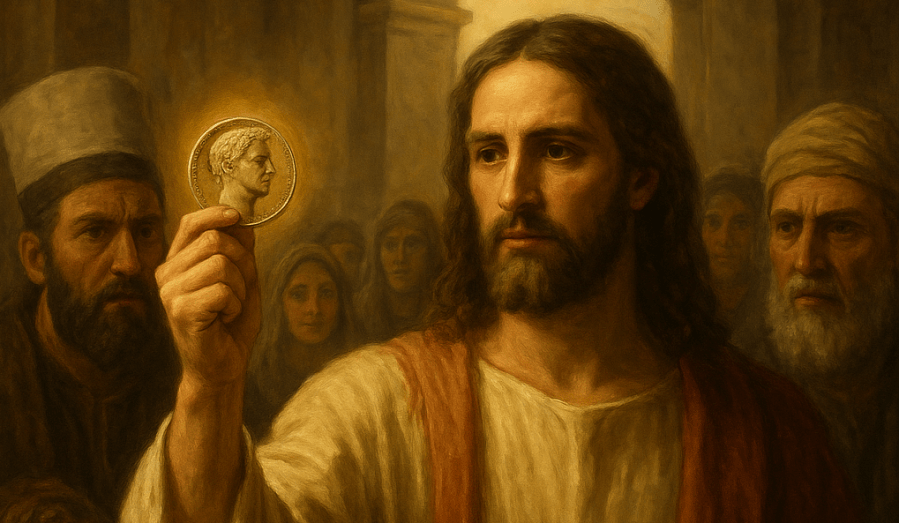
When Jesus said, “Render to Caesar the things that are Caesar’s, and to God the things that are God’s” (Mt. 22.15-22; Mk. 12.13-17; Lk. 20.20-26), He was not endorsing Caesar’s authority or teaching that Christians owe loyalty both to God and government. Instead, He exposed the hypocrisy of His opponents and reminded His hearers that their full allegiance belongs to God alone.
The Trap Question
The Pharisees and Herodians conspired to trap Jesus with a question about taxes:
Then the Pharisees went and plotted how to entangle him in his words… “Teacher, we know that you are true and teach the way of God truthfully… Tell us, then, what you think. Is it lawful to pay taxes to Caesar, or not?
Matthew 22:15-17
The trap was set: if Jesus said paying the tax was lawful, He would appear to support Rome and discredit his Messianic claims. If He opposed the tax, Rome could arrest Him for sedition. Either answer was dangerous.
But Jesus, aware of their malice, asked for a coin. Holding it up, He inquired,
“Whose likeness and inscription is this?” They said, “Caesar’s.” Then He said to them, “Therefore render to Caesar what is Caesar’s and to God the things that are God’s.”
Matthew 22:20-21
With a single sentence, He escaped the trap and turned the question back on them.
The Coin and Counter-Message
The denarius bore the image of Tiberius Caesar along with a blasphemous inscription: “Tiberius Caesar, son of the divine Augustus, High Priest.” The irony of this scene is thick: The true Son of God, the High Priest, held in His hand a coin claiming those very titles for a mortal emperor.
By highlighting the coin’s “likeness” and “inscription”, Jesus recalled their attention to the the first two commandments: “You shall have no other gods before me” (Ex. 20:3) and “You shall not make for yourself a carved image” (Ex. 20:4). His response was not about the legitimacy of taxation but about allegiance. Jesus’s answer served as a clear reminder that worship and allegiance belongs to God alone. Jesus’s brilliant response both demonstrated the hypocrisy of his questioners as they pulled the idolatrous image out of their pocket, and proclaimed to all who heard that the LORD alone is God, and by implication, Caesar is not.
What Really Belongs to Caesar?
In this context, how should we understand Jesus’s words, “Render to Caesar what is Caesar’s”? There are three options.
- An endorsement of taxes – Yes, pay Caesar, for taxes belong to him.
- A call to revolt – Echoing of the Maccabean slogan which was popular among the advocates of tax rebellion, “Pay back the Gentiles what they deserve and obey the law” (1 Macc. 2:68), meaning the pagan overlords deserve nothing but violent revolt.
- A deliberate ambiguity – Neither legitimizing Caesar’s authority, nor forbidding the payment of taxes, but rather forcing his hearers to wrestle with the deeper question: What truly belongs to Caesar, and what belongs to God?
Only the third option fits the context. If Jesus had either openly endorsed taxes or advocated for tax rebellion, He would have fallen into the trap that was set for him. Therefore the only option that fits in this context is the third option. Jesus was challenging his hearers to give their undivided allegiance to God.
What Belongs to God?
The second part of Jesus’ answer is anything but ambiguous. Scripture is clear: everything belongs to God.
The earth is the LORD’s and the fullness thereof
Psalm 24:1
The world and those who dwell therein
For every beast of the forest is Mine,
Psalm 50:10
The cattle on a thousand hills.
God claimed that even the silver and the gold rightfully belonged to Him.
The silver is Mine and the gold is Mine,’ declares the LORD of hosts.
Haggai 2:8
If the LORD alone is God, as the two commandants referred to by Jesus clearly teach, then Caesar’s claims as inscribed on the Denarius are ultimately illegitimate. Jesus’s point was not about dividing life into two realms – political and religious – but about giving undivided allegiance to God alone.
The Crowd’s Reaction
When they heard it, they marveled. And they left him and went away.
Matthew 22:22
Matthew makes it clear that the crowd was not impressed with a simple endorsement of taxes. They recognized that Jesus had avoided the trap and upheld His claim to divine authority. Indeed, two days later, He was accused of “forbidding to pay taxes to Casesar” (Luke. 23:2), showing that His words were not understood as a pro-tax endorsement.
Yet neither was He arrested for inciting tax rebellion, proving his answer was understood as something far deeper. The apostles later encouraged believers to submit to governing authorities and pay taxes (Romans 13:1-7; 1 Peter 2:13-15). Christians do so not because rulers have a rightful claim of ownership over other people’s possessions, but because the True King – Jesus Christ – reigns over all, and God commands His people to live peaceably and honorably under earthly governments.
As Peter reminds us, we are “sojourners and exiles” (1 Peter 2:11). Our mission is not to overthrow rulers but to advance God’s Kingdom by following Christ’s example of humility and submission – even under unjust authorities.
Conclusion
Jesus’s teaching does not sanction divided allegiance – some to God, and some to Caesar. Rather, it forces us to recognize that everything belongs to God. To render to God all that is His leaves nothing for Caesar. That is of course, unless we choose to place our faith in the idolatrous image and inscription engraved on the coin.
 The Christian Exile