How Does Satan Rule America?

See also:
The Principalities and Powers: The Invisible Rulers We Need To See
Are the Other “gods” of the Bible Real?
Do False Gods Still Rule the Nations?

In the book of Job, the adversarial spiritual being known as “Satan” tells the Lord that he has been “walking to and fro on the earth” (Job 1:7). Later, Scripture speaks even more plainly as Peter warns that “your adversary the devil prowls around like a roaring lion, seeking someone to devour” (1 Peter 5:8). Together, these passages teach two important truths. First, Satan is indeed active in the world. But second, he is not omnipresent. Unlike God, who fills heaven and earth, Satan is a created being – limited in power, space, and knowledge.

He cannot be everywhere at once, nor can he focus personally on every individual at all times. So if Satan is neither all-powerful nor omnipresent, how is his influence so widespread?

Scripture gives us the answer: he works through deception and manipulation, operating indirectly through both heavenly powers and earthly rulers.

Satan’s Delegated Powers

The Bible reveals that Satan rules through a network of subservient spiritual beings who carry out his will. Jesus refers to “the devil and his angels” (Matthew 25:41), and Revelation 12:9 says that “his angels were cast out with him.” These angels are real spiritual entities, operating under his command.

Satan also works through the rulers of the kingdoms of men. In Luke 4:5-7, he offered Jesus “all the kingdoms of the world,” declaring:

To you I will give all this authority and their glory, for it has been delivered to me, and I give it to whom I will. If you, then, worship me, it will all be yours.

That statement reveals that the nations of the world are, to a large degree, under Satan’s sway. When men reject God’s rule, they inevitably come under Satan’s. This is precisely why God warned Israel about seeking a human king.

And the Lord said to Samuel, ‘Obey the voice of this people in all that they say to you, for they have not rejected you, but they have rejected me from being king over them.”

1 Samuel 8:7

Every earthly government that operates apart from God’s law is part of this same pattern of rebellion. This is why Paul wrote:

For we do not wrestle against flesh and blood, but against rulers, against the authorities, against the cosmic powers over this present darkness, against the spiritual forces of evil in the heavenly places.

Ephesians 6:12

Observe that Paul does not say our battle is simply against Satan himself, but against rulers and authorities – lesser powers, both spiritual and earthly, who derive their authority from him.

From Babel onward, every attempt by man to unite and govern themselves apart from God has been viewed in Scripture as rebellion. Each successive empire that flowed from Babel – Egypt, Assyria, Babylon, Rome – follows that same pattern. Revelation 13:4 makes it clear that the “beast,” representing this kind of human government, receives “his power, throne, and authority” directly from “the dragon,” that is, from Satan.

And they worshiped the dragon, for he had given his authority to the beast, and they worshipped the beast, saying, ‘Who is like the beast, and who can fight against it?”

For this reason, we must learn to view earthly government itself as evidence of Satan’s ongoing rule in the world.

How This Pattern Appears in America

The United States of America is not exempt from this biblical pattern. The same spiritual forces that ruled over Babylon, Persia, and Rome still operate behind the scenes in modern nations.

Scripture teaches that the nations are not merely political realities, but spiritual ones as well. Deuteronomy 32:8-9 describes how, when God divided the nations, He “set the boundaries of the peoples according to the number of the sons of God,” indicating that each nation came under the oversight of its own spiritual being. Daniel 10 pulls back the curtain even further, showing us how the actions of earthly rulers reflect unseen interactions among heavenly “princes.” While Christians may differ on some of the interpretive details of these passages, what remains clear is that the nations operate under the influence of spiritual beings which stand in tension with God’s reign.

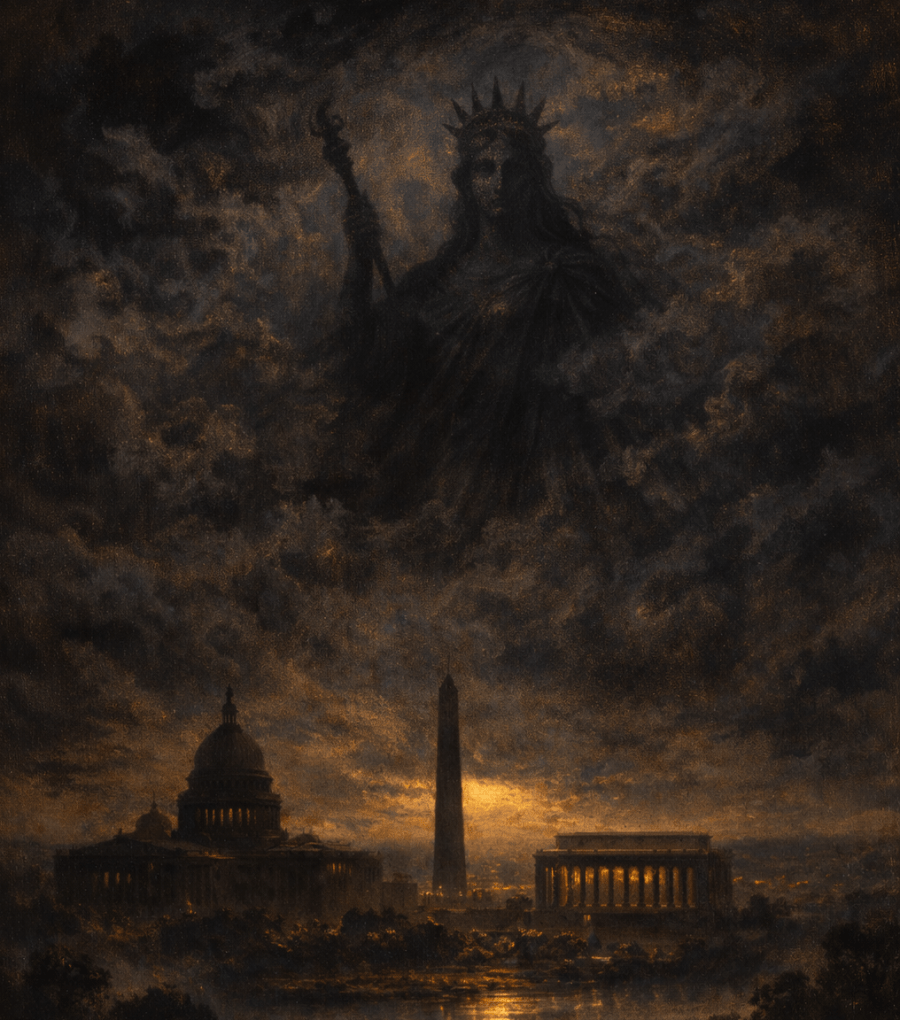
While these texts establish the reality of corrupt spiritual influences over the nations, we can also see this reality reflected in the symbols these cultures adopt for themselves. With this in mind, it’s worth noting how much of America’s national imagery draws straight from paganism. For instance, it is well known that the “D.C.” in “Washington D.C.” stands for the District of Columbia. But who is “Columbia”? Most people have never given it a second thought. Columbia was a mythical being created as a feminine personification of the spirit of America – often portrayed as a robed woman bearing a torch. The Statue of Liberty, in fact, was modeled after this image of Columbia.

Interestingly, the function of Columbia as the “spirit of America” closely resembles that of national deities in the ancient world. The Greeks personified their ideals in Athena, and the Romans embodied the power and destiny in the goddess Roma. In a similar way, Columbia was created to symbolize America’s ideals of enlightenment, liberty, and independence.

To be clear, this does not mean that Columbia is necessarily a literal goddess. We cannot identify her with any specific “principality or power” named in Scripture. Much like it would be impossible to prove that Athena and Roma accurately represent the actual spiritual rulers mentioned in Scripture, neither do we know any specific details about the actual spiritual entity that represents America. The image of Columbia can be easily explained as having arisen out of the Enlightenment-era admiration for Greek and Roman art and architecture. Scripture gives no detailed knowledge of the specific spiritual beings associated with modern nations, and it would be speculation to claim otherwise.

The existence of pagan symbols does not itself prove America’s corrupt spiritual allegiance; Scripture already does that. But the symbols arise from a culture’s imagination and reflect how a nation understands itself. In that sense, America’s pagan imagery mirrors what Scripture describes more broadly: every nation possesses a kind of spiritual “personality,” that is shaped by unseen powers that influence its values, priorities, and direction.  

So while we cannot know the specific identities or characteristics of the spiritual beings who stand behind the nations, we can know what the Bible plainly teaches – that the nations of the world are ruled by spiritual powers that exist in rebellion to God.  

The Rule of Satan

Here is what we know for certain from Scripture:

  • Satan is the god of this world (2 Corinthians 4:4).
  • He exercises his rule indirectly through spiritual and earthly principalities and powers (Ephesians 6:12).
  • These powers exercise regional dominion, ruling over specific nations (Daniel 10:13, 20).

Just as the Sidonians had Ashtoreth, Moab had Chemosh, and Ammon had Molech (1 Kings 11:5-7), so too each modern nation operates under some spiritual power that mirrors what we see happening on earth.

When we see national symbols that mirror pagan forms, we should therefore take notice. The District of Columbia, the Washington Monument shaped like an Egyptian obelisk (a symbol of the sun god Ra), the Capitol city adorned with statues of Mars, the Lincoln Memorial modeled after a Greek temple – these are not insignificant. Even if their creators saw them as mere works of art, they are still pagan in origin and should remind every Christian of the deeper reality Scripture describes: America, like every other earthly nation, is under the rule of Satan and his principalities and powers.

For this reason, it should not surprise us that America is marked by constant warfare, widespread violence and division, deceptive and destructive economic policies, and the slaughter of millions of innocent children through abortion. These are the natural fruits of a kingdom ruled by Satan – the one who “comes only to steal and kill and destroy” (John 10:10). He steals through inflation and taxation, kills through war and violence, and destroys through corruption of truth and life itself.

The Christian Response

First, Christians must recognize that “the whole world lies under the sway of the wicked one” (1 John 5:19). Satan works through both the earthly and spiritual rulers of the nations, deceiving them and spreading his lies. Revelation 13:14 and 20:3, 8 describe him as “the deceiver of the nations.

Therefore, earthly governments – no matter how moral or democratic they may appear – remain part of the same system that rejects Christ’s kingship.

If these things are true – and Scripture insists they are – then uncomfortable questions inevitably follow. Christians must not confuse patriotism with faithfulness to Christ, or loyalty to a nation with allegiance to the kingdom of God.

How can any Christian pledge allegiance to a kingdom ruled by powers in rebellion against Christ? Why would a follower of Jesus devote his life to the service of a government that refuses His kingship? And how would a disciple of the Prince of Peace take up arms in defense of a nation whose authority arises from rejection of God’s rule?

For the time being, Satan continues to deceive the nations. Yet his rule is neither absolute nor enduring. Because of the gospel, his defeat is certain. “Then comes the end,” Paul writes, “when He delivers the kingdom to God the Father after destroying every rule and every authority and power” (1 Corinthians 15:24).

Christ alone possesses “all authority in heaven and on earth” (Matthew 28:18). Therefore, the hope of every Christian must never be tethered to the doomed authorities of this world, but anchored in “the kingdom of our Lord and of His Christ” (Revelation 11:15).

Every nation bears the marks of spiritual rebellion, but only one kingdom stands eternal – the kingdom of Christ. America, like all the nations in history, will rise and fall. Its monuments will eventually crumble. But the throne of Christ will never be shaken.

Our task as Christians is not to try to reform the Satanic kingdoms of this world into slightly more Christian versions of themselves, but to bear witness to a greater kingdom – to “proclaim the excellencies of Him who called you out of darkness into His marvelous light” (1 Peter 2:9). Our allegiance belongs to Christ alone.

Do False Gods Still Rule the Nations?

For many Christians today, the phrase “false gods” immediately brings to mind imaginary deities – empty carvings of wood and stone. These are seen as the inventions of primitive cultures and products of human superstition and ignorance.

As the previous two articles in this series have demonstrated, these false gods are not mere human inventions, but real spiritual beings. Scripture continually presents them as powerful entities who exert genuine influence over regions, nations, and rulers.

While the Bible affirms again and again that there is only one true God, the LORD, the Creator and Sovereign over all, it does not deny the existence of other spiritual beings – some of whom have been falsely worshipped as gods. These beings are real, but they are created beings, and far beneath the LORD in power and glory. You can read those two articles here:

The Regional “gods” in the Old Testament

The story of King Solomon provides a clear example of where the Bible refers to these “gods.” Scripture tells us that Solomon loved many foreign women – Moabite, Ammonite, Edomite, Sidonian, and Hittite women. His decision to marry many of these foreign women was a direct violation of the LORD’s command:

You shall not enter into marriage with them, neither shall they with you, for surely they will turn away your heart after their gods.

1 Kings 11:2

And sure enough, Solomon’s heart was turned:

When Solomon was old his wives turned away his heart after other gods, and his heart was not wholly true to the LORD his God, as was the heart of David his father. For Solomon went after Ashtoreth the goddess of the Sidonians, and after Milcom the abomination of the Ammonites… Then Solomon built a high place for Chemosh the abomination of Moab, and for Molech the abomination of the Ammonites, on the mountain east of Jerusalem. And so he did for all his foreign wives, who made offerings and sacrificed to their gods.

1 Kings 11:5; 7-8

Observe a few important things here:

  • Each of these gods is specifically named – Ashtoreth, Milcom, Chemosh, Molech.
  • The text never mocks these gods as imaginary or fictional
  • Each of the gods mentioned is associated with specific nations and regions

The picture presented by this biblical text – a picture of different spiritual beings attributed to different people groups – is not simply a reference to an ancient pagan worldview. It reflects a reality described in the Bible itself.

In the book of Deuteronomy, Moses describes how the LORD divided the nations of the world.

When the Most High gave to the nations their inheritance,
when he divided mankind,
he fixed the borders of the peoples
according to the number of the sons of God.
But the LORD’s portion is his people,
Jacob his allotted heritage.

Deuteronomy 32:8-9

This passage tells us that the Most High assigned the nations under the authority of various sons of God. Throughout the Old Testament, the phrase “sons of God” consistently refers to spiritual beings or angels (Job 1:6; Psalm 29:1). Thus, the text teaches that God allotted authority over specific nations to specific spiritual beings, while reserving Israel as His own possession.

But just like the nations themselves rebelled against the LORD, so also did these “sons of God.” That’s why Psalm 82 describes the LORD standing in judgment over these corrupt divine rulers.

God has taken his place in the divine council;
in the midst of the gods (elohim) he holds judgment:
“How long will you judge unjustly
and show partiality to the wicked…
You are gods,
sons of the Most High, all of you;
nevertheless, like men you shall die
and fall like any prince.”
Arise, O God, judge the earth;
for you shall inherit all nations.”

Psalm 82:1-2; 6-8

Spiritual Rulers in the Book of Daniel

The book of Daniel offers one of the clearest pictures of these heavenly rulers. When Daniel prays for understanding, an angelic messenger is delayed in delivering God’s answer:

The prince of the kingdom of Persia withstood me twenty-one days, but Michael, one of the chief princes, came to help me.

Daniel 10:13

Here the “prince of Persia” is clearly not a human ruler. It is a powerful spiritual being whose actions influence and are mirrored by the Persian empire. The angel Michael is described as “one of the chief princes,” – a heavenly counterpart fighting on behalf of Israel.

If we were to read the book of Daniel in the Septuagint – a Greek translation of the Old Testament used at the time of Christ and the apostles – we would see that both Michael and the Prince of Persia are described by the Greek word “archon,” meaning “ruler” or “authority.” This is significant, because this is the very word Paul later uses to describe the spiritual rulers and authorities that govern the present age of darkness.

  • “It is not a wisdom of this age or of the archon of this age, who are doomed to pass away” – 1 Corinthians 2:6
  • “The archon of the power of the air, the spirit that is now at work in the sons of disobedience” – Ephesians 2:2
  • “For we do not wrestle against flesh and blood, but against the archon, against the authorities, against the cosmic powers over this present darkness.” – Ephesians 6:12

Paul was carrying forward the same worldview described in Deuteronomy 32 and Daniel 10. These regional spiritual “arche” are real, and their influence is reflected in the rise and fall of earthly nations.

The “God of This World”

Jesus Himself used similar language when describing the devil. Three times in John’s account of the gospel, He calls Satan “the ruler (archon) of this world.”

  • “Now the archon of this world will be cast out” – John 12:31
  • “The archon of the world is coming” – John 14:30
  • “The archon of this world is judged” – John 16:11

During His temptation in the wilderness, Satan showed Jesus all the kingdoms of the world and claimed:

To you I will give all this authority and their glory, for it has been delivered to me, and I give it to whom I will.

Luke 4:6

It is noteworthy that Jesus never disputes Satan’s claim, but rather Luke presents this offer as a legitimate temptation. The implication is that Satan truly holds authority in this present world – authority that has been claimed by him through the rebellion of mankind.

The “god” of all Nations

This same idea appears all throughout the New Testament. Paul calls Satan “the prince of the power of the air, the spirit that is now at work in the sons of disobedience.” (Ephesians 2:2).

He is also identified as “the god of this age” who blinds the minds of unbelievers:

In their case the god of this world has blinded the minds of the unbelievers, to keep them from seeing the light of the gospel of the glory of Christ.

2 Corinthians 4:4

John likewise declares:

The whole world lies in the power of the evil one.

1 John 5:19

It would take some impressive hermeneutical gymnastics to avoid the clear conclusion: according to Scripture, Satan is the chief spiritual ruler of this present world system. Beneath him operate a host of rebellious spirits, sometimes referred to as his angels (Matthew 25:41; Revelation 12:7-9), and other times referred to as principalities and powers (Ephesians 1:20-21; 3:10; 6:12; Colossians 2:15). These are real, personal, heavenly beings who exercise real regional and cultural influence. Although these beings are destined for destruction (1 Corinthians 15:24), Scripture teaches that they do rule in this present age of darkness (1 Corinthians 2:6; Ephesians 2:2; 6:12).

If that is true, then it is not only ancient nations like Egypt, Moab, Canaan, Babylon, and Rome that were under such dominion. It means that every earthly nation today lies within his sphere of influence.

It means that:

  • Satan is the god of Russia.
  • Satan is the god of Japan.
  • Satan is the god of Nigeria.
  • Satan is the god of North Korea.
  • Satan is the god of the United States.

This worldview is not flattering to any earthly nation, but it is biblical. It reminds us that no worldly power, no matter how noble it may appear, is neutral. Every kingdom of man ultimately belongs to this present fallen order.

The Christian Response

If the nations of this world lie under the dominion of false gods, then Christians must be careful not to confuse patriotism with faithfulness to Christ.

We are citizens of another Kingdom – one not ruled by the god of this age, but by the Sovereign Lord of all creation. Therefore, as Revelation 18:4 declares,

Come out of her, my people,
lest you take part in her sins,
lest you share in her plagues.

Behind every throne stands a spiritual power, but above them all stands the LORD Most High, and His anointed King, Jesus – who is the Lord of lords and King of kings. His Kingdom cannot be shaken. The gods of the nations are real, but they are fallen and doomed for destruction. The LORD alone is God, and His Kingdom alone will stand forever.

Are the Other “gods” of the Bible Real?

Many Christians grow up hearing that the other “gods” in the Bible are nothing more than carved idols or imaginary inventions. After all, the Bible insists in no uncertain terms that there is only one true God (Deuteronomy 6:4; Isaiah 45:5; 1 Corinthians 8:4).

And yet, the inspired text often speaks of these other “gods” in ways that sound far more real than imaginary. For example, in the book of Psalms, the LORD is praised as being superior above all other “gods.” Psalm 95:3 declares: “The LORD is a great God, and a great King above all gods,” and Psalm 97:9 states, “You are exalted far above all gods.Psalm 29:1 even claims that the one God deserves worship from the other “elohim.” Even in the New Testament, in Paul’s first letter to the Corinthians, when Paul addresses the question of eating food offered to idols, he admitted that “indeed there are many ‘gods’ and many ‘lords’” (1 Corinthians 8:5) before clarifying that for Christians there is only one God (1 Corinthians 8:6).

So what do we make of this? Is God just accommodating ancient superstitions? Is He really praised for being greater than things that do not exist? How would such a claim bring honor to the LORD? If these “gods” were purely imaginary, then such praise would be trivial – like saying the Almighty is stronger than a fictional comic-book hero. To say that God is greater than an imaginary being would be an empty comparison, like claiming that the sun shines brighter than a shadow. The glory of God is not seen in contrast to what is unreal, but in His supremacy over all that truly exists.

Or could it be that Scripture is revealing something true about the spiritual world? Are these “other gods” genuine spiritual beings? Or are they simply the products of ancient imaginations? To answer this, we first need to examine the Bible’s own vocabulary for identifying these other gods.

The Hebrew Word Elohim

The English word “God” is a decent translation of the Hebrew word elohim, but it is not a perfect one. In English, the word “God” usually carries one of two meanings.

  1. (capitalized) The one true supreme being, the Creator of the universe
  2. (uncapitalized) A pretend deity, the gods from ancient mythology

But the Hebrew word elohim has a broader range of meaning.

1. Elohim as the Creator

Similar to the English word God, the Hebrew word is sometimes used to refer to the one true Creator of the universe. The very first verse of Scripture says “In the beginning, elohim created the heavens and the earth” (Genesis 1:1). Over and over again, Israel’s God is identified as elohim (Exodus 3:6; Deuteronomy 4:35; Psalm 100:3). When used in this way, the text always sets Him apart as unique, sovereign, and incomparable (Deuteronomy 10:17; Psalm 86:10).

2. Elohim as the gods of the nations

Also similar to the English word God, the Hebrew word is sometimes used to refer to the false gods of the nations. The Ten Commandments forbids Israel from having any “other elohim” before the LORD (Exodus 20:3). Deuteronomy observed that the surrounding nations “served their elohim” (Deuteronomy 29:26). It can be observed that the word elohim functions as both singular and plural, so determining whether it refers to “God” or false “gods” requires examination of the context.

3. Elohim as other spiritual beings

This is where it gets interesting. Elohim can also refer to other spiritual beings we normally wouldn’t call “gods” in English.

Psalm 8:5 says that mankind was created “a little lower than the elohim.” Translations of this verse vary. ESV translates elohim here as “heavenly beings.” KJV and NIV translate it as “angels.” The Greek Septuagint, used by Jesus and the apostles, chose “angels,” a rendering confirmed by inspiration in Hebrews 2:6-8. Regardless of how we translate it, it is clear that mankind was created a little lower than real spiritual beings.

Psalm 82 describes God as presiding in a divine council:

God has taken his place in the divine council;
in the midst of the gods he holds judgment.

Psalm 82:1

Again, God is described as holding judgment in a council of real spiritual beings.

In 1 Samuel 28:13, when Saul consults the witch of En-dor, she reports: “I see a god coming up out of the earth.” Again, she did indeed see a real spiritual being coming up out of the earth – the deceased human Samuel.

In short, elohim is not a title restricted to the Supreme Creator. It is a more general word for inhabitants of the spiritual realm, many of which are indeed very real. There is certainly a sense in which the LORD is the one true Elohim, but the Bible also recognizes the existence of other real spiritual beings, which Scripture refers to as elohim.

So when we ask, “Are the other gods in the Bible real?” the answer depends on what we mean by “gods.” If by “gods” we mean spiritual beings in a general sense, then yes – the Bible teaches that other “gods” are real.

There is Only One LORD

But while the Bible acknowledges the reality of other spiritual beings, it never endorses what people today refer to as polytheism. The God of Israel is utterly unique, set apart from all others.

Who is like you, O LORD, among the gods? Who is like you, majestic in holiness, awesome in glorious deeds, doing wonders?

Exodus 15:11

For what god is there in heaven or on earth who can do such works and mighty acts as yours?

Deuteronomy 3:24

There is none like you among the gods, O Lord.

Psalm 86:8

For the LORD is a great God, and a great King above all gods.

Psalm 95:3

For you, O LORD, are most high over all the earth; you are exalted above all gods.

Psalm 97:9

No, these passages are not comparing God to imaginary beings like Captain America or Spider-man. These passages proclaim that the LORD is supreme above all real spiritual beings.

The LORD is unique in His power (Jeremiah 32:17, 27; Psalm 115:3) and is the Creator of all others (Nehemiah 9:6, Psalm 148:1-5). As Nehemiah 9:6 plainly states, “You are the LORD, you alone.

Just because the Bible says that there are other elohim, it quite plainly denies polytheism. It continually exalts the one incomparable God above all other spiritual beings.

Why Call Them “False Gods”?

If other elohim exist, why does Scripture so often label them as “false gods” (2 Chronicles 13:9; Isaiah 44:9-20)?

Because their claims to deity are false.

  • They are not equal to the LORD
  • They did not create heaven and earth
  • Their power is incomparable to the LORD’s
  • They cannot save, redeem, or give life

Compared to the LORD, they are “nothing” (Isaiah 41:24). Not because they don’t exist, but because their claims are empty.

Think of it this way: If I were to point out a con artist, and ask you “Is that con artist real?” how would you respond? Of course the con artist is real, in the sense the con artist is an actual person. But is the character the con artist pretends to be real? And are the stories the con artist tells real? Of course not! In the same way, these “other gods” in the Bible are real spiritual beings, but their claims to supremacy and their calls for worship and allegiance are lies.

Deuteronomy 32:17 clarifies that when Israel sacrificed to other “gods,” they were really sacrificing to demons.

They sacrificed to demons that were no gods,
to gods they had never known,
to new gods that had come recently,
whom your fathers had never dreaded.

Paul makes the same point in 1 Corinthians 10:19-20: pagan sacrifices are not meaningless gestures to imaginary idols – they are participation with demons.

What do I imply then? That food offered to idols is anything, or that an idol is anything? No, I imply that what pagans sacrifice they offer to demons and not to gods. I do not want you to be participants with demons.

Likewise, Galatians 4:8 says that Gentiles were enslaved to “those that by nature are not gods.” They were real beings – beings who were capable of enslaving – but not true gods.

So, Are the Other Gods Real?

Yes and no.

Yes, if by “real” we mean actual spiritual beings who exist behind the veil of the unseen spiritual realm.

No, if by “real” we mean equal rivals to the Creator.

The Bible affirms the reality of a spiritual world filled with many spiritual beings, beings which at times are referred to as elohim. But the Bible never compromises the uniqueness of the LORD God.

We do not live in a world with one God who actually exists and countless imaginary ones. We live in a world where the one true God reigns supreme over a host of other real, but lesser, spiritual beings.

And in such a world, the call remains the same:

Hear, O Israel, the LORD our God, the LORD is one.

Deuteronomy 6:4

The Principalities and Powers: The Invisible Rulers We Need To See

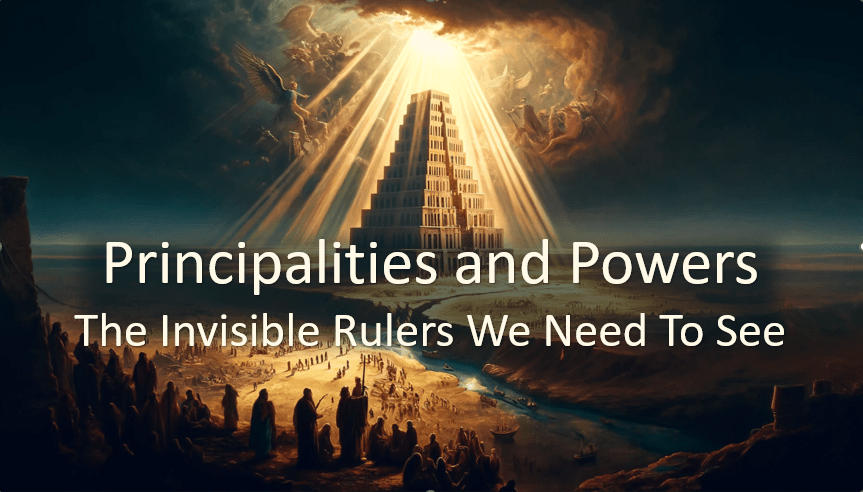
The story of Babel is familiar to many. After the flood, God commanded Noah’s family to multiply and fill the earth (Genesis 9:1). Instead, Noah’s descendants, led by Nimrod, settled in the plains of Shinar and set out to build a city and a tower reaching to heaven (Genesis 11:2-4). Desiring to make a name for themselves and avoid scattering, they defied God’s command and pridefully demonstrated independence from God.

God disrupted their rebellion by confusing their language and scattering them across the earth (Genesis 11:7-9). These events set the stage for God’s covenant with Abraham, through whom all the scattered and rebellious nations would be blessed (Genesis 12:1-3).

At least, that’s the version most people know. What this familiar summary of the story usually neglects, however, are the “principalities and powers.”

When telling any story, it is easy to focus on the main characters, whose actions most directly move the plot forward. We shouldn’t, however, overlook the background characters, without whom the story doesn’t make as much sense. Recognizing the role of the “principalities and powers” not only helps us see the significance of Babel, but is also key to understanding the broader theme of how God uses the principalities and powers to govern the unbelieving world.

Who Are the Principalities and Powers?

The phrase “principalities and powers” does not come from Genesis. It originates with Paul, who used the terms to describe both heavenly and earthly authorities.

Heavenly Powers

In a couple of places, it seems that Paul uses this language to refer to some sort of spiritual beings in heavenly realm with whom Christians must contend.

… that the manifold wisdom of God might be made known by the church to the principalities and powers in the heavenly places.

Ephesians 3:10

For we do not wrestle against flesh and blood, but against principalities, against powers, against the rulers of the darkness of this age, against spiritual hosts of wickedness in the heavenly places.

Ephesians 6:12

Earthly Authorities

In other instances, Paul uses the same terms to describe earthly political rulers. Interestingly, when used to refer to earthly rulers, translators tend to translate archon and exousia, as “rulers and authorities”, but these are the exact same Greek words elsewhere translated as “principalities and powers.”

Let every soul be subject to the governing authorities. For there is no authority except from God, and the authorities that exist are appointed by God… For rulers are not a terror to good works, but to evil.

Romans 13:1-3

Remind them to be subject to rulers and authorities, to obey, to be ready for every good work.

Titus 3:1

Both Realms Intertwined

Sometimes, the context does not make it entirely clear whether Paul is referring to spiritual authorities, earthly authorities, or perhaps both at the same time:

For I am persuaded that neither death nor life, nor angels nor principalities nor powers, nor things present nor things to come, nor height nor depth, nor any other created thing, shall be able to separate us from the love of God which is in Christ Jesus our Lord.

Romans 8:38-39

For by Him all things were created that are in heaven and that are on earth, visible and invisible, whether thrones or dominions or principalities or powers. All things were created through Him and for Him.

Colossians 1:16

Having disarmed the principalities and powers, He made a public spectacle of them, triumphing over them in it.

Colossians 2:15

The various and sometimes ambiguous ways Paul uses these terms blurs the line between spiritual and earthly rulers and raises some interesting questions. Who are these spiritual beings? What kind of authority do they have? Are the they somehow connected to earthly political rulers and authorities? What is God’s purpose for these spiritual beings? Do they continue to hold power and influence over the world today?

The Relationship Between Heavenly Powers and Earthly Authorities

While Scripture may not reveal the answer to every question we may have, there are some interesting Old Testament passages that likely helped shape Paul’s understanding of these principalities and powers. One example is Daniel 10:10-21, which vividly describes a heavenly struggle between spiritual entities, which he describes as the “Prince of Persia” and the “Prince of Greece.” These spiritual beings seem to correspond to the earthly kingdoms of Persia and Greece, indicating that their heavenly conflict somehow influenced, or was mirrored by, the affairs of earthly kingdoms.

Similarly, Psalm 82 presents a rebuke of rebellious spiritual beings, referred to as “gods” for their failure to govern justly. The failure of these “gods” are identified by their earthly impact, as the weak, fatherless, and needy are left afflicted, while the wicked are shown favoritism.

God has taken his place in the divine council;
In the multitude of the gods he holds judgment:
How long will you judge unjustly
and show partiality to the wicked?
Give justice to the weak and fatherless;
Maintain the right of the afflicted and destitute.
Rescue the weak and needy;
Deliver them from the hand of the wicked.”

Psalm 82:1-4

As in Daniel 10, Psalm 82 also shows that the corruption of these heavenly authorities is connected to corruption in earthly governance.

The interplay between heavenly and earthly powers is further emphasized in Isaiah 24:21-22, where both heavenly hosts and earthly kings are held accountable for their actions.

On that day the LORD will punish
the host of heaven, in heaven,
and the kings of the earth, on the earth.

They will be gathered together
as prisoners in a pit;
they will be shut up in a prison,
and after many days they will be punished.

Not only does Isaiah confirm the existence of both heavenly and earthly authorities, but their dual accountability underscores God’s sovereignty over both realms.

Principalities and Powers at Babel

Returning to Genesis we read of how God confused mankind’s language and scattered the nations across the earth, focusing on the immediate human rebellion and God’s response. While Genesis 11 does not explicitly mention the spiritual “principalities and powers,” the events at Babel serve as the backdrop to Deuteronomy 32:8-9, which reveals the spiritual dimension of this rebellion. Here we learn that in the aftermath of Babel, God fixed the borders of the scattered nations and assigned them to “the sons of God,” a phrase consistently used in Hebrew to refer to spiritual beings (e.g., Job 1:6; 2:1; 38:7; Genesis 6:1-4). In contrast to the other nations, God reserved Israel as His own special heritage, underscoring the unique covenant relationship He shared with them.

When the Most High gave the nations their inheritance,
when he divided mankind,
he fixed the borders of the peoples
according to the number of the sons of God.
But the LORD’s portion is his people,
Jacob is his allotted heritage.

Deuteronomy 32:8-9

This passage makes it clear that Babel was not only a moment of human rebellion, but it was also the moment when God assigned these newly scattered nations to the governance of other spiritual beings, while reserving Israel for Himself. That’s why the tower of Babel was such a critical moment in human history, and that’s why Paul places such a big emphasis on the presence and role of the “principalities and powers” throughout his writings.

Living as Exiles Under Principalities and Powers

For Christians, this understanding reshapes how we view the world. Earthly rulers, though instituted by God, operate within a realm where rebellious spiritual powers exert influence. Whether this is a direct influence, through idolatry and temptations, or an indirect influence, through cultural norms, ideologies, and philosophies, Scripture does not fully reveal. But the Bible does clearly affirm their existence and their opposition to God’s kingdom. These forces stand behind earthly political systems, but Christ’s victory on the cross has disarmed and defeated them (Colossians 2:15), ensuring that they cannot separate us from His love (Romans 8:38-39).

At its core, the gospel is a call to change allegiance, away from the rulers, principalities, and powers that dominate the unbelieving world, to the one true King, Jesus Christ (Colossians 1:13-14). To confess that “Jesus is Lord” (Romans 10:9) is to reject the lordship of any competing power, whether spiritual or earthly, that may wish to maintain authority for themselves.

The gospel is far more than a formula for getting to heaven after we die. It is an invitation to every tribe, tongue, and nation to forsake false gods and rulers, and to pledge their allegiance to the Lamb (Revelation 7:9-10). As citizens of God’s kingdom, we live as strangers and exiles in this world, seeking first His kingdom and His righteousness. Under Christ’s Lordship, we proclaim his reign in both word and deed, anticipating the day when every knee – whether in heaven, on earth, or under the earth, bows and confesses that Jesus is Lord (Philippians 2:10-11).