
How Should a Christian Approach the Issue of Illegal Immigration and Deportations?

Earlier this week a Christian friend sent me the following request for an article:

I’ve seen lots of liberals and conservatives arguing over deportations. There are lots of emotions on both sides, and I haven’t had the chance to think through it. Can you write an article on the subject of how a Christian should approach the issue of illegal immigration and deportations?

This is an important question, and yes, it is often an emotionally charged issue. As Christians, we must ensure that our perspective is shaped by Scripture rather than political partisanship. To do that, we need to carefully consider a few key biblical principles.

What Does the Bible Say About Immigration in General?

Before addressing the more complex issue of illegal immigration, it’s important to remember what the Bible says about immigrants – often referred to in Scripture as “sojourners” or “foreigners.” On this, the Bible is clear. Immigrants must be treated with kindness and fairness. This begins with God’s commands to Israel in the Old Testament. Many foreigners in Israel were there for economic reasons, much like many immigrants today. God explicitly and repeatedly commanded Israel to treat them well.

You shall not wrong a sojourner or oppress him, for you were sojourners in the land of Egypt.

Exodus 22:21

When a stranger sojourns with you in your land, you shall not do him wrong. You shall treat the stranger who sojourns with you as the native among you, and you shall love him as yourself, for you were strangers in the land of Egypt: I am the LORD your God.

Leviticus 19:33-34

He [The LORD] executes justice for the fatherless and the widow, and loves the sojourner, giving him food and clothing. Love the sojourner, therefore, for you were sojourners in the land of Egypt.

Deuteronomy 10:18

Furthermore, Israel was commanded not to return runaway slaves to their masters.

You shall not give up to his master a slave who has escaped from his master to you. He shall dwell with you, in your midst, in the place that he shall choose, within one of your towns, wherever it suits him. You shall not wrong him.

Deuteronomy 23:15-16

While this passage does not explicitly refer to foreigners in particular, and arguably does not provide a direct parallel to illegal immigration, this shows that in the case of slavery, when certain individuals escaped difficult circumstances and found refuge in another land, God desired his people to prioritize hospitality over their legal (or rather “illegal”) status.

The New Testament does not speak as directly to the issue of immigration. We do, however, see in the parable of the Good Samaritan that our neighbor is defined as whoever we love and provide care for, regardless of their nationality (Luke 10:25-37). Among those who have been baptized into Christ, “There is neither Jew nor Greek” for they are all “one in Christ” (Galatians 3:28). Christians are even commanded to love their enemies, providing for their needs (Romans 12:20).

Therefore it is plain to see that God expects Christians to love, do good, and care for others, including immigrants. This stands in stark contrast to the harsh and vindictive attitudes that are often prevalent in the world around us, and sometimes influence public policy. Our primary concern should be to reflect Christ’s love when we interact with people, regardless of their nationality or legal status.

Does This Mean Christians Should Oppose Deportations?

This is where the discussion becomes more complex. The thing is, at least among the vast majority of Christians, there is little debate about how Christians are expected to personally treat immigrants in general. The question of illegal immigration and deportation requires careful consideration of additional biblical principles.

First, while Israel was commanded to care for foreigners within its borders, they were never given the responsibility to change the immigration policies of surrounding nations. The prophets often rebuked Israel for mistreating immigrants (Malachi 3:5; Ezekiel 22:7, 29; Jeremiah 7:5-7, etc), but they never once rebuked Israel for failing to make other nations more hospitable to foreigners. There was no command for Israel to use its power, wealth, or alliances to change the policies of the ungodly Gentile nations.

This is not because God was not concerned with the injustices of other nations, but because he desired Israel to demonstrate his wisdom to those other nations by following his law (Deuteronomy 4:5-8), not by directly seeking to reform other nations’ policies. As Gentiles, such as Rahab (Joshua 2:11), Ruth (Ruth 1:16), or Naaman (2 Kings 5:15) came to recognize the wisdom and power of the Lord, they were drawn to leave their former allegiances, and were welcomed as they embraced Israel and their God.

Similarly, in the New Testament, Jesus and the apostles also never attempted to change Roman public policy, even though Rome was guilty of many injustices. The closest Jesus came to commenting on Roman law was when He was asked about paying taxes to Caesar (Matthew 25:15-22), and even then, He turned the question around into an opportunity to teach people about the importance of giving their allegiance to God. If Jesus had desired to change Roman public policy, He had the opportunity when Satan offered Him “all the kingdoms of the world” and all their “authority and glory” (Luke 4:5-7). Yet Jesus rejected this as a temptation.

Likewise, the apostles never campaigned to change Roman policies. The early church was known for “turning the world upside down” (Acts 17:6), but not through political activism. Instead, they focused on living a radically distinctive lifestyle, as salt and light (Matthew 5:13-17), faithfully following Christ’s commands while submitting to governing authorities (Romans 13:1-7; 1 Peter 2:13-17).

Would Jesus and the apostles be concerned with how Christians treat immigrants? Absolutely. If Jesus and his apostles were around today, would they have opinions about immigration laws and their enforcement? It wouldn’t surprise me. But just as we see in the example of Jesus himself, and in the example of the early church, our focus should be on living out the gospel, proclaiming our allegiance to a different Lord, and maintaining citizenship in a heavenly country, not political reform of earthly kingdoms.

How Should Christians Handle Situations Involving Illegal Immigrants?

Since the Bible calls us both to love immigrants and to submit to governing authorities (Romans 13:1-7), we must proceed wisely, carefully considering each of these obligations.

  • Show Love and Compassion to Immigrants, Regardless of Legal Status.

This is especially important if we find ourselves counseling immigrants who have become Christians, and have begun to wrestle with the implications of their illegal status.

If a brother or sister is poorly clothed and lacking in daily food, and one of you says to them, “Go in peace, be warmed and filled,” without giving them the things needed for the body, what good is that?

James 1:16-17

We must avoid harsh, vindictive attitudes toward those who are in difficult situations, even if those difficult situations are brought on by their own choices.

  • Recognize that God Appoints Governing Authorities for a Reason

In Romans 13:1-7, Paul commands the Christians in Rome to remain subject to the governing authorities. He states that “there is no authority except from God, and those that exist have been instituted by God.” He teaches them that God appoints the authorities as His ministers for their good, and as an avenger to carry out His wrath on wrongdoers. As governments bear the sword enforcing their policies, they do not do so in vain. God has a purpose for them.

It’s important to remember that Romans was written while the wicked Nero reigned as emperor. This passage is not suggesting that God endorsed Nero’s numerous unjust uses of the sword. It simply reminds us that “all things work together for good, for those who are called according to his purpose” (Romans 8:28). This means that even bad things, such as tribulation, distress, persecution, famine, nakedness, danger, or sword (Romans 8:35) can work together “for good.” In the same way, God uses the governing authorities, even the wicked and unjust ones like Nero for the good of His children.

  • Encourage Submission To Laws Where Possible

Since we recognize that God has a purpose for the governing authorities, we should submit to their authority. The only exception to this rule would be if obedience to God necessitates disobedience to their commands (cf. Acts 5:29).

If an illegal immigrant becomes a Christian, we should encourage them to consider what submission to governing authorities looks like in their situation. Some cases may require difficult decisions. Each situation should be handled with wisdom and compassion, and a desire to please our Lord in everything He has required of us. Ultimately we are to subject ourselves to human institutions, and to those who enforce their laws, not because we view ourselves as their servants, but because it is the will of God (1 Peter 2:13-17).

For example, I once knew a young man who confessed to his close friends that he was brought to the U.S. illegally as a child. After this young man became a Christian, and after much prayer and counsel, he decided the right thing to do was to return to his home country as soon as arrangements could be made. It was a difficult decision, but he made it out of a desire to live faithfully. Each case is unique. It is important to surround fellow Christians with wise counsel and prayer.

  • Avoid Unnecessary Involvement in Enforcement

It is important to remember that while governing authorities do not bear the sword in vain (Romans 13:4), God has called us as Christians to live peaceably with all, providing for physical needs when they are present (Romans 12:18-21). Christians are not called to act as enforcers of immigration law. I do not find anything in Scripture that would require Christians to be snooping around, asking unnecessary questions, calling tip-lines, or otherwise trying to expose someone’s illegal status. God has appointed governing authorities to bear the sword, and he has not given that responsibility to His children.

So, What Is the Christian Perspective on Illegal Immigration?

In short, Christians are called to live as citizens of another kingdom (Philippians 3:20) while respecting the earthly authorities under which we live.

  • We should love and care for immigrants (Luke 10:25-37)
  • We should submit to governing authorities as much as possible (Romans 13:1-7)
  • We should be distinct from the world, in that we must not be vindictive or harsh, but instead show the character of Christ (Colossians 3:12-14)
  • We should not become obsessed with political activism, remembering that our mission is to seek first God’s kingdom, and to proclaim the supreme authority of His Son (Matthew 6:33; 28:19-20).

As strangers and exiles in this world (1 Peter 2:11), we must let our ultimate allegiance to Christ shape how we engage complex issues like illegal immigration. We are neither enforcers of government policy, nor the enemies of the governing authorities. Our primary mission to to bring the light of Christ into every dark corner of this world, drawing as many as possible out of the domain of darkness into the Kingdom of His beloved Son (Colossians 1:13).
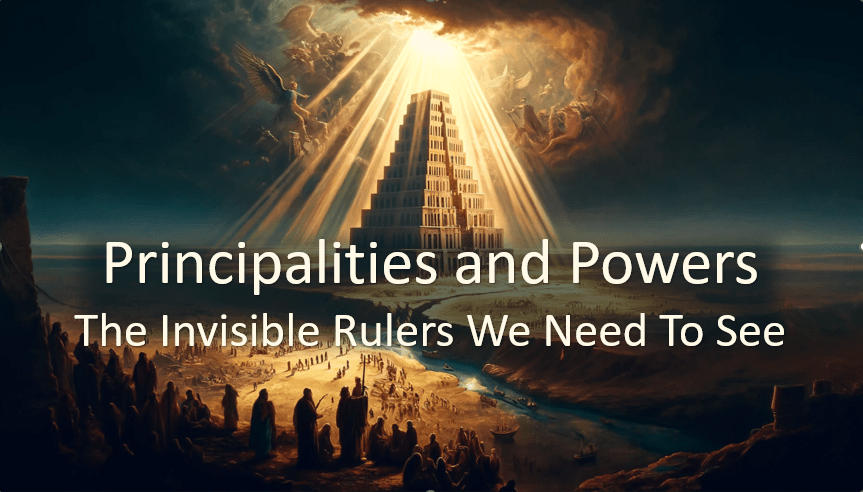
The Principalities and Powers: The Invisible Rulers We Need To See

The story of Babel is familiar to many. After the flood, God commanded Noah’s family to multiply and fill the earth (Genesis 9:1). Instead, Noah’s descendants, led by Nimrod, settled in the plains of Shinar and set out to build a city and a tower reaching to heaven (Genesis 11:2-4). Desiring to make a name for themselves and avoid scattering, they defied God’s command and pridefully demonstrated independence from God.

God disrupted their rebellion by confusing their language and scattering them across the earth (Genesis 11:7-9). These events set the stage for God’s covenant with Abraham, through whom all the scattered and rebellious nations would be blessed (Genesis 12:1-3).

At least, that’s the version most people know. What this familiar summary of the story usually neglects, however, are the “principalities and powers.”

When telling any story, it is easy to focus on the main characters, whose actions most directly move the plot forward. We shouldn’t, however, overlook the background characters, without whom the story doesn’t make as much sense. Recognizing the role of the “principalities and powers” not only helps us see the significance of Babel, but is also key to understanding the broader theme of how God uses the principalities and powers to govern the unbelieving world.

Who Are the Principalities and Powers?

The phrase “principalities and powers” does not come from Genesis. It originates with Paul, who used the terms to describe both heavenly and earthly authorities.

Heavenly Powers

In a couple of places, it seems that Paul uses this language to refer to some sort of spiritual beings in heavenly realm with whom Christians must contend.

… that the manifold wisdom of God might be made known by the church to the principalities and powers in the heavenly places.

Ephesians 3:10

For we do not wrestle against flesh and blood, but against principalities, against powers, against the rulers of the darkness of this age, against spiritual hosts of wickedness in the heavenly places.

Ephesians 6:12

Earthly Authorities

In other instances, Paul uses the same terms to describe earthly political rulers. Interestingly, when used to refer to earthly rulers, translators tend to translate archon and exousia, as “rulers and authorities”, but these are the exact same Greek words elsewhere translated as “principalities and powers.”

Let every soul be subject to the governing authorities. For there is no authority except from God, and the authorities that exist are appointed by God… For rulers are not a terror to good works, but to evil.

Romans 13:1-3

Remind them to be subject to rulers and authorities, to obey, to be ready for every good work.

Titus 3:1

Both Realms Intertwined

Sometimes, the context does not make it entirely clear whether Paul is referring to spiritual authorities, earthly authorities, or perhaps both at the same time:

For I am persuaded that neither death nor life, nor angels nor principalities nor powers, nor things present nor things to come, nor height nor depth, nor any other created thing, shall be able to separate us from the love of God which is in Christ Jesus our Lord.

Romans 8:38-39

For by Him all things were created that are in heaven and that are on earth, visible and invisible, whether thrones or dominions or principalities or powers. All things were created through Him and for Him.

Colossians 1:16

Having disarmed the principalities and powers, He made a public spectacle of them, triumphing over them in it.

Colossians 2:15

The various and sometimes ambiguous ways Paul uses these terms blurs the line between spiritual and earthly rulers and raises some interesting questions. Who are these spiritual beings? What kind of authority do they have? Are the they somehow connected to earthly political rulers and authorities? What is God’s purpose for these spiritual beings? Do they continue to hold power and influence over the world today?

The Relationship Between Heavenly Powers and Earthly Authorities

While Scripture may not reveal the answer to every question we may have, there are some interesting Old Testament passages that likely helped shape Paul’s understanding of these principalities and powers. One example is Daniel 10:10-21, which vividly describes a heavenly struggle between spiritual entities, which he describes as the “Prince of Persia” and the “Prince of Greece.” These spiritual beings seem to correspond to the earthly kingdoms of Persia and Greece, indicating that their heavenly conflict somehow influenced, or was mirrored by, the affairs of earthly kingdoms.

Similarly, Psalm 82 presents a rebuke of rebellious spiritual beings, referred to as “gods” for their failure to govern justly. The failure of these “gods” are identified by their earthly impact, as the weak, fatherless, and needy are left afflicted, while the wicked are shown favoritism.

God has taken his place in the divine council;
In the multitude of the gods he holds judgment:
How long will you judge unjustly
and show partiality to the wicked?
Give justice to the weak and fatherless;
Maintain the right of the afflicted and destitute.
Rescue the weak and needy;
Deliver them from the hand of the wicked.”

Psalm 82:1-4

As in Daniel 10, Psalm 82 also shows that the corruption of these heavenly authorities is connected to corruption in earthly governance.

The interplay between heavenly and earthly powers is further emphasized in Isaiah 24:21-22, where both heavenly hosts and earthly kings are held accountable for their actions.

On that day the LORD will punish
the host of heaven, in heaven,
and the kings of the earth, on the earth.

They will be gathered together
as prisoners in a pit;
they will be shut up in a prison,
and after many days they will be punished.

Not only does Isaiah confirm the existence of both heavenly and earthly authorities, but their dual accountability underscores God’s sovereignty over both realms.

Principalities and Powers at Babel

Returning to Genesis we read of how God confused mankind’s language and scattered the nations across the earth, focusing on the immediate human rebellion and God’s response. While Genesis 11 does not explicitly mention the spiritual “principalities and powers,” the events at Babel serve as the backdrop to Deuteronomy 32:8-9, which reveals the spiritual dimension of this rebellion. Here we learn that in the aftermath of Babel, God fixed the borders of the scattered nations and assigned them to “the sons of God,” a phrase consistently used in Hebrew to refer to spiritual beings (e.g., Job 1:6; 2:1; 38:7; Genesis 6:1-4). In contrast to the other nations, God reserved Israel as His own special heritage, underscoring the unique covenant relationship He shared with them.

When the Most High gave the nations their inheritance,
when he divided mankind,
he fixed the borders of the peoples
according to the number of the sons of God.
But the LORD’s portion is his people,
Jacob is his allotted heritage.

Deuteronomy 32:8-9

This passage makes it clear that Babel was not only a moment of human rebellion, but it was also the moment when God assigned these newly scattered nations to the governance of other spiritual beings, while reserving Israel for Himself. That’s why the tower of Babel was such a critical moment in human history, and that’s why Paul places such a big emphasis on the presence and role of the “principalities and powers” throughout his writings.

Living as Exiles Under Principalities and Powers

For Christians, this understanding reshapes how we view the world. Earthly rulers, though instituted by God, operate within a realm where rebellious spiritual powers exert influence. Whether this is a direct influence, through idolatry and temptations, or an indirect influence, through cultural norms, ideologies, and philosophies, Scripture does not fully reveal. But the Bible does clearly affirm their existence and their opposition to God’s kingdom. These forces stand behind earthly political systems, but Christ’s victory on the cross has disarmed and defeated them (Colossians 2:15), ensuring that they cannot separate us from His love (Romans 8:38-39).

At its core, the gospel is a call to change allegiance, away from the rulers, principalities, and powers that dominate the unbelieving world, to the one true King, Jesus Christ (Colossians 1:13-14). To confess that “Jesus is Lord” (Romans 10:9) is to reject the lordship of any competing power, whether spiritual or earthly, that may wish to maintain authority for themselves.

The gospel is far more than a formula for getting to heaven after we die. It is an invitation to every tribe, tongue, and nation to forsake false gods and rulers, and to pledge their allegiance to the Lamb (Revelation 7:9-10). As citizens of God’s kingdom, we live as strangers and exiles in this world, seeking first His kingdom and His righteousness. Under Christ’s Lordship, we proclaim his reign in both word and deed, anticipating the day when every knee – whether in heaven, on earth, or under the earth, bows and confesses that Jesus is Lord (Philippians 2:10-11).

“God’s Kingdom and the World’s Kingdoms are Separate” by David Lipscomb

The Gospel Advocate, Mar. 13, 1866, pp. 161-166.

Christ recognized the claims of the Tempter to the kingdoms of this world. Acknowledged by his action at the time, by his response to the wicked one, through his inspired apostles, Matthew, Luke and Paul, that the offer of the kingdoms of this world by the wicked one, was a temptation to the Son of God. This could only have been true on the supposition that they were actually the possession of the devil. The world had been delivered him by men to whose control God had committed it. Christ, we have found, came into the world to rescue it from the dominion or possession of the wicked one. He proposed to do this, not by entering into and controlling the kingdoms of this world, that had been established under the rule and in the interest of the wicked one, but by destroying and consuming these and establishing a kingdom, “not made with hands” (Dan. 2:34-35; 44-45) – one whose “founder and builder is God” (Heb. 11:10).

We find the Savior definitely marking his relationship to these kingdoms, when he asks Peter,

“Of whom do the kings of earth take custom or tribute? Of their own children or of strangers?” Peter saith unto him, “Of strangers.” Jesus saith unto him, “Then are the children free. Notwithstanding, lest we should offend them, go thou to the sea, and cast an hook, and take up the fish that first cometh up, and when thou hast opened his mouth, thou shalt find a piece of money: that take and give unto them for me and for thee.”

Matthew 17:25-27

He thus, by his own act, confirmed by a miracle, places himself and the Apostle Peter among the strangers to the kingdoms of this world. They are the children of no earthly government, although born and living under them.

The enemies of the Savior saw that his claims to be king were adverse to the claims of any earthly potentate or power, so they made this the chief ground of opposition to him.

The Pharisees ask him, “Is it lawful to give tribute unto Caesar, or not? But Jesus perceived their wickedness, and said, Why tempt ye me, ye hypocrites? Shew me the tribute-money. And they brought unto him a penny. And he saith unto them, whose is this image and superscription? They say unto him, Caesar’s. Then saith he unto them, render, therefore, unto Caesar, the things that are Caesar’s; and unto God, the things that are God’s.”

Matthew 22:17-21

Or as Tertullian, over fifteen hundred years ago, commented on this as follows:

The image of Caesar, which is on the coin, we give to Caesar. The image of God which is in man, is to be given to God. Therefore, thou must give the money, indeed, to Caesar, but thyself to God, for what will remain to God, if both man and money he given to Caesar?

On Idolatry, chapter 15

The enemies of the Savior knew that his kingdom was in opposition to all earthly kingdoms, so they expected him to forbid the paying of tribute to Caesar, and to develop an open and violent hostility to Caesar’s government. They only mistook the nature of his weapons and kingdom, as well as the manner of establishing that kingdom. In accordance with this idea, the charge which they made against like at his crucifixion was that he claimed to be a king, therefore could not be Caesar’s friend (Mark 15:1-2; Luke 23:2-3; John 18:34-35). He admitted the charge, but only answered, “My kingdom is not of this world” (John 18:36). It enters not the contest and strife for dominion after the manner of the earthly kingdoms. It uses no earthly weapons or violent means in its establishment. When Pilate is disposed to release Jesus, the multitudes cry at him. “Let this man go, thou art not Caesar’s friend” (John 19:12).

This same feeling of antagonism manifested itself in the persecution, punishment and martyrdom of the Apostles and primitive Christians by the rulers and powers of the earthly kingdom. This antagonism was foretold by the Prophets.

Why do the heathen rage, and the people imagine a vain thing? The kings of the earth set themselves, and the riders take counsel together, against the Lord, and against his Anointed.

Psalm 2:1-2

Peter and John, after the healing of the impotent man in Solomon’s porch, were arrested and straightway threatened that they should speak no more in the name of Jesus. They quote the foregoing from David, and apply it.

For a truth against thy holy child Jesus, whom thou hast anointed, both Herod and Pontius Pilate, with the Gentiles, and the people of Israel were gathered together, for to do whatsoever thy hand and thy counsel determined before to be done, and now, Lord. behold their threatenings.

Acts 4:26

Jesus Christ recognized, clearly, this antagonism. He recognized ever that the world governments were his enemies. They sought his life at his birth. To destroy him, Herod “destroyed all the children of two years old and under, in Bethlehem, and in all the coasts thereof” (Matt. 2:16). Christ selects and sends out his twelve apostles. He tells them

They shall be delivered up to the councils, and by them be scourged in the synagogues, and ye shall be brought before governors and kings for my sake, for a testimony against them and the Gentiles.

Matthew 10:17-18

The taking on themselves the name of Christ, would bring on them the opposition and persecution of the political governments. But in these trials to which they are subjected, on account of Christ, he tells them, “Fear not them [the civil rulers] who kill the body, but are not able to kill the soul: but rather fear him [God] who is able to destroy both soul and body in hell” (Matt. 10:28). Christ speaking of his death said, “Now is the judgment of this world: now shall the prince of this world be cast out” (John 12:31).

In other words, now is the trial of the strength of the prince of this world and the Prince of Heaven. The power of the prince of this world will be triumphed over, and thus will his claims be regarded and his power overthrown. In the trial of strength, Jesus Christ permits the rulers of this world to exercise their utmost stretch of power by killing the body, he then rises a victor from the grave, there­by showing that when they have exerted their utmost stretch of power, he can overcome and destroy all their work. Paul, speaking of the triumph of Christ over the highest powers of the mightiest of earthly kingdoms, says,

Having spoiled principalities and powers, he made a show of them openly, triumphing over them in it.

Colossian 2:15

He spoiled them by destroying their prestige of superiority, and in his personal triumph over their utmost stretch of power, he gave the assurance that in the long controversy he had entered upon with the nations, his final triumph and their utter destruction were sure. He made a shew of his triumph over them, in shewing himself after his resurrection from the grave. He shews his superior power to them all. You can only carry down to the grave. I am superior to the prison bonds of death. Where then your boast[s]? But this antagonism is presented again,

Hereafter I will not talk much with you for the prince of this world cometh, and hath nothing in me.

John 14:30

Here he announces that the prince of this world—he that governs and rules the world, hath nothing in Jesus—no interest or prestige in his kingdom. Who is the prince of this world? The wicked one—the devil? Then he operates through and uses Pontius Pilate, the civil ruler. The civil ruler, the human government then, is the agency through which the devil works. But says one, the prince of this world was Pontius Pilate, who was coming. Then Pontius Pilate, the representative of the civil human government, “hath nothing in Christ,” no part, nor lot, nor heritage there. Civil government is the same today that it was then. This government, whose ruler or head, whether Pontius Pilate or the wicked one he referred to, is the same to which the Christians of primitive times were admonished to be subject by Christ and his apostles.

The impression made upon the disciples themselves, was that they were not subjects of the earthly kingdoms. Hence they looked for an earthly kingdom, the restoration of earthly power to Israel. “Lord, wilt thou at this time restore again the kingdom of Israel?” (Acts 1:6). The same impression upon their minds is recognized in the fact that the disposition to carry the idea to an unwarranted extreme, called forth the repeated admonition from the apostle,

Be subject to the powers that be…

Romans 13:1

Submit yourselves to every ordinance of man for the Lord’s sake…

1 Peter 2:13

Put them in mind to be subject to principalities and powers, to obey magistrates…

Titus 3:1

Now if the idea had not have crept into their minds that they were somehow not subject of these earthly kingdoms, there would not have been the necessity for this repeated admonition being given them. Notice, too, they were commanded to do these things for the Lord’s sake, not for the sake of the governments. These admonitions certainly connect the Christian with these earthly governments under which he lives, in relationship that we will examine at the proper time. But they all show the Christian was not taught to regard himself as part and parcel of these kingdoms.

In accordance with this, too, the wicked one is ever regarded in Scripture as the prince of this world.

Now is the judgment of this world: shall the prince of this world be cast out.

John 12:31

The prince of this world is judged.

John 16:11

Wherein in time past ye walked according to the course of this world, according to the prince of the power of the air, the spirit that now worketh in the children of disobedience.

Ephesians 2:2

Put on the whole armor of God, that ye may be able to stand against the wiles of the devil. For we wrestle not against flesh and blood, but against principalities, against powers, against the rulers of the darkness of this world, against spiritual wickedness in high places. Wherefore take unto you the whole armor of God. that ye may be able to withstand in the evil day.

Ephesians 6:11-13

These verses demonstrate the way in which the principalities, powers, the rulers of this world are certainly classed among the wiles of the wicked one that are to be withstood through the use of God’s armor. The wicked one is also sometimes called the God of this world, indicating his influence and power in this world. When the kingdoms of this world become the kingdoms of God and his Son, we presume the devil will no longer be called the God of this world.

We have thus found that the separation and antagonism between God’s institutions and man’s, or as they might now be properly termed, the wicked one’s, kept up and impressed through the four thousand years of the existence of the types, have fully maintained, by the teaching of Christ himself in the great antitype, the spiritual and eternal kingdom of God. We wish to call the attention of the readers here to the fact that the existence of Jesus Christ here on earth in his fleshly body, was to some extent a type of the existence of the spiritual body. His temptations, its temptations, his poverty, sorrows, trials, persecutions, betrayal, death, burial, resurrection and glorious, triumphant ascension, all typifying the same experiences that it must undergo. He never came in contact with the prince of this world, or the governments of this world, but to be tempted to corruption or to be persecuted. The Church of Christ, we may safely affirm, has never come in contact with the governments of this world but to be persecuted or corrupted.

The alliances she has made with the princes and governments of this world have ever been more fatal to her strength and purity than the persecutions she has undergone. Christ was above temptation when the wicked one offered an alliance—his followers have not been proof against the same kind of offers made by the emissaries and agents of the wicked one. Constantine weakened the church a thousand-fold more than Nero or Diocletian. The alliances, friendships, and blandishments of the world-powers today are more fatal to the strength and purity of the church than the combined opposition of the world could possibly be. Then her own experiences accord with the teachings of God, warning her against the association of the world or human institutions. They are the institutions of the wicked one. What fellowship hath Christ with Belial? What participation can a child of God have in the kingdoms of this world?

Again, the Scriptures have recognized every relationship of life into which it is possible for a Christian to enter, and given instruction that thoroughly furnishes the child of God with directions how he should act therein. They have given instruction how the parties should mutually conduct themselves toward each other as husband and wife, parent and child, master and servant, elder and younger, stranger and friend, and even as wrong-doer and wrong-sufferer—every relationship into which it is possible for a Christian to enter, has its appropriate instructions for the Christians guidance therein, save one if it be lawful to enter into that one. In one relationship of life, and that the most universally prevalent one with the human family, this instruction is in part wanting. That relationship is, subject and ruler in the earthly kingdom. One party to this relationship, the subject, is directed and guided as to the manner conducting himself in this relationship. But the ruler, the most important one of all the relationships of this world, because on him the peace and quiet of the world depends, in whose hands the happiness of millions rests, is left without one single word of instruction as to how he should direct himself.

Why this omission, why this painful silence of God as to the Christian ruler of the kingdoms of this world? The Christian father, child, the Christian husband, wife, master, servant, the Christian, that falls into wrong, the Christian that suffers wrong doing, the Christian subject of a human government, all have their rules of conduct laid down in the Scriptures of God, but not a solitary word in the volume of inspiration as to how the Christian ruler of the earthly kingdoms shall conduct himself. What means this omission, friends? “All scripture is given by inspiration of God, and is profitable… that the man of God may be perfect., thoroughly furnished into every good work” (2 Tim. 3:16-17), and yet no direction furnished him how he shall act when he comes to assist in directing and conducting the governments of this world.

The Christian father, husband, wife, child, master, servant, subject, can walk by the light of divine truth, under the spiritual guidance of God, but the Christian ruler, governor, magistrate, law-maker, law-executor, must grope his way in the dark, directed only by his own frail and erring reason; no wonder he makes so many false steps. No wonder his wisest plans so often miscarry. But brethren we ask you seriously, what meaneth this omission? Was it inadvertence, omission, oversight in the law-maker? Who dare so affirm? How can we resist the conclusion that God never anticipated his children participating in the governmental affairs of these earthly kingdoms. He recognized these kingdoms as the kingdoms of the wicked one, and made no provision for his children participating therein.

“Jesus’ Temptations and World Powers” by David Lipscomb

The Gospel Advocate, March 6, 1866, pp. 145-149.

We have found that God’s government, as established among the Jews as its subjects, was separated from all the institutions of man—that they were taught to rely upon God’s appointments in every emergency of life—that a failure to rely upon his appointments by seeking aid through their own inventions or through alliance with other human institutions, was always regarded by God as an indication of lack of faith in Him, and as an act of rebellion against His authority. We find that for four thousand years he has been teaching His servants the impossibility of forming alliances with, and participating in the institutions of man, and at the same time retaining his favor. They are finally rejected, cast out, a dis­persed and scattered nation, on account of their persistent determination to participate in and to rely upon these institutions. For near two thousand years they have been a scattered, exiled, wandering, despised and persecuted people, and stand to-day a living monument attesting to every nation under the sun:

How great a folly and crime it is for God’s people to intermeddle with or participate in the institutions of human mold—to touch, taste, handle those things “which are for the destruction of those who use them.”

Colossians 2:22, Anderson’s Translation

He has taught the lesson of complete and perfect separation from the world kingdoms, he has taught them this for the benefit of the Church of Christ, he has assigned them a position of complete separation from all human institutions, which position they are to retain upon peril of their rejection and destruction as God’s people. Into the position from which they were broken, the believers in Christ were grafted. The believers in Christ, or the Church of God, stand then entirely separated from the world-powers by the direction and work of God. Daniel says, “it was to break in pieces and consume all these earthly kingdoms” (Daniel 2:44). I repeat then, if there were not a single word in the New Testament indicating they were separate, without specific authority of precept or example, for the subjects of the one participating in the affairs of the other, they must forever remain distinct, allowing no participation in the affairs of one by members and citizens of the other.

Is there example for so connecting them to the law and the testimony? Christ, the king, the representative of that church on earth, is met at the moment of his birth by a decree from the civil government under which he was born, for his destruction. The ruler recognizes him as the founder and head of the kingdom which “shall break in pieces and consume all these,” is then his enemy. He is preserved by his Father from destruction.

He commences his mission openly as the Son of God. Is recognized by his Father as “My Beloved Son in whom I am well pleased” (Matthew 4:17). In the commencement of his public ministry his fidelity to his Father must be tested. He comes into the world to engage in a stupendous work — He must suffer excruciating torments — will he be faithful to his Father who sent him? Test him at the beginning. He is tempted, tried as never man was tried. He is tried at every point by the wicked one. In that temptation the devil taketh him up into a high mountain and sheweth him all the kingdoms of the world and the glory of them, and saith unto him, “all these things will I give thee if thou wilt fall down and worship me” (Matthew 4:5, 9). Or as Luke 4:5 records it:

The devil taking him up into a high mountain shewed hint all the kingdoms of the world in a moment of time and the devil said unto him, “All this power avail give thee, and the glory of them: for that is delivered unto me, and to whomsoever I will, I give it. If thou wilt fall down and worship me, all shall be thine.”

We are seeking to locate the true position of the king­doms of the earth — all the kingdoms of the earth. The devil says, “They are mine, I will give them thee, if thou wilt fall down and worship me.”

“But,” says one, “the devil is a liar and the truth is not in him. He owns not a foot of soil.” Yea, but a liar, even the father of lies may tell the truth, and should be accredited when corroborated by one so truthful as the Son of God. Does the Son of God corroborate this statement? Let us examine for a moment. The Divine historian says he was tempted. Paul says, “He hath suffered, being tempted” (Hebrews 2:18). Now in order to its being a temptation, it must have been a veritable offer of something to the Son of God, which he very intently desired, yet could not take upon the terms offered. In other words, it must have been an offer of an object or possession ardently desired, by one having the right or power to bestow it. Now Jesus Christ knew the possessor of these kingdoms. It could be no temptation to an individual for me to offer him a title to a tract of land which he knew I did not have the shadow of a right to, or the power to obtain that right. Then in order to the offer’s being a temptation to the Son of God, He must have thought the devil had the power to give what he proposed to bestow. Then if the Son of God was tempted by the devil, all the kingdoms of this world were the devil’s kingdoms.

Indeed, what was the object of the mission of the Son of God into this world, but to rescue this world from the dominion of the wicked one and bring it back to its primeval allegiance to his Father? If it were not under the dominion of the wicked one, it could not be rescued from his power. Whatever rule or authority was exercised over the earth was exercised through these kingdoms. Hence Jesus Christ’s mission, sor­rows, suffering and death, were all meaningless unless the kingdoms of this world be the kingdoms of the wicked one.

But let us revert to their origin. Whence did they originate? Not among the people of God, but among those in rebellion against Him. Who is the prime mover in all rebellion against God? The wicked one. There are but two sources of power in the universe, God and his great enemy. Every kingdom then not originating from God, must receive its power and authority from the wicked one. These earthly kingdoms then originated in the rebellion of the human family against God, lives to-day by virtue of that rebellion, and must die when that rebellion ceases. The little stone broke in pieces the image, and it filled the whole earth, so no place was found for these governments when the world was brought back to allegiance to God. The devil claimed them and Jesus Christ admitted his claim.

Let us look a moment at the point of this temptation. Jesus Christ came into this world to strive and wrestle with the devil for the dominion of this world, to rescue and redeem it from the power of the devil. He came as the “sent” of his Father. He came to conquer this world, destroy all domin­ion and principality, he came “to put down all rule and all authority and power” (1 Corinthians 15:24). When this is accomplished, he will deliver up the kingdom to the Father, and himself be subject unto the Father” (1 Corinthians 15:28). Or in other words he had come to fight for the dominion of the world, when he had gained that dominion, he was to occupy the second position in the rule and authority of the domains he had conquered. He knew that the conquest would cost him suffering, sorrow, maltreatment, indig­nities, excruciating torments, the very anticipation of which made him draw back with the entreaty, “let the cup pass from me” (Matthew 26:39) and brought great drops of blood from his soul of anguish; He knew, too, the strife for the conquest of the world must bring him down to the humiliation of death, the degradation of the grave.

The devil, with his subtlety, pro­posed at the very threshold of his mission, “you are to be a subordinate in this kingdom under your Father, after all your sorrows and sufferings. Now worship me, or recognize me as head instead of God, and I will deliver them all into your hand with all their glory, without a struggle, a sorrow, a pang upon your part.” There was the point of the temptation, to let him rule the earth through the devil’s kingdoms, without suffering, without death, without the grave, instead of through God’s, with all these. His purpose then is not to destroy the devil’s power in his kingdoms, and then himself reign therein, but it is to destroy those kingdoms of the wicked one, and in their stead establish God’s kingdom. How came the kingdom or dominion of the earth the devil’s? “They were delivered into my hand,” says the wicked one.

What says the Divine record? As we have shown in a former number, God made man ruler over the whole under creation. He was its head. He had the authority from God to use and control it as he desired. God having once delegated authority to man, never reassumed it to himself. Hence man, in refusing to obey God, but rather to follow the dictates of the serpent, rebelled against God, and transferred his allegiance to the devil. He, as the head and rightful ruler of the world, and the founder of the kingdoms of the world, transferred, with his allegiance, the rule of the world from God to God’s great enemy.

The entire world, animate and inanimate, sympathizes in this change. The spirit of savage venom and brutish strife in the animate kingdom, and the briar, and thistle, and thorn in the inanimate, betoken the reign of the wicked one. These never had their growth in the kingdom of God, in which His will prevailed and His spirit animated. We have a strong persuasion, too, that when this world becomes the kingdom of God and of his Son, the briar, and thistle, and thorn will no longer grow, the venomous brute and the poisonous serpent will lose their devilish nature, and

The wolf shall dwell with the lamb, the leopard shall lie down with the kid, the calf, and the young lion, and the fatling together, and a little child shall lead them…. The suckling child shall play on the hole of the asp, and the weaned child shall put his hand on the cockatrice’s den.

Isaiah 12:6, 8

The prevalence of this feeling of venom and spite in man or brute, and the tendency of earth to grow the thistle, briar and thorn indicate clearly that the ruler is the wicked one; his spirit animates; he is the source of the power, the prince of this world. Jesus Christ came into this world to rescue the world from the dominion of the wicked one, and bring it back to its allegiance to his Father. How will he effect this? By infusing his spirit and introducing his subjects into the kingdoms of the world until he is able to out vote and control the world through the kingdoms of the wicked one? Or by destroying the kingdoms of the wicked one and establishing in their stead a kingdom of his own?

Man has no power to rule himself, all power and rule must come from God or the devil. Every institution then of earth, intended to control man, not founded of God, must look back through man, the agent to the wicked one, the prince of the world, as the source from which it sprang. Can God then rule in and animate a kingdom that has His enemy and his rival for its founder? Does not his character and his dignity require that he should destroy the works and institutions established under the inspiration of the wicked one, and establish a kingdom of his own, in and through which he will rule the world?

In the days of these kings shall the God of Heaven set up a kingdom, which shall never be destroyed: and the kingdom shall not be left to other people, but it shall break in pieces and consume all these kingdoms, and it shall stand forever.

Daniel 2:44

Then cometh the end, when he shall have delivered up the kingdom to God, even the Father; when he shall have put down all rule, and all authority, and power. For he must reign; until he hath put all enemies under his feet.

1 Corinthians 15:24-25

Every institution that exercises “authority, rule or power” over man, is a rival of Christ who claims sole author­ity, and must be “put down.”

He raised him from the dead, and set him at his own right hand in the heavenly places, far above all principality, and power, and might, and dominion, and every name that is named, not only in this world, but also in that which is to come, and hath put all things under his feet, and gave him to be the head over all things in the church.

Ephesians 1:20-22

It is only through or in the church he is to be head of all things.

For we wrestle not against flesh and blood, but against principalities, against powers, against the rulers of the darkness of this world, against wicked spirits in high places.

Ephesians 6:12

How Earthly Kingdoms Stand Against Christ

Throughout Scripture, earthly kingdoms, such as Egypt, Canaan, Assyria, Babylon, and Rome, consistently oppose God’s kingdom. From Nimrod’s Babel to the “Babylon” in Revelation, this continual theme deserves consideration. What about today? How should Christians view and relate to the earthly nation in which they live?

What is an “Earthly Kingdom”?

The word “kingdom” is now seldom used to refer to modern political dominions, with terms such as “nations,” “countries,” or “states” being more common. Here, I use the phrase “earthly kingdom” to distinguish these political dominions from the heavenly kingdom over which Christ reigns as King.

Christians should take no issue with the idea of a “king,” or “kingdom” in general. Calling Jesus “Christ” means acknowledging Him as God’s anointed King, the world’s true Lord. Christians are not anarchist. In a sense, Christians are monarchist, submitting to Christ’s rightful reign and seeking first His kingdom.

While the preceding article “What Jesus Talked About the Most” focuses on Christ’s Kingdom, this article examines the other earthly dominions which are governed by earthly rulers. How should Christians, citizens of the heavenly Kingdom, think about and relate to earthly nations and their rulers?

Who Do Earthly Kingdoms Serve?

When Jesus spent forty days in the wilderness, the devil tempted him:

And the devil took him up and showed him all the kingdoms of the world in a moment of time, said to him, “To you I will give all this authority and their glory, for it has been delivered to me, and I give it to whom I will. If you, then, will worship me, it will all be yours.”

Luke 4:5-7

The devil claimed that he had authority over all the kingdoms of the world, and the ability to give those them to whom he wanted. Interestingly, Jesus never disputed this claim. Notice Jesus’s response:

You shall worship the Lord your God, and him only shall you serve.

Luke 4:8

That’s it. Jesus did not dispute the devil’s ability to make good on his offer. If Jesus did not recognize Satan’s capacity to do so, the offer would not have been a genuine temptation as the text portrays it to be.

In fact, everything else the New Testament says about Satan’s authority over earthly kingdoms supports the Devil’s claim. Satan is elsewhere described as “the ruler of this world” (John 12:31; 14:30; 16:11), “the god of this world” (2 Cor. 4:4), and the “prince of the power of the air” (Eph. 2:2). John states that “the whole world is under the power of the evil one” (1 John 5:9).

In Revelation, the “beast” worships the Dragon, from which the beast had received it’s authority (Rev. 13:4). The Dragon is identified as the Devil and Satan (Rev. 12:9). This “beast” is an image of earthly kingdoms from the book of Daniel and is identified with “Babylon,” or more precisely, those who in John’s day were exercising Babylonian type authority (Rev. 17:1-9). This “Babylon” is described as a “dwelling place for demons” (18:2), and Christians are warned to “come out of her” (18:4). “Babylon” and the other earthly kings and nations under her deception are ultimately judged and destroyed (Rev. 18:9, 23).

One of the primary ways Satan influences the world is through giving authority to earthly kingdoms, which are described as worshiping him, and are under his dominion.

How Do Earthly Kingdoms Maintain Power?

Earthly governments maintain power through top-down authority, coercing behavior through the threat of violence. As Paul noted, they “do not bear the sword in vain,” ruling through violence or its threat to punish those who would oppose them. Civil laws carry weight because disobedience is punished with fines, imprisonment, pain, or death. Without the threat of punishment, civil laws are powerless.

Jesus frequently contrasted His kingdom with the ways of earthly ones. While earthly kingdoms are described as persecutors, Jesus’s kingdom belongs to the poor in spirit, meek, merciful, and peacemakers.

Blessed are those who are persecuted for righteousness sake, for theirs is the kingdom of heaven.

Matthew 5:10

While earthly rulers “lord it over” and “exercise authority” over others, the greatest in Jesus’s kingdom is a servant.

You know that those who are considered rulers of the Gentiles lord it over them, and their great ones exercise authority over them. But is shall not be so among you. But whoever would be great among you must be your servant.

Mark 10:42-43a

While subjects of earthly kingdoms fight for the success of those kingdoms, Jesus’s Kingdom is seen as “not of this world” due to their refusal to fight.

If my kingdom were of this world, my servants would have been fighting, that I might not be delivered to the Jews. But my kingdom is not of this world.

John 18:36

Earthly kingdoms are by their very nature violent, relying on the power of the sword to gain and maintain the power to lord over others. Without the power of death, earthly rulers would be unable to enforce even the most basic laws.

How Do Earthly Kingdoms Oppose God?

When people assert the right to rule over mankind, they claim authority which God has reserved for His Son. As Isaiah prophesied, the government rests on His shoulders, with an authority and dominion that is without end.

For to us a child is born,
to us a son is given
and the government shall be upon his shoulder…
Of the increase of his government and of peace
there will be no end.

Isaiah 9:6-7a

Jesus confirms this authority, stating, “All authority in heaven and on earth has been given to me” (Mt. 28:18). Earthly kingdoms exist because they do not recognize this authority. Instead of submitting to God’s rightful authority, they exalt themselves. Babylon’s attitude of self-exaltation is described by Isaiah as a rivalry the rightful authority of the Most High.

You said in your heart,
“I will ascend to heaven;
above the stars of God
I will set my throne on high;
I will sit on the mount of assembly
in the far reaches of the north;
I will ascend above the height of the clouds;
I will make myself like the Most High.

Isaiah 14:13-14

When Israel asked for a king like the nations, this too was recognized as a rejection of God’s reign (1 Sam. 8:7). Jeremiah likewise warned them against learning the “ways of the nations” (Jer. 10:2) reminding them that there is no king like the LORD.

 Who would not fear you, O King of the nations?
For this is your due;
for among all the wise ones of the nations and in all their kingdoms
there is none like you.

Jeremiah 10:7

As plainly stated in Psalm 2, God recognizes earthly kings as standing against the LORD and against His anointed King.

Why do the nations rage
and the peoples plot in vain?
The kings of the earth set themselves,
and the rulers take counsel together,
against the LORD and against his Anointed, saying
“Let us burst their bonds apart
and cast away their cords from us.”

Psalm 2:1-3

Earthly kings who do not change their ways and submit to God’s Anointed will be destroyed (Ps. 2:10-12).

Why Are Earthly Kingdoms Important?

Although earthly kingdoms are described as serving Satan, ruling by the power of death, and standing in opposition to Christ, Christians must recognize that God still uses them to accomplish an important task.

While Christians are forbidden from avenging their enemies (Rom. 12:19-21), God does not permit evildoers to escape His vengeance, and He uses earthly authorities for this purpose, as ministers who execute His wrath on evildoers.

Let every person be subject to the governing authorities. For there is no authority except from God, and those that exist have been instituted by God. Therefore whoever resists the authorities resists what God has appointed, and those who resist will incur judgment. For rulers are not a terror to good conduct, but to bad… For he is the servant of God, an avenger who carries out God’s wrath on the wrongdoer.

Romans 13:1-5

There are numerous examples in the Bible of God using earthly governments as his servants for this purpose. When Israel asked for a king like all the nations, God punished them by giving them what they asked for, a government like that of earthly nations (1 Sam. 8:22). God used the office of an earthly king to execute his wrath, just as he says in Hosea,

I gave you a king in my anger,
and I took him away in my wrath.

Hosea 13:11

Assyria is also described an instrument in God’s hands to execute His wrath. Interestingly, Isaiah makes it clear that God was able to use them as His ministera, even though they had no intention to serve God willingly.

Ah, Assyria, the rod of my anger;
the staff in their hands is my fury!
Against a godless nation I send him,
and against the people of my wrath I command him,
to take spoil and seize plunder,
and to tread them down like the mire of the streets.
But he does not so intend,
and his heart does not so think;
but it is in his heart to destroy,
and to cut off nations not a few.

Isaiah 10:5-7

Likewise, Jeremiah 50-51 describes how God used Babylon to punish Israel for their wickedness. Even the pagan King Cyrus was called “My shepherd who shall perform all my pleasure” (Is. 44:28).

Despite the wickedness of earthly authorities, God still uses them to fulfill His will on the earth. As long as evildoers continue, earthly kingdoms will play an important role, and must be submitted to for this reason.

There Is Another Way

When Jesus established his Kingdom, He did not do so by the pursuit of earthly political authority, but by dying on a cross at the hands those authorities. His refusal to fight for power shows His kingdom was different in nature from the kingdoms of the world (John 18:36). Jesus is a real king (John 18:37), but His kingdom gains and maintains its power the same way Jesus did, through faithful obedience, love, service, and sacrifice, submitting even to rebellious earthly authorities.

Peter urged Christians to disciples submit to pagan Roman emperor, not because they agree with their claim of lordship, but “for the Lord’s sake.” (1 Pet. 2:13). They trust that God can use these authorities as His servants (1 Pet. 2:14). By following Christ’s example of submissive suffering (1 Pet. 3:13-17; 4:1), His disciples faithfully trust in God’s ability to restore, confirm, and strengthen them (1 Pet. 5:10).

We submit to them, because they we that to Christ belongs the true “dominion forever and ever. Amen.” (1 Pet. 5:11). Christians are called to submit to earthly authorities and their kingdoms, all while living as strangers and exiles whose citizenship is in Christ’s kingdom.

What Jesus Talked About the Most

Many people assume the goal of Christianity is to go to heaven. However, throughout the New Testament, not a single sermon concludes with “if you follow these steps, you can go to heaven when you die.” Far more often we find sermons proclaiming Jesus’s status as the anointed King (Christ) and Ruler (Lord). For example, in Peter’s Pentecost sermon, he declared “God has made him both Lord and Christ, this Jesus whom you crucified” (Acts 2:36). Similarly, Peter preached to Cornelius’s household about “Jesus Christ,” who is “Lord of all” (Acts 10:36). Even in Roman custody, Paul tried to convince others about Jesus and the Kingdom of God (Acts 28:23). Jesus’s kingship and lordship are at the very heart of the gospel (Romans 1:1-4).

The New Testament mentions the “kingdom” over 150 times, more than twice the frequency of the word “church.” While it is certainly worthwhile to study what the New Testament teaches about the church and heaven, it is unfortunate that the kingdom does not receive greater emphasis in modern Christianity. This was not the case with Jesus, who talked more about the kingdom than any other subject.

Jesus Preached the Kingdom

The gospel authors consistently emphasize the Kingdom as the main emphasis of Jesus’s teaching. For example, Mark 1:15 summarizes Jesus’s preaching throughout Galilee in one sentence: “The time is fulfilled, and the kingdom of God is at hand; repent and believe in the gospel.” Matthew 4:23 describes him as teaching in synagogues and “proclaiming the gospel of the kingdom.” Similarly, Matthew 9:35 and Luke 8:1 also highlight the kingdom as subject of Jesus’s message while healing diseases and afflictions. These passages all underscore the kingdom as the central focus of Jesus’s teachings.

When Jesus taught his disciples to pray, he taught them to pray about the kingdom (Mt. 6:9-13). Jesus instructed them to preach about the kingdom (Lk. 9:2; 10:9). His miracles, such as healing the sick and casting out demons, demonstrated that the kingdom was breaking into the world (Lk. 11:20). Jesus continually taught about how to enter the kingdom (Mt. 5:3; 6:33; Mk. 10:15; Lk. 13:3; 14:15-24; Jn. 3:3-5). Most of Jesus’s parables were used to explain the nature of his kingdom (Mt. 13:24, 31, 33, 34, 44, 45, 47; 18:23; 20:1, 22:2; 25:1; Mk. 4:26, 30, Lk. 13:18, 20).

Why did Jesus spend so much time talking about the kingdom? Because Jesus understood this to be the reason he was sent.

He said to them, “I must preach the good news of the kingdom of God to other towns as well; for I was sent for this purpose.”

Luke 4:43

What Is the Kingdom?

To put it simply, the Kingdom of God is the place where God reigns supreme and His will is done (Mt. 6:9-10). It is the “dome” (or “dominion”) over which God reigns as King.

Everyone in the first century knew what a “kingdom” was, but today we tend to use words like “nations,” “countries,” or “states” to describe political dominions. While modern rulers don’t typically use the title “King,” democratically elected rulers continue to hold similar authority to govern their respective states. Despite differences in how today’s rulers ascend to power, the concept of kingdoms and dominions with authoritative rulers persists in today’s world.

God also has a “kingdom” where choices are made in harmony with His will. Jesus, who is sinless, loving, and obedient, is the perfect example of what it looks like for God to reign over a person’s life completely. To enter his kingdom, one must be born again of water and Spirit, surrendering their life to continual imitation of Christ (John 3:3, Rom. 6:1-14; Phil. 2:5-8).

In the Sermon on the Mount, Jesus taught his disciples to pray, “Your kingdom come, Your will be done” (Mt. 6:10). God’s kingdom is where God’s will is done.

When is the Kingdom?

The Kingdom of God was not preached as a distant future event but as something imminent. John the Baptist and Jesus each preached that the Kingdom was “at hand” (Mt. 3:1-2; Mk. 1:15).

Similarly, in Luke 11:20, Jesus said,

But if it is by the finger of God that I cast out demons, then the kingdom of God has come upon you.

Jesus even told his disciples that some of them would witness the coming of the kingdom in their lifetime.

Truly, I say to you, there are some standing here who will not taste death until they see the Son of Man coming in his kingdom.

Matthew 16:28

For this reason, it should be no surprise when Paul and John also speak as if Christians were already in God’s kingdom at the time of their writing (Col. 1:13; Rev. 1:9). While there is a sense in which we still wait for the ultimate appearing of his kingdom, when the kingdom is delivered to the Father, when death is no more and every tear is wiped away (1 Cor 15:24, 2 Tim. 4:1; Rev. 11:15; 21:3-4), the kingdom of God is not merely a future hope for eternal life. It is a real kingdom presently here on earth.

If God’s kingdom is here, where is it?

Where is the Kingdom?

When questioned by the Pharisees about the arrival of God’s kingdom, he answered them:

The kingdom of God is not coming in ways that can be observed, nor will they say, “Look, here it is!” or “There!” for behold, the kingdom of God is in the midst of you.

Luke 17:20-21

Unlike earthly kingdoms with defined borders, Jesus’s kingdom exists anywhere things are done God’s way. Most of the world, filled with filled with war, violence, coercion, poverty, child abuse, sex trafficking, theft, injustice, hatred, and more, stands in opposition to God’s kingdom. But there are places where God’s will is done on earth as it is in heaven.

Jesus clarified to Pilate that while his kingdom is not of earthly origin, and is not sustained by earthly means, it is nonetheless a real kingdom, where Jesus reigns as a real King.

Jesus answered, “My kingdom is not of this world. If my kingdom were of this world, my servants would have been fighting, that I may not be delivered over to the Jews. But my kingdom is not of this world.”

Then Pilate said to him, “So you are a king?” Jesus answered, “You say that I am a king. For this purpose I was born and for this purpose I have come into the world – to bear witness to the truth – everyone who is of the truth listens to my voice.”

John 18:36-37

Jesus’s kingdom is as real as any other kingdom, and it is on earth now. If you want to know where God’s kingdom is, look to the places where people have reborn by both water and Spirit, and are heeding Jesus’s voice.

Who is the Kingdom?

Before identifying who is in the Kingdom of Christ today, it is helpful to differentiate this kingdom from the kingdom of God as it is otherwise described in the Bible. All that God did prior to the establishment of the Kingdom of Christ was done with that purpose in mind.

In the sense of rightful authority, all creation belongs to the Creator. But in the garden of Eden, something pivotal happened. Adam and Eve, rather than obeying the voice of their Creator, obeyed the voice of the Serpent. In so doing, they ceded authority to him who would eventually lead the whole world astray. In this sense, Satan too has a kingdom. But his kingdom only exists because he has usurped authority which did not at any point rightfully belong to him.

Since that time, two kingdoms have existed side by side, God’s and Satan’s, each bidding for mankind’s allegiance. After rescuing Abraham’s family from slavery in Egypt, God ruled over His kingdom of Israel through the law of Moses. Even as God anticipated a king (Deut. 17:14-20), He warned against the attitudes and actions which would defy his ultimate authority. Unfortunately, Israel rejected God’s reign, choosing instead to imitate surrounding earthly kingdoms (1 Sam. 8), leading to Israel’s decay and punishment (Hosea 13:11).

It was during this period of decay when the prophets announced that God would establish a new eternal Kingdom, where God would reign through His anointed King (Is. 9:6-7). Daniel too spoke of a Kingdom that was coming that would cut in pieces and destroy other earthly kingdoms (Dan. 2:36-45; 7:13-14).

Jesus was and is the fulfillment of this hope for a Kingdom. Paul refers to those who “boast in the cross of the Lord Jesus Christ” as the new “Israel of God” (Gal. 6:14-16), and Peter refers to Christ’s church as “a holy nation” (1 Pet. 2:9). That’s because Jesus has made them to be, “A kingdom of priests for God” (Rev. 5:10).

What Kingdom Are You a Citizen Of?

Salvation is much more than simply going to heaven. It includes rescue from the political forces and evil structures of this world which have aligned themselves with Satan (Col. 1:13; 2:15; 1 Jn. 3:8). The fact that Jesus established a Kingdom means that people are now forced to choose which Kingdom they pledge their allegiance to. We may be “born” into an earthly nation, but we are “born again” into God’s Kingdom.

It is important to note that the Bible rejects the concept of a “dual citizenship,” emphasizing that Christians live as foreigners, strangers, or exiles in their earthly nations. Our citizenship is not on earth, but in heaven (Phil. 3:20). The faithful are those who acknowledge themselves as strangers and exiles on the earth (Heb. 11:13). Christians are exiles, and as such, they are to abstain from the passions of the flesh which characterize the world (1 Pet. 1:17; 2:11).

The Kingdom of God is here now. This truth lies at the very core of the gospel which Jesus proclaimed, and it should be central to our message as well.

The time is fulfilled, and the kingdom of God is at hand; repent and believe in the gospel.

Mark 1:15

“The Church of God Among the Nations” by David Lipscomb

The Gospel Advocate; February 27, 1866

Has the separation that was established and perpetuated by God through a period of four thousand years, between God’s institutions and subjects and the human institutions of earth and their subjects, been obliterated in the dispensation for which all dispensations were given—the dispensation or reign of the Lord Jesus Christ? It is a universally received idea, we believe, among the students of the Bible, that there is not a lesson taught in God’s dealings with his people under His fleshly dispensations, not a principle vindicated, that was not intended more, for effect upon the perfect, spiritual kingdom of the “fullness of the times” than for immediate effect upon the temporal kingdoms to which they were given. The prime object of all those lessons of separation was to have their permanent effect upon the eternal kingdom of Jesus Christ. Is God less jealous of the sanctity of his eternal kingdom, established and reigned over through his anointed Son, than he was for the mere preparatory ones established and ruled through his frail, weak, sinning, human subjects? Our work, certainly, is sufficient, after having shown this separation, unless authority can be produced for uniting that which God hath sundered. But we again call attention to the positive teachings of the Holy Spirit directly upon the relationship they sustain toward each other.

For the Lord hath a controversy with the nations, he will plead with all flesh; he will give them that are wicked to the sword, saith the Lord.

Jeremiah 25:31

In which the fact is presented of a “controversy between God and the nations.” This controversy is undoubtedly with reference to the question: Who shall govern the world? Who shall rule man? God or the governments of the world? The result of this controversy is, “he will give the wicked,” those who maintain the government of the nations instead of the government of God, “to the sword.”

We next call attention to the teachings of the Holy Spirit through Daniel to Nebuchadnezzar. In Nebuchadnezzar’s dream or vision, the workings of human governments, their history and destiny, and the connection of the Church of Christ with them is plainly foretold by God and revealed by Daniel. In the vision of the image of the man, with a golden head, a chest of silver, belly and thighs of brass, legs of iron and feet of iron and clay, is presented the four kingdoms of earth, that were to attain to universal sway, and rule the world. The head of gold typifies the kingdom of Babylon, of which Nebuchadnezzar was the most powerful and illustrious ruler. It, with all its power, must be destroyed and its golden treasures and exalted honors become the prey of its despoilers. It is succeeded by the Medo-Persian empire, that rises on the ruins of its predecessor, attains universal sway, subjugates the world, and in turn, itself is broken and destroyed, to be succeeded by the third or brazen empire of Greece, whose mighty, conquering head, weeps that other worlds are not within the reach of its destroying and bloody sword. But with all of its mighty power it must soon be stripped of its powers and honors, a lifeless corpse, weltering in the blood of its own children. For the Roman empire strong as iron which “breaketh in pieces and consumeth all things,” commences its work of ruin and destruction. With it the vision of earthly, human empire closes. It indeed is broken in the pride of its strength and the glory of its power.

What human government, then, will be able to stand? No other human government can ever attain to universal dominion. All the governments of earth, to-day, are but the broken, discordant fragments of this once mighty empire. In their iron strength they linger out a lengthened existence even when dissevered, oftentimes exhibiting a mighty prowess that bespeaks them true to their origin, but by continual conflicts and ever worrying strife, are wearing themselves away, wasting their strength and making room for the kingdom which the “God of Heaven set up in the days of these kings.” Their mission, from the prophetic history, was to destroy one another, and under the rulings of God’s providence to give those who upheld them “to the sword.” Their destiny was to be destroyed. The end of the vision was:

A stone cut out of the mountain without hands, smote the image upon the feet, that were of iron and clay, and broke it to pieces. Then was the iron, the clay, the brass, the silver, and the gold broken to pieces together, and became like the chaff or the summer’s threshing floors; and the wind carried them away, that no place was found for them, and the stone that smote the image became a great mountain, and filled the whole earth.

Daniel 2:34-35

The interpretation of this was, that:

In the days of these kings [the Roman] shall the God of Heaven set up a kingdom, which shall never be destroyed, and the kingdom shall not be left to other people, but it shall break in pieces and consume all these kingdoms, and it shall stand forever.

Daniel 2:44

Here again the mission of these nations is distinctly set forth and their connection with the Church of Christ well defined. They were to be destroyed by the working of this kingdom, which the God of Heaven should set up, and the broken fragments as the chaff of the summer’s threshing floor to be blown away, so that no place for them should be found.

In contrast with the lesson that has been taught with reference to the destruction of the earthly kingdoms, the Kingdom of Heaven, “shall never be destroyed.” “‘The kingdom shall not be left to other people.” Another point of contrast. It has been taught that these earthly kingdoms, with all their riches and honors, should become the prey of their despoilers. Not a kingdom or government of earthly mold but in its overthrow or conquest, has been, with all its powers, possessions and honors, regarded and appropriated as the prey of the despoilers. But not so with the God-ordained kingdom. It was not to be left as a prey to other people, but with all its riches, honors, and priceless treasures, it is to be the perpetual heritage of its own meek and lowly children. No despoiler’s hand can deprive them or their rightful heritage in this kingdom, for God, its founder, is the guardian and protector of all its possessions. But the true omission of the Kingdom of God, with reference to the earthly kingdoms, is expressed in the next clause. “But it shall break in pieces and consume all these,” Its mission then, as distinctly set forth in this prophecy, is to break in pieces, consume and destroy all the kingdoms of earth. A spirit of perpetual antagonism is here developed, between God’s Kingdom and every form of human government. “God has a controversy with the nations.” An irrepressible conflict rages between the Government of God and all the human institutions of earth, which can only cease by the complete triumph of the one and the utter annihilation of the other. God will and can accept no doubtful fealty—no divided allegiance. He reserved to Himself the right to govern man. “To Him every knee shall bow and every tongue shall confess.”

The object of God then in establishing his Church or Government was to destroy all the governments and institutions of man, and through his Church, and only through it, rule and control the world. The church’s relationship to the world-powers and institutions of man must be in harmony with this—its chiefest mission. It cannot be one of alliance with and support to any of these institutions. It cannot, at one and the same time, both uphold and destroy an institution. Its first mission is to destroy all authority and power, and rule and bring the world in subjection to its great King. It is only to be remembered in this contest that the “weapons of its warfare are not carnal, but mighty, through God, to the pulling down of strongholds.” The little stone cut out of the mountain without hands was to fill the whole earth, so that no pace could be found for the image or any part of it. The Kingdom of Heaven will destroy all these earthly kingdoms and so engross the feelings, affections, time and labors of the denizens of earth, that no room or place will be found for the service of the earthly kingdoms. They are perishing. “It shall stand forever.”

The obligations and duties of the members of the Church of Christ, can in no manner conflict with this prime work and mission of the church itself. They cannot uphold what it must destroy. In doing this they war against the church, for it is through its members that the church accomplishes her work. If we thwart the workings of God’s church, we fight against God himself. But says one, “This antagonism was predicated only with reference to the kingdoms then in existence, not with reference to those which should afterwards arise.” The four kingdoms of Nebuchadnezzar’s vision are the only human kingdoms that have ever attained to universal sway. They are placed in contrast with the fifth universal kingdom—the Church of God. Evidently these strongest of all earthly kingdoms are made choice of as embracing and typifying all the institutions of human mold in their principles, workings and destiny. We doubt whether there has been brought into existence a single form or principle of government that did not find its first development and application in one of these four universal kingdoms. Indeed all the governments of earth are but the fragments and off-shoots or this last empire. What was true of the nature and destiny of this as a whole, is equally true of each of its different, dissevered parts. It is noteworthy that no two of these universal empires could exist at once in their fully developed power. As the one arose the other gradually decayed, wore away, disappeared and made room for its successor. Since the establishment of the Church of Christ, no human institution has ever made even a respectable effort to attain to universal dominion. The tendency has been to weaken the bonds that bind nations together, to disintegrate and separate. The attrition and friction of perpetual conflict and war will continue to weaken and wear out their strength and vigor, so that as the Church of Christ advances they will vanish away, and when it shall have accomplished its perfect work and attained to its full proportions, they will have been entirely destroyed. So that man owing allegiance only to God’s government, will render no divided service. His Kingdom will fill the whole earth. God will rule in and through it, and thus be all and in all.

But the prophecies of Daniel are even yet more replete with instruction upon these subjects. The dealings of these empires with Shadrach, Meshach and Abednego, and their deliverance from the furnace, the trials of Daniel, and the closing of the Lion’s mouth, the banishing of Nebuchadnezzar from the throne, his seven years of beastly life, and the final complete destruction at once of his kingdom and all were intended to teach one clear, specific truth, that all these human kingdoms were in their very nature opposed to the rule and dominion of God, but that their highest exaltation wrought their deepest humiliation, with all their might they must come to naught. The very divisions that were to take place in this mighty iron empire—the last and strongest of earth, under the types of the heads and horns, are pointed out, their nature and work designated and the destruction of each one plainly foretold. The disposition of those was, to “speak great words against the Most High; to wear out the Saints of the Most High; to think to change times and laws;” but the end, notwithstanding, for a time this power was to be granted to them, was to be “the judgment shall sit, and they shall take away his dominion to consume and to destroy it unto the end” or to a complete destruction.

And the kingdom and dominion and the greatness of the kingdom under the whole heavens shall be given to the people of the Saints of the Most High, whose kingdom is an everlasting kingdom and all dominions shall serve and obey him.

Daniel 7:27

“The Old Testament Kings and God’s Justice” by David Lipscomb

The Gospel Advocate; February 20, 1866

In our investigations we have found that God, at all times, kept a wide gulf of separation between his Jewish kingdom and subjects, and the world-institutions by which they were surrounded. No alliances—no af­filiations—no courtesies as equals with the man-governments or their subjects, were never engaged in without receiving a signal mark of God’s displeasure. May his subjects not have adopted some government of their own, and have harmonized it in spirit with his laws, and have thus received his approbation? In the beginning, as we have found, God gave the law, perfect and complete, in the most minute particulars. He left no room for human legislation—for the exercise of human discretion.

The law was, ye shall not do after all the things that we do here this day, every man whatsoever is right in his own eyes… Whatsoever things I command you, observe to do it; thou shalt not add thereto nor diminish from it.

Deuteronomy 12:8, 32

Yet we find in later ages a changed govern­ment, altered institutions among the Jews. How did these changes come about?

It came to pass when Samuel was old, he made his sons judges in Israel. His sons walked not in his ways, but turned aside after lucre, and took bribes and perverted judgment. Then all the elders of Israel gathered themselves together and came to Samuel unto Ramah, and said unto him, behold thou art old, and thy sons walk not in thy ways: now make us a king to judge us, like all the nations. But the thing displeased Samuel, when they said give us a king to judge us: and Samuel prayed unto the Lord. And the Lord said unto Samuel, “Hearken unto the voice of the people, in all that they say unto thee: for they have not rejected thee, but they have rejected me, that I should not reign over them.”

1 Samuel 8:1

He tells them the consequences of this course. But still ordains they shall have a government of their own to punish them for their folly in becoming dissatisfied with God’s government and desiring a human one. If the Jews would ever have been justified in interpolating human laws and human expedients into the Divine government, it certainly was when those institutions of God were perverted to base and unlawful pur­poses, and his officers failed to do their duties. We see that the desire of a man-government even then amounted to a rejection of God as their king and ruler.

The introduction of this human polity was the main cause of Israel’s many sins and rebellions in her history, of the long bloody family feuds between Israel and Judah, brought upon her, her sorrows and woes, her sad overthrow and long and cruel dispersions as fugitives and outcasts among the nations of the earth. This king, as their head, was the chief cause of turning them from the law of God. We find Saul, David, Solomon, Hezekiah all approved of God in their private walk, so elated with pride at their wonderful exaltation, that they violated God’s law themselves and led their subjects into sin.

If the best among these kings caused their subjects to sin, and weaned their affections from God, divided their allegiance, diverted their sense of responsibility from the law of God to the law of the king, what must have been the fatal effects of her more corrupt and wicked princes. We find them continually leading them away from God’s law into sin. At their return from captivity in Babylon, under Ezra and Nehemiah, it was said in Ezra 9:2, “The band of the princes and rulers have been chief in this trespass,” that had brought them into captivity. It was Hezekiah’s forgetfulness of God’s law in his anxiety to be courteous and friendly with the King of Babylon, that pro­duced the second captivity. Hosea speaking of this same rejection of God and choosing an earthly king, says:

O Israel, thou hast des­troyed thyself; but in me is thy help. I will be thy king: where is any other that may save thee in all the cities? and thy judges of whom thou saidst, Give me a king and princes. I gave thee a king in mine anger, and took him away in my wrath.

Hosea 13:9

Your dissatisfaction with my appointments as I gave them was your ruin. To punish you for this, I gave you a king who oppressed you, who involved you in difficulties, brought upon you war, trouble, famine, and slaughter, but when under this punishment, you failed to humble yourself and repent, but waxed worse and worse in your sin and rebellion, in my wrath I took from you your king and left you deso­late, without either a Divine or human head, a prey to all your enemies, to be scattered over the face of the earth, a by-word and a hissing among all the nations, as a perpetual warning to all families, kindred, tribes and tongues, of the folly and sin of becoming dissatisfied with Heaven’s appointments.

God, to some extent at least, recognizes this earthly king as a rival of himself, and indicates the impossibility of man’s having both, a Heavenly and an earthly king. He clearly indicates that the Jew could not have another king, and at the same time be regarded as the subjects of Heaven. We find that the Jew was prohibited of God from either mak­ing alliances with human governments formed by nations not of God’s people, or of adopting into the government he had made for them, institutions of their own devising. He was God, and He their only King, ruler, law-maker—they could have none other. To have another was to reject God.

What thing soever I command you, observe to do it. Thou shall not add thereto, nor diminish from it.

Deuteronomy 12:32

We thus find that God kept his subjects aloof from all connection with the world, or human governments. He considered his alliances with these institutions as adulteries in his espoused wife. In Ezekiel 23, under the type of the two sisters, Aholah and Aholibah, in their whoredoms, he represents Judah and Israel in their alliances with the world-governments. In their punishment by their lovers he typifies their punishment inflicted by those nations with whom they formed alliances.

But in process of time this nation of God is so corrupted by these earthly, human institutions and alliances, that God will no longer forbear with them. He abolishes this national institution, and in its place estab­lishes his universal and eternal spiritual kingdom. “What relationship does this new and eternal kingdom sustain to the world-institutions by which it is surrounded and with which it comes in contact?” is the ques­tion of prime importance in our investigation, and one which, in importance to the well being of the church is not transcended by any known to the Christian world. The Jewish dispensation was the type of the Chris­tian kingdom. The Christian kingdom or church superseded the Jewish and occupied the same position with reference both to God and the world that refused submission to Him, that the Jewish did.

Paul in his letter to his Roman brethren, says the Jews, through unbelief, were broken off, and the Gentiles, through faith, were grafted in. Without determining what is the special position from which the Jews was broken or cast, and into which the Gentile was grafted, it suffices our present purpose to note that just the position with reference to God and the world, from which the unbelieving Jew was broken, the believing Gentile was grafted in. The Jewish institution was the type of the spiritual, teaching through God’s dealings with it, how He would deal with the church, this could not be so unless they occupied the same relationship to God and the world. God’s dealing with the Jew in one relationship, could not teach us how he would deal with the Christian in a dissimilar one. The treatment of the out­ward nations by the Jews could be no lesson to us as to how we should act towards the unbelieving unless we occupied a like position with reference to them.

These things being so, and God having, through a period of four thousand years, kept a deep and wide gulf of separation between his people, his nation, his kingdom and the human kingdoms of earth with their subjects, having, under every possible form and on every occasion, besought and warned his children against such associations or affiliations; against alliances, individual or national; against relying upon the human institutions for aid or help in any of their difficulties, having shown that the help of the human institutions was weakness, confusion and ruin to them—in a word, God having separated them in every possible manner, and on every possible occasion, he did it all, not for them, but to teach us that Christians must be a separate and distinct people.

With all these teachings, through so long a period, so repeatedly, emphatically and distinctly set forth, it certainly is true, that without some positive net or declaration of God connecting or uniting them, the government of God with its subjects, must forever remain separated from the world-institu­tions with their subjects, with no alliance or affiliation, no participation of the one in the affairs of the other. Upon him that would connect them, the responsibility of showing when and how God united them, and what that union is, certainly devolves. We shall, in our next, examine the Scriptures to see if they have been so united.

Christianity and Economics, Part 8: Regulation and Doing the Right Thing

To read other parts in the Christianity and Economics series, click here.

In a free market economy, scarce resources are continually directed towards the ends most valued by consumers (See Part 4). There are times, however, when people who are not happy with a particular market outcome will turn to governing authorities to enact some sort of regulation of the market. Many seem to think that the free market is generally very good and efficient at allocating resources, but if allowed to operate too freely, it will enable the greedy and dishonest to take advantage of others. It is argued that the government should occasionally use their power to steer the market back toward the public good.

Those who advocate for the government’s regulation of the economy are often well intended, and it’s easy to sympathize with their concerns. Who wants to worry about giving their children unsafe medicine? Who likes the idea of people being asked to work long hours in unsafe working conditions? Who wants to be mislead by a dishonest salesman into buying a poor quality product? What can be done to protect consumers against greedy and dishonest business practices?

Most people think the obvious answer is to have the government pass laws to regulate against harmful business practices. However, as we consider regulatory practices, we must consider both the economic and ethical implications. The truth is that government intervention in the economy is unhelpful in improving market outcomes, and it is an unethical means of doing so.

The Economics of Interventionism

The free-market economy lowers prices and increases the quality of goods and services by means of competition. As was explained in Part 6, voluntary exchange will only occur when both parties believe the transaction is beneficial. If one party views an exchange as harmful, they can simply refuse the transaction to pursue a better alternative.

When government intervenes in the production and exchange of goods, it does so by passing regulations in the name of “protecting” the public. But the problem with economic regulation is that it enables some parties to benefit, but only at the expense of other parties who do not benefit. For this reason, those who wish to benefit in a interventionist economy will have economic incentives to serve the politicians and bureaucrats who pass those regulations, rather than the consumers who buy their products. To explain why this is the case, consider the following example.

Imagine you open a small business as a shoe maker. Your top priority is returning customers. To this end, you choose your materials, your styles, your production methods, your product placement, your prices, and your delivery methods based off of what your consumer wants. If consumers value the shoes you produce, you earn profits. If consumers does not value it, you suffer losses (Part 4). Since there are plenty of other shoe makers in the market, you must continually strive to produce superior value for your consumers, or else they will choose to buy their shoes from somewhere else. The presence of competition, along with the importance of maintaining a good reputation with your customers, ensures that businesses remain committed to serving their customers in the best way possible. Although there is no guarantee that there will be no “bad” shoe makers out there, it does mean that “bad” shoe makers will be forced to either improve their product to satisfy their customer’s desires, or else lose potential profits as customers chose to pursue other options.

Now imagine the government decided to take action to protect consumers from “bad” shoe makers by regulating the shoe industry. Rather than allowing entrepreneurs to decide the full process of shoe production, critical decisions about the quality of the material, the production methods, and even how you can advertise your shoes are now made by bureaucrats. To enforce these regulations, the government now requires licenses and compulsory inspections. As a producer of shoes, you must now spend time and resources, not only in producing the kind of product your customer wants, but also in catering to political regulations.

Although this intervention in the shoe market was motivated by the noble goal of protecting consumers from “bad” shoe makers, the new regulations create compliance costs. These increased costs create barriers to potential shoe makers who may wish to enter the market. This reduces competition, which in turn helps the “big” shoe companies, who have more resources available to absorb these new costs. In this way, regulation restricts competition, reduces the supply of shoes, and increases prices, to the detriment of consumers. It would come as no surprise to learn that the “big” shoe companies actually lobbied for those regulations which help them, hurt their rivals, and reduce competition.

This example illustrates an important point. The free market succeeds precisely because competition holds businesses accountable to consumers. Regulation doesn’t work because it incentivizes political favoritism, reduces competition, and ultimately leaves the consumer with less choices. Less competition means less consumer choices, which means that consumers will have to settle for less quality and higher priced goods.

When people engage in voluntary exchange, they do so because they believe they will be better off as a result of the trade (Part 6). In this way, the free market tends to maximize the satisfaction of everyone. Government intervention in the market hinders this process and invites conflict as one party benefits only at the expense of another.

The Ethics of Intervention

The Bible clearly teaches that greed is a sin. Jesus warned that we should “be on your guard against all covetousness” (Lk. 12:15). Paul wrote that covetousness “is idolatry” (Col. 3:5) and warned that “the love of money is a root of all kinds of evils” (1 Tim. 6:10).

The Bible also teaches that fraud is sin. God commands his people to use honest weights and measures in their business dealings (Lev. 19:35-36; Deut. 25:15). Jesus includes “do not defraud” in his answer to the rich man’s question, “What must I do to inherit eternal life?” (Mk. 10:19).

Greed and fraud are serious problems, but the question remains: What should we, as Christians, do about it?

One principle that Christians must remember is that we must not do evil that good may come (Rom. 3:8). It is wrong to forcibly remove a person’s right to manage their own property as they think is best (Part 5). For this reason, economic regulation violates the Biblical commands against theft.

As Christians, we do have a responsibility to overcome evil. But as Paul makes it clear, we must not do this by doing evil. We overcome evil by doing good.

Do not be overcome by evil, but overcome evil with good.

Romans 12:21

A few verses earlier, Paul commands:

Beloved, never avenge yourselves, but leave it to the wrath of God, for it is written, “Vengeance is mine, I will repay, says the Lord.”

Romans 12:19

God does not charge the church with the responsibility of using governing authorities as their military wing to punish evildoers for their sins. To the contrary, Christians are commanded to maintain an attitude of submission to whatever authorities God appoints. (Rom. 13:1-2).

As mere humans, we cannot always know precisely what is in the heart of another person. Suppose a seller sharply raises the prices of his product. Since we have no way of reading minds, we have no ways of knowing for sure if the seller has raised his prices in an attempt to feed his family, or if he is merely greedy. That’s one reason why it is best to leave judgment to God.

This is not to say that Christians should simply accept that evil business practices will go unchecked. Rather because we are confident that each person will give an account before God (Rom. 14:4, 12), and because we are confident that God will repay wrongdoers (Rom. 12:19), we are freed from the responsibility of punishing them for their sins. Since we are confidence that evil will not go unchecked, we can focus on doing good (Rom. 12:21).

On a more practical point, in a free market, even the greediest of sellers can only earn a profit in the long run by giving his customers what they want.  If they try to sell their product for too high of a price, or if they dishonestly mislead their customers, they will eventually earn themselves a poor reputation, and their customers will stop doing business with them. This doesn’t make their greed acceptable. It simply means that in a free market, long term success can only be found by serving others, because without others benefiting from the exchange, there would be no voluntary exchange.

This is not the case in an interventionist economy, where greed can be put into practice by seizing political power to enforce regulations which allow the greedy person to profit at other’s expense, against their will. This seems to have been a major problem in Israel in Micah’s day.

Woe to those who devise wickedness and work evil on their beds!
When the morning dawns, they perform it,
because it is in the power of their hand.
They covet fields and seize them,
and houses, and take them away;
they oppress a man and his house,
a man and his inheritance.

Micah 2:2

When Christians worry that a free market will result in unbridled greed, they do so because they have not learned to think economically. In a free market, no one can “covet fields and seize them” or “oppress a man and his house”. This can only happen when men are granted the power to do so. To receive a profit in a free market, where no one is given the power to rule over another person’s property by the force of law, entrepreneurs must offer something of value to their customers.

It is important to remember that the free market is far from unregulated. Although the free market may be unregulated by the state, it is strictly and continually regulated by consumer preferences.

In this way, Christians can regulate the economy. Although Christians are not permitted to use the government sword to overcome evil, they can work to change people’s preferences. They do this by making disciples, instructing others to follow all the commands of Jesus (Mt. 28:19-20). When people follow Jesus, they will be more loving and kind and honest with their neighbors. This will positively impact their business practices far more than any government enforced regulation. If Christians really want better market outcomes, they should remain faithful to the One who has the ability to transform the hearts and minds of his followers.

The Real Problem With Christian Nationalism

Bad arguments for correct positions often do more harm than good arguments for incorrect positions. This certainly seems to be the case with many of the popular criticisms against Christian nationalism. It’s not uncommon to read that Christian nationalism is wrong because “it suppresses minorities” or because “it is racist” or because it motivates political violence or “insurrection.

The problem with focusing only on the most unreasonable extremes is that it leaves the door open for Christians to adopt a more reasonable and balanced version of Christian nationalism. Many Christian nationalists simply believe that their government should look out for the best interest of its citizens, and the best way to do that is by encouraging their government to uphold godly values. They don’t try to suppress minorities, enforce Christianity by the force of law, and would never “storm the capital”. Since many of the popular attacks don’t accurately depict the most common forms of Christian nationalism, it’s no wonder why many find those attacks unconvincing.

Christian nationalism is wrong, but not for the reasons many popular arguments would have you believe. The real problem with Christian nationalism is that it misses the fundamental distinction between the kingdom of God and the kingdom of the world.

Before accepting Christian nationalism in any form whatsoever, I encourage you to carefully consider the following passages.

1 Samuel 8:1-22

Although God originally formed his people as the unique nation of Israel, they were different from other nations in that they had no king other than God himself. Eventually, the Israelites grew tired of being different and so they asked for a king “like the nations” (8:5). Why did Israel want a king? Because they wanted someone to fight their battles for them (8:20).

The problem with Israel’s nationalism was that of trust. Israel wanted a human ruler because they no longer trusted in God to continue to fight their battles. That’s why God viewed Israel’s request as a rejection of his own kingship (8:7). Ultimately, God gave them their request. Over the next several centuries, Israel’s nationalism led to continual political conflicts, failed alliances, and ultimately to exile.

This passage reveals something very important about how God views the nationalistic desire for governing authorities to fight our battles. While this passage makes it clear that God is the head of all rule and authority (cf. Col. 2:10), and he institutes them for his purposes (cf. Rom. 13:1), he does so only as a concession to humans who cannot trust in him to fight their battles for them. Since humans insist on having governments, God uses them as ministers to accomplish his purposes (Rom. 13:1-5). But this does not mean that God approves of them. Often times God used wicked nations (such as Assyria or Babylon) as his ministers to punish Israel, only to turn around and punish them for their evil (e.g. Is. 10:5-15). Governments are under the influence of Satan (Lk. 4:5-7), but nevertheless, when people turn to earthly rulers, God permits them to have their way and uses those governments to accomplish his purposes.

Jesus, on the other hand, rejected the devil’s offer to take control of the kingdoms of the world (Mt. 4:8-10), refused to use his power to secure political power, and ran away from those who tried to make him a king (Jn. 6:15). Jesus came to destroy Israel’s nationalism by breaking down the wall of hostility between Jews and Gentiles (cf. Eph. 2:11-18).

Psalm 33:16-17

The king is not saved by his great army;
a warrior is not delivered by his great strength.
The war horse is a false hope for salvation,
and by its great might it cannot rescue.

Even after God allowed Israel to have a king, he still opposed their nationalism. He stressed that the security and success of his people was not to be found in the king, but in God himself.

When David wrote “Blessed in the nation whose God is the Lord” (Ps. 33:12), he did so in the context of opposing Israel’s nationalism (which ironically is nearly the opposite of how many Christian nationalist will use the verse today.) David was saying that people are blessed when they trust in God to be their Lord as opposed to turning to earthly rulers (33:10-11).

Isaiah 40:15-17

Behold, the nations are like a drop from a bucket,
and are accounted as the dust on the scales;
behold, he takes up the coastlands like fine dust…
All the nations are as nothing before him,
they are accounted by him as less than nothing and emptiness.

Although this passage doesn’t necessarily forbid Christian nationalism, it should greatly reduce the temptation by reminding us of the greatness of the Lord’s sovereignty in comparison to the meaningless nations. When people believe that the nations hold supreme influence on the course of the world, it is understandable why they would place a good deal of importance on influencing those nations for good. But for those whose eyes are fixed on the Lord there is continual peace, for they know that regardless of what unfolds in politics, whether good or bad, the Lord will use the authorities as his ministers to accomplish his good purposes (Rom. 13:1-5).

Matthew 20:25-28

But Jesus called them to him and said, “You know that the rulers of the Gentiles lord it over them, and their great ones exercise authority over them. It shall not be so among you. But whoever would be great among you must be your servant, and whoever would be first among you must be your slave, even as the Son of Man came not to be served but to serve, and to give his life as a ransom for many.”

The quest for ruling power characterizes the world, but it must not characterize Jesus’ disciples. Christian nationalism, even in its very best and most reasonable form, is ultimately about influencing earthly powers to govern and rule in a particular way. Christians should have no part in wielding this kind of power.

John 18:36-37

Jesus answered, “My kingdom is not of this world. If my kingdom were of this world, my servants would have been fighting, that I might not be delivered over to the Jews. But my kingdom is not of this world.” Then Pilate said to him, “So you are a king?” Jesus answered, “You say that I am a king. For this purpose I was born and for this purpose I have come into the world – to bear witness to the truth. Everyone who is of the truth listens to my voice.”

When Jesus announced “My kingdom is not of this world,” Pilate then interpreted his words like many do today, as if Jesus was only speaking figuratively. He asked “So are you a king?” But Jesus, with no hint of confusion, weakness, or compromise responded, “You say that I am a king. For this purpose I was born.”

Apparently, the idea of being a king and establishing a real kingdom was a big deal to Jesus. What’s more, this kingdom is primarily distinguished from the kingdom of the world in that its citizens do not fight in the same way citizens of earthly kingdoms fight.

Strangers and Foreigners

Most Christians believe in a two-kingdom concept in some form or another. Jesus made this clear in Matthew 22:15-22. The Pharisees in this passage tried to trap Jesus by asking him about the matter of paying taxes to Caesar. It is here that Jesus replied, “Render to Caesar the things that are Caesar’s, and to God the things that are God’s.” Most any Christian will acknowledge that there is a distinction between what belongs to Caesar and what belongs to God, although they will sometimes disagree where that line of distinction is drawn. But the early Christians drew that line with a decisive stroke.

Peter spoke to Christians as if they did not belong to the earthly kingdoms in which they lived.

And if you call on him as Father who judges impartially according to each one’s deeds, conduct yourself with fear through the time of your exile.

1 Peter 1:17

Peter would later refer to them as “sojourners and exiles” (2:11).

The book of Hebrews likewise encouraged Christians to follow the examples of those who by faith “acknowledged that they were strangers and exiles on the earth.” (Heb. 11:13). Paul held to the same ideas as can be seen in the following passage.

2 Timothy 2:3-4

Share in suffering as a good soldier of Christ Jesus. No soldier gets entangled in civilian disputes, since his aim is to please the one who enlisted him.

Paul told Timothy that a Christian should view themselves as a loyal soldier in the Lord’s army, not distracted by concerns outside of his domain. He reminded Timothy that a soldier does not have the time, nor the right, to involve himself in the affairs of the country in which he finds himself. Why? Because his relationship to that county is that of a foreigner. Christian nationalism is no more appropriate for a Christian than German nationalism would be for an American soldier stationed in Germany.

Nationalism, in it’s most basic and defendable form, suggest that nationalism is reasonable because citizens are right to concern themselves with the affairs of their own country before concerning themselves with globalist affairs of foreign nations. Yet it is this very logic which renders Christian nationalism unreasonable since Christians are citizens of a different kingdom.

Christian Nationalism is Backsliding

Other scriptures could certainly be added to this list, but the point should be clear. Christianity isn’t merely non-nationalistic. It is anti-nationalistic. The early Christians didn’t merely fail to transform Rome into a Christian nation, they viewed themselves as strangers and exiles living in a foreign country. The Bible doesn’t merely fail to support Christian nationalism, it warns Christians against it.

Come out of her [Babylon] my people,
lest you take part in her sins,
lest you share in her plagues.

Revelation 19:4

Advancing God’s kingdom today requires that we remain distinct from the world (Jn. 15:19). Christian nationalism, in any form whatsoever, is backsliding because it blurs the line of distinction between the church and the world, between foreigners and citizens, and between the Kingdom of God and the kingdom of the world. To seek to build up nations reverses what Jesus accomplished when he established a kingdom that would rule over all nations, and one day will ultimately triumph over all earthly rule and authority (1 Cor. 15.24).

Just as Old Testament Israel rebelled against God when they demanded a king, Christians express a lack of trust in God when they embrace Christian nationalism. Christians are citizens of a different kingdom (Phil. 3:20). It’s time we live like it.