How Does Satan Rule America?

See also:
The Principalities and Powers: The Invisible Rulers We Need To See
Are the Other “gods” of the Bible Real?
Do False Gods Still Rule the Nations?

In the book of Job, the adversarial spiritual being known as “Satan” tells the Lord that he has been “walking to and fro on the earth” (Job 1:7). Later, Scripture speaks even more plainly as Peter warns that “your adversary the devil prowls around like a roaring lion, seeking someone to devour” (1 Peter 5:8). Together, these passages teach two important truths. First, Satan is indeed active in the world. But second, he is not omnipresent. Unlike God, who fills heaven and earth, Satan is a created being – limited in power, space, and knowledge.

He cannot be everywhere at once, nor can he focus personally on every individual at all times. So if Satan is neither all-powerful nor omnipresent, how is his influence so widespread?

Scripture gives us the answer: he works through deception and manipulation, operating indirectly through both heavenly powers and earthly rulers.

Satan’s Delegated Powers

The Bible reveals that Satan rules through a network of subservient spiritual beings who carry out his will. Jesus refers to “the devil and his angels” (Matthew 25:41), and Revelation 12:9 says that “his angels were cast out with him.” These angels are real spiritual entities, operating under his command.

Satan also works through the rulers of the kingdoms of men. In Luke 4:5-7, he offered Jesus “all the kingdoms of the world,” declaring:

To you I will give all this authority and their glory, for it has been delivered to me, and I give it to whom I will. If you, then, worship me, it will all be yours.

That statement reveals that the nations of the world are, to a large degree, under Satan’s sway. When men reject God’s rule, they inevitably come under Satan’s. This is precisely why God warned Israel about seeking a human king.

And the Lord said to Samuel, ‘Obey the voice of this people in all that they say to you, for they have not rejected you, but they have rejected me from being king over them.”

1 Samuel 8:7

Every earthly government that operates apart from God’s law is part of this same pattern of rebellion. This is why Paul wrote:

For we do not wrestle against flesh and blood, but against rulers, against the authorities, against the cosmic powers over this present darkness, against the spiritual forces of evil in the heavenly places.

Ephesians 6:12

Observe that Paul does not say our battle is simply against Satan himself, but against rulers and authorities – lesser powers, both spiritual and earthly, who derive their authority from him.

From Babel onward, every attempt by man to unite and govern themselves apart from God has been viewed in Scripture as rebellion. Each successive empire that flowed from Babel – Egypt, Assyria, Babylon, Rome – follows that same pattern. Revelation 13:4 makes it clear that the “beast,” representing this kind of human government, receives “his power, throne, and authority” directly from “the dragon,” that is, from Satan.

And they worshiped the dragon, for he had given his authority to the beast, and they worshipped the beast, saying, ‘Who is like the beast, and who can fight against it?”

For this reason, we must learn to view earthly government itself as evidence of Satan’s ongoing rule in the world.

How This Pattern Appears in America

The United States of America is not exempt from this biblical pattern. The same spiritual forces that ruled over Babylon, Persia, and Rome still operate behind the scenes in modern nations.

Scripture teaches that the nations are not merely political realities, but spiritual ones as well. Deuteronomy 32:8-9 describes how, when God divided the nations, He “set the boundaries of the peoples according to the number of the sons of God,” indicating that each nation came under the oversight of its own spiritual being. Daniel 10 pulls back the curtain even further, showing us how the actions of earthly rulers reflect unseen interactions among heavenly “princes.” While Christians may differ on some of the interpretive details of these passages, what remains clear is that the nations operate under the influence of spiritual beings which stand in tension with God’s reign.

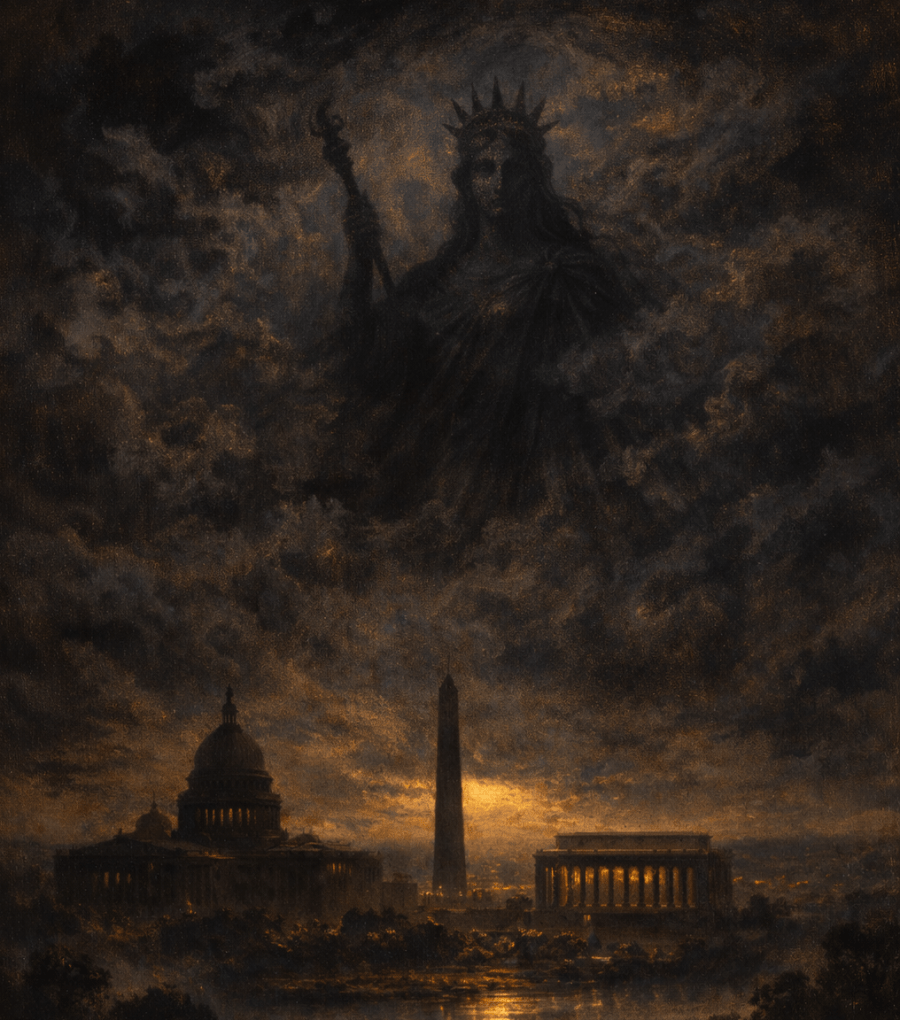
While these texts establish the reality of corrupt spiritual influences over the nations, we can also see this reality reflected in the symbols these cultures adopt for themselves. With this in mind, it’s worth noting how much of America’s national imagery draws straight from paganism. For instance, it is well known that the “D.C.” in “Washington D.C.” stands for the District of Columbia. But who is “Columbia”? Most people have never given it a second thought. Columbia was a mythical being created as a feminine personification of the spirit of America – often portrayed as a robed woman bearing a torch. The Statue of Liberty, in fact, was modeled after this image of Columbia.

Interestingly, the function of Columbia as the “spirit of America” closely resembles that of national deities in the ancient world. The Greeks personified their ideals in Athena, and the Romans embodied the power and destiny in the goddess Roma. In a similar way, Columbia was created to symbolize America’s ideals of enlightenment, liberty, and independence.

To be clear, this does not mean that Columbia is necessarily a literal goddess. We cannot identify her with any specific “principality or power” named in Scripture. Much like it would be impossible to prove that Athena and Roma accurately represent the actual spiritual rulers mentioned in Scripture, neither do we know any specific details about the actual spiritual entity that represents America. The image of Columbia can be easily explained as having arisen out of the Enlightenment-era admiration for Greek and Roman art and architecture. Scripture gives no detailed knowledge of the specific spiritual beings associated with modern nations, and it would be speculation to claim otherwise.

The existence of pagan symbols does not itself prove America’s corrupt spiritual allegiance; Scripture already does that. But the symbols arise from a culture’s imagination and reflect how a nation understands itself. In that sense, America’s pagan imagery mirrors what Scripture describes more broadly: every nation possesses a kind of spiritual “personality,” that is shaped by unseen powers that influence its values, priorities, and direction.  

So while we cannot know the specific identities or characteristics of the spiritual beings who stand behind the nations, we can know what the Bible plainly teaches – that the nations of the world are ruled by spiritual powers that exist in rebellion to God.  

The Rule of Satan

Here is what we know for certain from Scripture:

  • Satan is the god of this world (2 Corinthians 4:4).
  • He exercises his rule indirectly through spiritual and earthly principalities and powers (Ephesians 6:12).
  • These powers exercise regional dominion, ruling over specific nations (Daniel 10:13, 20).

Just as the Sidonians had Ashtoreth, Moab had Chemosh, and Ammon had Molech (1 Kings 11:5-7), so too each modern nation operates under some spiritual power that mirrors what we see happening on earth.

When we see national symbols that mirror pagan forms, we should therefore take notice. The District of Columbia, the Washington Monument shaped like an Egyptian obelisk (a symbol of the sun god Ra), the Capitol city adorned with statues of Mars, the Lincoln Memorial modeled after a Greek temple – these are not insignificant. Even if their creators saw them as mere works of art, they are still pagan in origin and should remind every Christian of the deeper reality Scripture describes: America, like every other earthly nation, is under the rule of Satan and his principalities and powers.

For this reason, it should not surprise us that America is marked by constant warfare, widespread violence and division, deceptive and destructive economic policies, and the slaughter of millions of innocent children through abortion. These are the natural fruits of a kingdom ruled by Satan – the one who “comes only to steal and kill and destroy” (John 10:10). He steals through inflation and taxation, kills through war and violence, and destroys through corruption of truth and life itself.

The Christian Response

First, Christians must recognize that “the whole world lies under the sway of the wicked one” (1 John 5:19). Satan works through both the earthly and spiritual rulers of the nations, deceiving them and spreading his lies. Revelation 13:14 and 20:3, 8 describe him as “the deceiver of the nations.

Therefore, earthly governments – no matter how moral or democratic they may appear – remain part of the same system that rejects Christ’s kingship.

If these things are true – and Scripture insists they are – then uncomfortable questions inevitably follow. Christians must not confuse patriotism with faithfulness to Christ, or loyalty to a nation with allegiance to the kingdom of God.

How can any Christian pledge allegiance to a kingdom ruled by powers in rebellion against Christ? Why would a follower of Jesus devote his life to the service of a government that refuses His kingship? And how would a disciple of the Prince of Peace take up arms in defense of a nation whose authority arises from rejection of God’s rule?

For the time being, Satan continues to deceive the nations. Yet his rule is neither absolute nor enduring. Because of the gospel, his defeat is certain. “Then comes the end,” Paul writes, “when He delivers the kingdom to God the Father after destroying every rule and every authority and power” (1 Corinthians 15:24).

Christ alone possesses “all authority in heaven and on earth” (Matthew 28:18). Therefore, the hope of every Christian must never be tethered to the doomed authorities of this world, but anchored in “the kingdom of our Lord and of His Christ” (Revelation 11:15).

Every nation bears the marks of spiritual rebellion, but only one kingdom stands eternal – the kingdom of Christ. America, like all the nations in history, will rise and fall. Its monuments will eventually crumble. But the throne of Christ will never be shaken.

Our task as Christians is not to try to reform the Satanic kingdoms of this world into slightly more Christian versions of themselves, but to bear witness to a greater kingdom – to “proclaim the excellencies of Him who called you out of darkness into His marvelous light” (1 Peter 2:9). Our allegiance belongs to Christ alone.

Do False Gods Still Rule the Nations?

For many Christians today, the phrase “false gods” immediately brings to mind imaginary deities – empty carvings of wood and stone. These are seen as the inventions of primitive cultures and products of human superstition and ignorance.

As the previous two articles in this series have demonstrated, these false gods are not mere human inventions, but real spiritual beings. Scripture continually presents them as powerful entities who exert genuine influence over regions, nations, and rulers.

While the Bible affirms again and again that there is only one true God, the LORD, the Creator and Sovereign over all, it does not deny the existence of other spiritual beings – some of whom have been falsely worshipped as gods. These beings are real, but they are created beings, and far beneath the LORD in power and glory. You can read those two articles here:

The Regional “gods” in the Old Testament

The story of King Solomon provides a clear example of where the Bible refers to these “gods.” Scripture tells us that Solomon loved many foreign women – Moabite, Ammonite, Edomite, Sidonian, and Hittite women. His decision to marry many of these foreign women was a direct violation of the LORD’s command:

You shall not enter into marriage with them, neither shall they with you, for surely they will turn away your heart after their gods.

1 Kings 11:2

And sure enough, Solomon’s heart was turned:

When Solomon was old his wives turned away his heart after other gods, and his heart was not wholly true to the LORD his God, as was the heart of David his father. For Solomon went after Ashtoreth the goddess of the Sidonians, and after Milcom the abomination of the Ammonites… Then Solomon built a high place for Chemosh the abomination of Moab, and for Molech the abomination of the Ammonites, on the mountain east of Jerusalem. And so he did for all his foreign wives, who made offerings and sacrificed to their gods.

1 Kings 11:5; 7-8

Observe a few important things here:

  • Each of these gods is specifically named – Ashtoreth, Milcom, Chemosh, Molech.
  • The text never mocks these gods as imaginary or fictional
  • Each of the gods mentioned is associated with specific nations and regions

The picture presented by this biblical text – a picture of different spiritual beings attributed to different people groups – is not simply a reference to an ancient pagan worldview. It reflects a reality described in the Bible itself.

In the book of Deuteronomy, Moses describes how the LORD divided the nations of the world.

When the Most High gave to the nations their inheritance,
when he divided mankind,
he fixed the borders of the peoples
according to the number of the sons of God.
But the LORD’s portion is his people,
Jacob his allotted heritage.

Deuteronomy 32:8-9

This passage tells us that the Most High assigned the nations under the authority of various sons of God. Throughout the Old Testament, the phrase “sons of God” consistently refers to spiritual beings or angels (Job 1:6; Psalm 29:1). Thus, the text teaches that God allotted authority over specific nations to specific spiritual beings, while reserving Israel as His own possession.

But just like the nations themselves rebelled against the LORD, so also did these “sons of God.” That’s why Psalm 82 describes the LORD standing in judgment over these corrupt divine rulers.

God has taken his place in the divine council;
in the midst of the gods (elohim) he holds judgment:
“How long will you judge unjustly
and show partiality to the wicked…
You are gods,
sons of the Most High, all of you;
nevertheless, like men you shall die
and fall like any prince.”
Arise, O God, judge the earth;
for you shall inherit all nations.”

Psalm 82:1-2; 6-8

Spiritual Rulers in the Book of Daniel

The book of Daniel offers one of the clearest pictures of these heavenly rulers. When Daniel prays for understanding, an angelic messenger is delayed in delivering God’s answer:

The prince of the kingdom of Persia withstood me twenty-one days, but Michael, one of the chief princes, came to help me.

Daniel 10:13

Here the “prince of Persia” is clearly not a human ruler. It is a powerful spiritual being whose actions influence and are mirrored by the Persian empire. The angel Michael is described as “one of the chief princes,” – a heavenly counterpart fighting on behalf of Israel.

If we were to read the book of Daniel in the Septuagint – a Greek translation of the Old Testament used at the time of Christ and the apostles – we would see that both Michael and the Prince of Persia are described by the Greek word “archon,” meaning “ruler” or “authority.” This is significant, because this is the very word Paul later uses to describe the spiritual rulers and authorities that govern the present age of darkness.

  • “It is not a wisdom of this age or of the archon of this age, who are doomed to pass away” – 1 Corinthians 2:6
  • “The archon of the power of the air, the spirit that is now at work in the sons of disobedience” – Ephesians 2:2
  • “For we do not wrestle against flesh and blood, but against the archon, against the authorities, against the cosmic powers over this present darkness.” – Ephesians 6:12

Paul was carrying forward the same worldview described in Deuteronomy 32 and Daniel 10. These regional spiritual “arche” are real, and their influence is reflected in the rise and fall of earthly nations.

The “God of This World”

Jesus Himself used similar language when describing the devil. Three times in John’s account of the gospel, He calls Satan “the ruler (archon) of this world.”

  • “Now the archon of this world will be cast out” – John 12:31
  • “The archon of the world is coming” – John 14:30
  • “The archon of this world is judged” – John 16:11

During His temptation in the wilderness, Satan showed Jesus all the kingdoms of the world and claimed:

To you I will give all this authority and their glory, for it has been delivered to me, and I give it to whom I will.

Luke 4:6

It is noteworthy that Jesus never disputes Satan’s claim, but rather Luke presents this offer as a legitimate temptation. The implication is that Satan truly holds authority in this present world – authority that has been claimed by him through the rebellion of mankind.

The “god” of all Nations

This same idea appears all throughout the New Testament. Paul calls Satan “the prince of the power of the air, the spirit that is now at work in the sons of disobedience.” (Ephesians 2:2).

He is also identified as “the god of this age” who blinds the minds of unbelievers:

In their case the god of this world has blinded the minds of the unbelievers, to keep them from seeing the light of the gospel of the glory of Christ.

2 Corinthians 4:4

John likewise declares:

The whole world lies in the power of the evil one.

1 John 5:19

It would take some impressive hermeneutical gymnastics to avoid the clear conclusion: according to Scripture, Satan is the chief spiritual ruler of this present world system. Beneath him operate a host of rebellious spirits, sometimes referred to as his angels (Matthew 25:41; Revelation 12:7-9), and other times referred to as principalities and powers (Ephesians 1:20-21; 3:10; 6:12; Colossians 2:15). These are real, personal, heavenly beings who exercise real regional and cultural influence. Although these beings are destined for destruction (1 Corinthians 15:24), Scripture teaches that they do rule in this present age of darkness (1 Corinthians 2:6; Ephesians 2:2; 6:12).

If that is true, then it is not only ancient nations like Egypt, Moab, Canaan, Babylon, and Rome that were under such dominion. It means that every earthly nation today lies within his sphere of influence.

It means that:

  • Satan is the god of Russia.
  • Satan is the god of Japan.
  • Satan is the god of Nigeria.
  • Satan is the god of North Korea.
  • Satan is the god of the United States.

This worldview is not flattering to any earthly nation, but it is biblical. It reminds us that no worldly power, no matter how noble it may appear, is neutral. Every kingdom of man ultimately belongs to this present fallen order.

The Christian Response

If the nations of this world lie under the dominion of false gods, then Christians must be careful not to confuse patriotism with faithfulness to Christ.

We are citizens of another Kingdom – one not ruled by the god of this age, but by the Sovereign Lord of all creation. Therefore, as Revelation 18:4 declares,

Come out of her, my people,
lest you take part in her sins,
lest you share in her plagues.

Behind every throne stands a spiritual power, but above them all stands the LORD Most High, and His anointed King, Jesus – who is the Lord of lords and King of kings. His Kingdom cannot be shaken. The gods of the nations are real, but they are fallen and doomed for destruction. The LORD alone is God, and His Kingdom alone will stand forever.

Are the Other “gods” of the Bible Real?

Many Christians grow up hearing that the other “gods” in the Bible are nothing more than carved idols or imaginary inventions. After all, the Bible insists in no uncertain terms that there is only one true God (Deuteronomy 6:4; Isaiah 45:5; 1 Corinthians 8:4).

And yet, the inspired text often speaks of these other “gods” in ways that sound far more real than imaginary. For example, in the book of Psalms, the LORD is praised as being superior above all other “gods.” Psalm 95:3 declares: “The LORD is a great God, and a great King above all gods,” and Psalm 97:9 states, “You are exalted far above all gods.Psalm 29:1 even claims that the one God deserves worship from the other “elohim.” Even in the New Testament, in Paul’s first letter to the Corinthians, when Paul addresses the question of eating food offered to idols, he admitted that “indeed there are many ‘gods’ and many ‘lords’” (1 Corinthians 8:5) before clarifying that for Christians there is only one God (1 Corinthians 8:6).

So what do we make of this? Is God just accommodating ancient superstitions? Is He really praised for being greater than things that do not exist? How would such a claim bring honor to the LORD? If these “gods” were purely imaginary, then such praise would be trivial – like saying the Almighty is stronger than a fictional comic-book hero. To say that God is greater than an imaginary being would be an empty comparison, like claiming that the sun shines brighter than a shadow. The glory of God is not seen in contrast to what is unreal, but in His supremacy over all that truly exists.

Or could it be that Scripture is revealing something true about the spiritual world? Are these “other gods” genuine spiritual beings? Or are they simply the products of ancient imaginations? To answer this, we first need to examine the Bible’s own vocabulary for identifying these other gods.

The Hebrew Word Elohim

The English word “God” is a decent translation of the Hebrew word elohim, but it is not a perfect one. In English, the word “God” usually carries one of two meanings.

  1. (capitalized) The one true supreme being, the Creator of the universe
  2. (uncapitalized) A pretend deity, the gods from ancient mythology

But the Hebrew word elohim has a broader range of meaning.

1. Elohim as the Creator

Similar to the English word God, the Hebrew word is sometimes used to refer to the one true Creator of the universe. The very first verse of Scripture says “In the beginning, elohim created the heavens and the earth” (Genesis 1:1). Over and over again, Israel’s God is identified as elohim (Exodus 3:6; Deuteronomy 4:35; Psalm 100:3). When used in this way, the text always sets Him apart as unique, sovereign, and incomparable (Deuteronomy 10:17; Psalm 86:10).

2. Elohim as the gods of the nations

Also similar to the English word God, the Hebrew word is sometimes used to refer to the false gods of the nations. The Ten Commandments forbids Israel from having any “other elohim” before the LORD (Exodus 20:3). Deuteronomy observed that the surrounding nations “served their elohim” (Deuteronomy 29:26). It can be observed that the word elohim functions as both singular and plural, so determining whether it refers to “God” or false “gods” requires examination of the context.

3. Elohim as other spiritual beings

This is where it gets interesting. Elohim can also refer to other spiritual beings we normally wouldn’t call “gods” in English.

Psalm 8:5 says that mankind was created “a little lower than the elohim.” Translations of this verse vary. ESV translates elohim here as “heavenly beings.” KJV and NIV translate it as “angels.” The Greek Septuagint, used by Jesus and the apostles, chose “angels,” a rendering confirmed by inspiration in Hebrews 2:6-8. Regardless of how we translate it, it is clear that mankind was created a little lower than real spiritual beings.

Psalm 82 describes God as presiding in a divine council:

God has taken his place in the divine council;
in the midst of the gods he holds judgment.

Psalm 82:1

Again, God is described as holding judgment in a council of real spiritual beings.

In 1 Samuel 28:13, when Saul consults the witch of En-dor, she reports: “I see a god coming up out of the earth.” Again, she did indeed see a real spiritual being coming up out of the earth – the deceased human Samuel.

In short, elohim is not a title restricted to the Supreme Creator. It is a more general word for inhabitants of the spiritual realm, many of which are indeed very real. There is certainly a sense in which the LORD is the one true Elohim, but the Bible also recognizes the existence of other real spiritual beings, which Scripture refers to as elohim.

So when we ask, “Are the other gods in the Bible real?” the answer depends on what we mean by “gods.” If by “gods” we mean spiritual beings in a general sense, then yes – the Bible teaches that other “gods” are real.

There is Only One LORD

But while the Bible acknowledges the reality of other spiritual beings, it never endorses what people today refer to as polytheism. The God of Israel is utterly unique, set apart from all others.

Who is like you, O LORD, among the gods? Who is like you, majestic in holiness, awesome in glorious deeds, doing wonders?

Exodus 15:11

For what god is there in heaven or on earth who can do such works and mighty acts as yours?

Deuteronomy 3:24

There is none like you among the gods, O Lord.

Psalm 86:8

For the LORD is a great God, and a great King above all gods.

Psalm 95:3

For you, O LORD, are most high over all the earth; you are exalted above all gods.

Psalm 97:9

No, these passages are not comparing God to imaginary beings like Captain America or Spider-man. These passages proclaim that the LORD is supreme above all real spiritual beings.

The LORD is unique in His power (Jeremiah 32:17, 27; Psalm 115:3) and is the Creator of all others (Nehemiah 9:6, Psalm 148:1-5). As Nehemiah 9:6 plainly states, “You are the LORD, you alone.

Just because the Bible says that there are other elohim, it quite plainly denies polytheism. It continually exalts the one incomparable God above all other spiritual beings.

Why Call Them “False Gods”?

If other elohim exist, why does Scripture so often label them as “false gods” (2 Chronicles 13:9; Isaiah 44:9-20)?

Because their claims to deity are false.

  • They are not equal to the LORD
  • They did not create heaven and earth
  • Their power is incomparable to the LORD’s
  • They cannot save, redeem, or give life

Compared to the LORD, they are “nothing” (Isaiah 41:24). Not because they don’t exist, but because their claims are empty.

Think of it this way: If I were to point out a con artist, and ask you “Is that con artist real?” how would you respond? Of course the con artist is real, in the sense the con artist is an actual person. But is the character the con artist pretends to be real? And are the stories the con artist tells real? Of course not! In the same way, these “other gods” in the Bible are real spiritual beings, but their claims to supremacy and their calls for worship and allegiance are lies.

Deuteronomy 32:17 clarifies that when Israel sacrificed to other “gods,” they were really sacrificing to demons.

They sacrificed to demons that were no gods,
to gods they had never known,
to new gods that had come recently,
whom your fathers had never dreaded.

Paul makes the same point in 1 Corinthians 10:19-20: pagan sacrifices are not meaningless gestures to imaginary idols – they are participation with demons.

What do I imply then? That food offered to idols is anything, or that an idol is anything? No, I imply that what pagans sacrifice they offer to demons and not to gods. I do not want you to be participants with demons.

Likewise, Galatians 4:8 says that Gentiles were enslaved to “those that by nature are not gods.” They were real beings – beings who were capable of enslaving – but not true gods.

So, Are the Other Gods Real?

Yes and no.

Yes, if by “real” we mean actual spiritual beings who exist behind the veil of the unseen spiritual realm.

No, if by “real” we mean equal rivals to the Creator.

The Bible affirms the reality of a spiritual world filled with many spiritual beings, beings which at times are referred to as elohim. But the Bible never compromises the uniqueness of the LORD God.

We do not live in a world with one God who actually exists and countless imaginary ones. We live in a world where the one true God reigns supreme over a host of other real, but lesser, spiritual beings.

And in such a world, the call remains the same:

Hear, O Israel, the LORD our God, the LORD is one.

Deuteronomy 6:4

Do Not Neglect the Heart

Paul’s prayer for the Thessalonians was:

…that he may establish your hearts blameless in holiness before our God and Father at the coming of our Lord Jesus with all his saints.

1 Thessalonians 3:13

Notice carefully: Paul did not simply pray that they might be established blameless, but that their hearts might be established blameless. The distinction matters.

The heart is where holiness begins – or where sin festers. As Jesus taught:

Out of the heart come evil thoughts, murder, adultery, sexual immorality, theft, false witness, slander.

Matthew 15:19

Outward morality without an inward holy heart is hollow. Jesus rebuked the Pharisees for this very problem:

Woe to you, scribes and Pharisees, hypocrites! For you clean the outside of the cup and the plate, but inside they are full of greed and self-indulgence… You are like whitewashed tombs, which outwardly appear beautiful, but within and full of dead people’s bones and all uncleanness.” – Matthew 23:25-28

It is possible to appear righteous while the heart is rotten. True holiness must go deeper.

How Are Hearts Established in Holiness?

Paul gives the answer just one verse earlier:

May the Lord make you increase and abound in love for one another and for all, as we do for you, so that he may establish your hearts blameless in holiness before our God and Father.

1 Thessalonians 3:12-13

The hope of a blameless heart at Christ’s coming (v. 13) is directly tied to growth in love (v. 12). Love is not optional – it is the very means by which the heart is made holy.

For Paul, love was the defining mark of Christianity. Love toward one another and toward all is how our hearts are strengthened in holiness. Growth in love is growth in holiness. Without love, we cannot expect to stand before God with a blameless heart at Christ’s return.

Christian love is thus inseparable from hope. When love increases, hope and certainty for the future increases. Without love, the certainty of our hope dries up.

What Kind of Love?

Here we must be clear: when Paul speaks of “love” he does not mean mere affection. In our day the word “love” is used flippantly to justify almost anything. “If two people love each other, how could it be wrong?” That reasoning is then used to defend fornication, adultery, and homosexuality. Yet in Paul’s prayer, love is inseparably tied to holiness.

True love does not lead into sin; it leads out of it. To drag someone deeper into sexual immorality is not to love them but to despise them. Real love seeks another’s eternal good, not their temporary pleasure. Affection that destroys the soul is not love at all, but a worthless counterfeit.

And this principle extends beyond sexual sin. If our desire to be friendly excuses sinful social activities, that is not true friendship. If our desire to be kind silences our call to righteousness, our “kindness” becomes cruelty. Love that is severed from holiness is not the kind of love Paul prayed for.

Paul’s Example of Holy Love

When Paul exhorts the Thessalonians to “increase and abound in love for one another and for all,” he adds, “as we do for you.” The kind of love Paul expected was the love he had modeled:

  • Renouncing his right to make authoritative demands (1 Thess. 2:6)
  • Laboring night and day for their sake (2:9)
  • Sharing not only the gospel but his very life (2:8)
  • Caring for them tenderly like a nursing mother cares for her children (2:7)

This is not the hollow “love” the world celebrates. It is a cross-shaped, self-denying love – love that gives itself wholly for another’s eternal good. That is the kind of love that establishes a heart in holiness.

Examining the Heart

So take some time and inspect your heart. It is good to examine your external duties – your doctrine, morality, speech, church attendance, and conduct at home. But don’t neglect the heart.

  • Does your external life genuinely flow from a blameless heart, or is it an act?
  • Are there hidden heart problems that need addressing?
  • Can it truly be said that you love God, love the church, and love all those you interact with?
  • If you’re really seeking the eternal good of others, do your actions reflect it?

If you recognize the need for your hearts to be further established in holiness, how is it strengthened? By increasing in love – the kind of love Christ displayed on the cross. A love that bears burdens, sacrifices self, and seeks not temporary happiness but eternal joy for others.

At Christ’s coming, it will not be the appearance of righteousness that matters, but whether our hearts have been established blameless in holiness.

Keep your heart with all vigilance, for from it flow the springs of life.

Proverbs 4:23

Render to Caesar? A Misunderstood Teaching of Jesus

When Jesus said, “Render to Caesar the things that are Caesar’s, and to God the things that are God’s” (Mt. 22.15-22; Mk. 12.13-17; Lk. 20.20-26), He was not endorsing Caesar’s authority or teaching that Christians owe loyalty both to God and government. Instead, He exposed the hypocrisy of His opponents and reminded His hearers that their full allegiance belongs to God alone.

The Trap Question

The Pharisees and Herodians conspired to trap Jesus with a question about taxes:

Then the Pharisees went and plotted how to entangle him in his words… “Teacher, we know that you are true and teach the way of God truthfully… Tell us, then, what you think. Is it lawful to pay taxes to Caesar, or not?

Matthew 22:15-17

The trap was set: if Jesus said paying the tax was lawful, He would appear to support Rome and discredit his Messianic claims. If He opposed the tax, Rome could arrest Him for sedition. Either answer was dangerous.

But Jesus, aware of their malice, asked for a coin. Holding it up, He inquired,

 “Whose likeness and inscription is this?” They said, “Caesar’s.” Then He said to them, “Therefore render to Caesar what is Caesar’s and to God the things that are God’s.”

Matthew 22:20-21

With a single sentence, He escaped the trap and turned the question back on them.

The Coin and Counter-Message

The denarius bore the image of Tiberius Caesar along with a blasphemous inscription: “Tiberius Caesar, son of the divine Augustus, High Priest.” The irony of this scene is thick: The true Son of God, the High Priest, held in His hand a coin claiming those very titles for a mortal emperor.

By highlighting the coin’s “likeness” and “inscription”, Jesus recalled their attention to the the first two commandments: “You shall have no other gods before me” (Ex. 20:3) and “You shall not make for yourself a carved image” (Ex. 20:4). His response was not about the legitimacy of taxation but about allegiance. Jesus’s answer served as a clear reminder that worship and allegiance belongs to God alone. Jesus’s brilliant response both demonstrated the hypocrisy of his questioners as they pulled the idolatrous image out of their pocket, and proclaimed to all who heard that the LORD alone is God, and by implication, Caesar is not.

What Really Belongs to Caesar?

In this context, how should we understand Jesus’s words, “Render to Caesar what is Caesar’s”? There are three options.

  1. An endorsement of taxes – Yes, pay Caesar, for taxes belong to him.
  2. A call to revolt – Echoing of the Maccabean slogan which was popular among the advocates of tax rebellion, “Pay back the Gentiles what they deserve and obey the law” (1 Macc. 2:68), meaning the pagan overlords deserve nothing but violent revolt.
  3. A deliberate ambiguity – Neither legitimizing Caesar’s authority, nor forbidding the payment of taxes, but rather forcing his hearers to wrestle with the deeper question: What truly belongs to Caesar, and what belongs to God?

Only the third option fits the context. If Jesus had either openly endorsed taxes or advocated for tax rebellion, He would have fallen into the trap that was set for him. Therefore the only option that fits in this context is the third option. Jesus was challenging his hearers to give their undivided allegiance to God.

What Belongs to God?

The second part of Jesus’ answer is anything but ambiguous. Scripture is clear: everything belongs to God.

The earth is the LORD’s and the fullness thereof
The world and those who dwell therein

Psalm 24:1

For every beast of the forest is Mine,
The cattle on a thousand hills.

Psalm 50:10

God claimed that even the silver and the gold rightfully belonged to Him.

The silver is Mine and the gold is Mine,’ declares the LORD of hosts.

Haggai 2:8

If the LORD alone is God, as the two commandants referred to by Jesus clearly teach, then Caesar’s claims as inscribed on the Denarius are ultimately illegitimate. Jesus’s point was not about dividing life into two realms – political and religious – but about giving undivided allegiance to God alone.

The Crowd’s Reaction

When they heard it, they marveled. And they left him and went away.

Matthew 22:22

Matthew makes it clear that the crowd was not impressed with a simple endorsement of taxes. They recognized that Jesus had avoided the trap and upheld His claim to divine authority. Indeed, two days later, He was accused of “forbidding to pay taxes to Casesar” (Luke. 23:2), showing that His words were not understood as a pro-tax endorsement.

Yet neither was He arrested for inciting tax rebellion, proving his answer was understood as something far deeper. The apostles later encouraged believers to submit to governing authorities and pay taxes (Romans 13:1-7; 1 Peter 2:13-15). Christians do so not because rulers have a rightful claim of ownership over other people’s possessions, but because the True King – Jesus Christ – reigns over all, and God commands His people to live peaceably and honorably under earthly governments.

As Peter reminds us, we are “sojourners and exiles” (1 Peter 2:11). Our mission is not to overthrow rulers but to advance God’s Kingdom by following Christ’s example of humility and submission – even under unjust authorities.

Conclusion

Jesus’s teaching does not sanction divided allegiance – some to God, and some to Caesar. Rather, it forces us to recognize that everything belongs to God. To render to God all that is His leaves nothing for Caesar. That is of course, unless we choose to place our faith in the idolatrous image and inscription engraved on the coin.

The Holy Land, Part 5: The Holy Land is Greater Than You May Think

In case you missed them, here’s the links to parts 1-4:
The Holy Land, Part 1: What Does it Really Mean to be Holy?
The Holy Land, Part 2: Who or What is Israel?
The Holy Land, Part 3: The Spiritual Significance of the Land
The Holy Land, Part 4: Did Israel Get Replaced?

One of the challenges in discussing the land promise is that the New Testament doesn’t address it as directly or explicitly as the Old Testament does. There’s no single, comprehensive statement that spells out exactly what became – or what will become – of God’s promise to give Abraham’s descendants a land. Because of this, some assume that the land promise no longer matters for Christians today – that it was once important for Old Testament Israel, but that it was quietly set aside once Israel was expanded to include all the faithful from every nation through Christ.

But that assumption may say more about our expectations than it does about the text of the New Testament itself.

The New Testament doesn’t ignore the concept of holy land. It does, however, reframe it.

It is important to remember that what made the land “holy” was not its geography or borders – it was the presence of God. In the Old Testament, Canaan was indeed set apart as God’s land because it was the place of His dominion and presence. It was holy, not because it belonged to Israel, but because it belonged to God.

So if we want to understand what happens to it in the New Testament, we should begin by asking: Where is God’s presence now? Where does He dwell? Where is His dominion exercised?  

While the New Testament doesn’t rehash the land promise in the same terms as the Old, it is far from silent about God’s kingdom, His dwelling place, or the scope of His reign. And when we follow those threads, a powerful truth emerges – one that shows us why the idea of “holy land” still matters today, but not in the same way many modern-day evangelicals assume. It matters, but in a transformed and expanded way.

Jesus Redefines Sacred Space

In John 4:19-20, a Samaritan woman asked Jesus a direct question about the geographical location where God should be worshiped.

 Sir, I perceive that you are a prophet. Our fathers worshiped on this mountain, but you say that in Jerusalem is the place where people ought to worship.

She was referring to Mount Gerizim, the center of Samaritan worship, while acknowledging the Jewish claim that worship should take place in God’s holy land, in Jerusalem. But Jesus’s response reframes the entire conversation:

Woman, believe me, that hour is coming when neither on this mountain nor in Jerusalem will you worship the Father. You worship what you do not know; we worship what we know, for salvation is from the Jews. But the hour is coming, and is now here, when the true worshipers will worship the Father in spirit and truth, for the Father is seeking such people to worship him. God is spirit, and those who worship him must worship in spirit and truth.

John 4:21-24

Jesus was not dodging the question – He was reframing the concept of God’s sacred place of worship. No longer would worship be restricted to one sacred geographic location. Neither Mount Gerizim nor Jerusalem would remain central. Instead, worship would become geographically universal, unbound by borders, anchored not in one place, but in every place He is rightly worshiped – in spirit and in truth.

What Jesus promised in John 4 wasn’t a change in God’s plan – it was the fulfillment of it. From the beginning, God’s promise to Abraham was never meant to be confined to a single strip of land. Instead, it pointed toward a blessing that would extend to all nations through Abraham’s offspring (Genesis 22:18).

Even early in Genesis, God spoke in expansive, global terms. He told Abraham that his descendants would be as numerous as the “dust of the earth” (Genesis 13:16) – an image not of a local settlement but of worldwide reach, a people far greater than the physical boundaries of Canaan could contain.

That’s why Paul, reflecting on this promise, could say its ultimate fulfillment was not limited to Canaan, but encompassed the entire world.

For the promise to Abraham and his offspring that he would be heir of the world did not come through the law but through the righteousness of faith.

Romans 4:13

For Paul, the land of Canaan served as a symbol, a preview of a much greater inheritance. The true fulfillment of God’s promise was not in one land, but in the whole world, reserved as an inheritance for the faithful.

God’s Presence in His People

Through Christ, the blessing and inheritance once promised to Abraham has now been extended to all who are in Him. And with that expansion comes a radical redefinition of where God dwells. No longer is His presence confined to a physical temple in a single geographic location. The New Testament reveals something far greater: God’s temple is now His people.

Paul writes:

Or do you not know that your body is a temple of the Holy Spirit within you, whom you have from God?

1 Corinthians 6:19

Elsewhere he declares:

For we are the temple of the living God; as God said,
I will make my dwelling among them and walk among them,
and I will be their God,
and they shall be my people.

2 Corinthians 6:16 (quoting from Leviticus 26:12)

And in the vision of the new creation, John hears these words:

Behold, the dwelling place of God is with man. He will dwell with them, and they will be his people, and God himself will be with them as their God.

Revelation 21:3

Just as God once made His home in the land of Canaan, Paul now explains that “the Spirit of God dwells in you” (Romans 8:9). This means that God’s holy presence is no longer limited by borders or buildings – it is present wherever His people are. Wherever Christians are gathered together, submitting to God’s will, there is God’s dominion. That is holy ground.

The New Creation

What makes a land “holy” has never been geography alone – it is the presence of God that makes any place sacred. In the Old Testament, that presence dwelled in the land of Canaan, but through Christ, God’s presence is now among His people – people drawn from every nation. That shift radically reshapes how we think about the idea of a “holy land.”

If God’s presence is no longer confined to one location but dwells with all who are in Christ, then the holiness once associated with a specific strip of land has now been extended as far as His people reach. In other words, God’s holy land has gone global! This being the case, it would be out of step with the teachings of the New Testament to single out Palestine as uniquely “holy” under the reign of Christ. To do so would suggest that God’s dwelling place is still geographically limited – that He does not dwell wherever His people live and worship in spirit and truth.

The problem with calling modern-day Israel “The Holy Land” isn’t that it assigns too much importance to their land – but that it imagines far too little about God’s Kingdom. God’s reign is no longer confined. It is greater – infinitely greater – and that expansion is the very fulfillment of what the prophets anticipated:

For the earth will be filled with the knowledge of the glory of the LORD as the waters cover the sea.

Habakkuk 2:14 (cf. Numbers 14:21; Psalm 72:19; Isaiah 6:3)

Jesus confirmed this global scope during the Sermon on the Mount. Quoting from Psalm 37:11, He announced the inheritance that awaited the meek:

Blessed are the meek, for they shall inherit the earth.

Matthew 5:5

He was not speaking of the present, broken world – a world enslaved by sin, violence, and decay. Rather He was pointing to something far greater. The author of Hebrews captures this cosmic transformation:

But you have come to Mount Zion and to the city of the living God, the heavenly Jerusalem… Yet once more I will shake not only the earth but also the heavens.
This phrase, “Yet once more” indicates the removal of things that are shaken – that is the things that have been made – in order that the things which cannot be shaken may remain.
Therefore let us be grateful for receiving a kingdom that cannot be shaken.

Hebrews 12:22, 26-28

Peter echoes the same theme. He reminds us that the current heavens and earth are being preserved for judgment in fire (2 Peter 3:7). This judgment, however, is what ushers in what has always been promised:

But according to his promise we are waiting for new heavens and a new earth in which righteousness dwells.

2 Peter 3:13

The land promise has not been discarded – it has been fulfilled, deepened, and universalized. What began as a parcel of land for Abraham’s descendants now culminates in a new world for the people of Christ. As Paul puts it, this is nothing less than a new creation (Galatians 6:15), the true and final “holy land” where righteousness dwells and where God makes His home with His people.

Understanding the fulfillment of the land promise reminds us that the church is not defined by borders or geography, but by the presence of God among His people. Wherever God dwells with His people, that is holy ground. As we go into all the world – making disciples of all nations, baptizing them, and teaching obedience to Christ – we are conquering enemy territory and extending God’s holy land. This truth fuels our mission, deepens our unity across every nation, and lifts our eyes beyond the passing kingdoms of this world to the one kingdom that will not be shaken.

The Holy Land, Part 4: Did Israel Get Replaced?

Read the previous parts of this series here:
The Holy Land, Part 1: What Does it Really Mean to be Holy?
The Holy Land, Part 2: Who or What is Israel?
The Holy Land, Part 3: The Spiritual Significance of the Land

The Return to the Promised Land

The Old Testament is filled with stories of Israel’s repeated unfaithfulness. Time and time again, the people of Israel abandoned his ways in favor of idolatry and the adoption of the corrupt practices of the surrounding nations. Eventually, their continual rebellion led to judgment: exile from the very land God had promised to them.

First, the ten northern tribes of Israel were conquered by the Assyrian Empire and were scattered. Later, the southern kingdom – Judah and Benjamin – fell to Babylon, and its people were also taken into captivity.

But exile was not the end of the story – neither for Israel nor for the promised land. During the Babylonian captivity, God sent prophets to speak messages of hope. On multiple occasions, they foretold a return to the land. But the return to the land would be different. God had plans to do something new.

For example, consider the prophecy found in Ezekiel 47:22-23. God commanded that when the people returned to the land, the sojourners living among them would receive an inheritance in the land alongside the Israelites. Sojourners were non-Israelites, or foreigners, living in the land of Israel.

You shall allot [the land] as an inheritance for yourselves and for the sojourners who reside among you and have children among you. They shall be to you as native-born children of Israel. With you they shall be allotted an inheritance among the tribes of Israel. In whatever tribe the sojourner resides, there you shall assign him his inheritance, declares the LORD GOD.

Think for a moment about how significant this is. God Himself declared that when the exile was over, foreigners would receive an inheritance alongside the Israelites. Once again we see that genetics and genealogy have nothing to do with God’s definition of Israel. The prophet Ezekiel anticipated that God was preparing the way for something far greater than a merely ethnic nation. He was showing that being Israel was never primarily about bloodline – it was about being part of God’s chosen family, however God ultimately decided to define that family.

The Vine Metaphor

Throughout the Old Testament, Israel is described as a vine planted in God’s land. The imagery is used repeatedly, and provides us with a vivid and powerful way to picture God’s purposes for His people.

For example, the psalmist in exile cried out, remembering how God had brought a vine out of Egypt and planted it in the land.

You brought a vine out of Egypt;
You drove out the nations and planted it.
You cleared the ground for it;
It took deep root and filled the land.

Psalm 80:8-9

Similarly, Hosea mourned, describing Israel as a vine offering its own fruit on altars to other gods.

Israel is a luxuriant vine
that yields its fruit.
The more his fruit increased,
the more altars he built;
as his country improved,
he improved his pillars.

Hosea 10:1

Isaiah used the metaphor to condemn Israel’s injustice, idolatry, and violence.

For the vineyard of the LORD of hosts
is the house of Israel,
and the men of Judah
are his pleasant planting
and he looked for justice,
but behold, bloodshed;
for righteousness,
but behold, an outcry!

Isaiah 5:7

Together with numerous other similar passages (Isaiah 27:2-6; Ezekiel 15:1-8; 17:1-10; 19:10-14; Jeremiah 2:21; 5:10; 12:11) these images all paint a vivid picture. The land is the vineyard, and the people of Israel are the vines. God planted Israel in His land, but the vine went wild. The vineyard was filled with bad fruit.

Jesus, building on this deeply rooted Old Testament imagery, used the vineyard metaphor to explain His own mission and identity.

I am the true vine, and my Father is the vinedresser. Every branch in me that does not bear fruit he takes away, and every branch that does not bear fruit he prunes, that it may bear more fruit. Already you are clean because of the word that I have spoken to you. Abide in me, and I in you. As the branch cannot bear fruit by itself, unless it abides in the vine, neither can you, unless you abide in me. I am the vine; you are the branches. Whoever abides in me and I in him, he it is that bears much fruit, for apart from me you can do nothing. If anyone does not abide in me he is thrown away like a branch and withers; and the branches are gathered, thrown into the fire, and burned.

John 15:1-6

With this statement, Jesus reveals the true significance of the vineyard metaphor. He wasn’t redefining it – He was fulfilling it. God’s vineyard, that is, God’s “Holy Land” now has only one true vine: Jesus, the true and faithful Israel. And all who wish to be a part of God’s vineyard must now be branches in Him. Anyone not connected to Him is like a dead branch, destined for the fire. Jesus is now the only way to be connected to God’s people.

Paul and the Definition of Israel

Paul builds on this idea in Romans 11:19-21 explaining that:

  • Some natural branches (unbelieving Jews) were broken off
  • Wild branches (believing Gentiles) were grafted in.
  • The root (God’s covenant and promises) remains

According to Paul, the key question that identifies whether one is in God’s vine is not ancestry, but faith. In Galatians 3, Paul takes us even deeper. Abraham, the father of Israel, was considered righteous because of his faith. That means that the true children of Abraham are those who have faith in Christ. Paul writes:

Know then that it is those of faith who are the sons of Abraham. And the Scriptures, foreseeing that God would justify the Gentiles by faith, preached the gospel beforehand to Abraham, saying “In you shall all the nations be blessed.

Galatians 3:7-8

And then he goes further:

Christ redeemed us…so that in Christ Jesus the blessing of Abraham might come to the Gentiles, so that we might receive the promised Spirit through faith.

Galatians 3:13-14

The promise to Abraham was never meant to end with ethnic Israel. It was always meant to extend to all nations through Abraham’s true offspring – Jesus Christ (Galatians 3:16). As Paul affirms, “All the promises of God find their Yes in him” (2 Corinthians 1:20). In Christ, the good news declared to the fathers is fulfilled (Acts 13:32-33).

In Ephesians 2, Paul explains that in Christ, Jews and Gentiles are brought together to share a common citizenship in God’s kingdom (Ephesians 2:11-13, 19). Through the cross, Jesus has “created one new man in place of the two,” having destroyed the dividing wall of hostility between them (Ephesians 2:14-15).

Does This Mean God “Replaced” Israel with the Church?

Some modern evangelicals recoil at this idea, dismissing it as “Replacement Theology,” the notion that the church has replaced Israel as God’s true people. But a careful reading of Scripture shows that Israel was never replaced – it was fulfilled.

God didn’t scrap one plan for another. Rather, His plan has always been for a people defined by faith, not flesh. Israel hasn’t been replaced; Israel has been expanded. Jesus, the Jewish Messiah, has fulfilled the promises made to Abraham and has thrown open the gates of Israel to include all nations. In Him, the people of God are not defined by ethnicity or geography, but by faith in Christ. Far from replacing Israel, the church is the ultimate fulfillment of all that Israel was always meant to become.

Shortly after His death, resurrection, and ascension, Peter writes to Christians using language that was first spoken to Israel:

But you are a chosen race, a royal priesthood, a holy nation, a people for his own possession, that you may proclaim the excellencies of him who called you out of darkness into his marvelous light.

1 Peter 2:9

Why can Peter say this? Because Christ makes all the difference. Jesus is the true Israel. And all who are in Him – Jew or Gentile – are part of God’s true Israel.

Paul echoes this in Galatians 6:16, referring to the church as “the Israel of God.” How much clearer could he be?

All the promises – including the promise of land – are granted to those who belong to Christ.

What Became of the Holy Land?

The land that was promised to Israel was once at the heart of God’s activity – a land that belonged to God, a land Israel was given, exiled from, and promised restoration to. For generations, it played a central role in God’s redemptive plan for the world. But even as Israel dwelled in the land, the prophets spoke of something greater. Not only would Israel expand to include foreigners, but the day was coming when God’s glory would fill all the earth as the waters cover the sea (Habakkuk 2:14). And then came Christ – not to abolish God’s promises, but to fulfill them.

So we’re left asking: what became of sacred space? What happened to the land God once called His own? Did the Holy Land lose it’s holiness? Or did something far more radical take place?

That’s the question we turn to in the final part of this series.

The Holy Land, Part 3: The Spiritual Significance of the Land

Now that we’ve established a clearer biblical understanding of holiness – that to be holy means being set apart by God’s presence and for God’s purposes – and clarified that Israel is not merely an ethnic group but a covenant people set apart by faith, let’s now turn our attention to the land God promised to Israel. What made that particular plot of land – the land of Canaan – holy in the first place?

A Land Promised by God

The idea of a “promised land” is rooted in God’s covenant with Abraham. In Genesis 12:7, God says, “To your offspring I will give this land,” referring to the land then occupied by the Canaanites.

Later, in Genesis 13:15-16, God broadens the scope of this promise:

For all the land that you see I will give to you and your offspring forever. I will make your offspring as the dust of the earth, so that if one can count the dust of the earth, your offspring also can be counted.

Already, there’s a hint that Abraham’s descendants would extend beyond his physical lineage – anticipating the broader definition of Israel as a people who share Abraham’s faith (cf. Romans 4:16-17). While God’s promise to Abraham centered geographically on the land of Canaan (Genesis 12:1-7; 15:18-21), the full scope of the promise would ultimately extend to a people as numerous as the dust of the earth itself.

God’s Land, God’s Sanctuary

As the Israelites prepared to enter the land, God spoke through Moses in Exodus 15:17:

You will bring them in and plant them on your own mountain,
the place, O LORD, which you have made for your abode,
the sanctuary, O Lord, which your hands have established.

Here, the land God was giving to Israel is described as God’s own dwelling place – His sanctuary. Leviticus 25:23 reinforces this point clearly:

The land shall not be sold in perpetuity, for the land is mine. For you are strangers and sojourners with me.

This is key: what made the land holy was not that it belonged to Israel, but that it belonged to God. Israel’s role was that of a guest. They were sojourners, even in the promised land. The land was holy – not because of who lived there, but because of the One who claimed it for His purposes.

Spiritual Geography

This concept of a geographical plot of land belonging to God himself can be traced back to Moses’s song in Deuteronomy 32, which we looked at briefly in the previous part of this study.

When the Most High gave to the nations their inheritance,
when he divided mankind,
he fixed the borders of the peoples
according to the number of the sons of God.
But the LORD’s portion is his people,
Jacob his allotted heritage.

Deuteronomy 32:8-9

Here we see that God assigned each nation its own allotted land, and with it, its own spiritual association. That is, the land was allotted according to the number of the “sons of God,” a phrase used in the Old Testament to refer to lesser spiritual beings (Job 1:6; 38:7; cf. Psalm 29:1; 89:6).

This divine allotment is the Bible’s explanation for why the surrounding nations came to serve other “gods” – it was part of God’s sovereign division of the land. From that vantage point, each geographical location had its own spiritual identity. Land is either holy, meaning the territory has been claimed by the one true God, where His presence dwelt and His covenant people loved, or the land was unholy, meaning the region was under the dominion of other spiritual powers.

This isn’t a denial of God’s omnipresence, but it underscores that geography itself has spiritual significance. The promised land was set apart by God’s claim on it. To live in the promised land was to dwell in the domain of the LORD; to leave it was to cross into the dominion of another spiritual power. (For a deeper dive, read “The Principalities and Powers” here.)

The Significance of Spiritual Geography

Clearly, David understood this. Have you ever noticed his lament when he fled from Saul into a foreign territory?

They have driven me out this day that I should have no share in the heritage of the LORD, saying, “Go serve other gods.”

1 Samuel 26:19

David wasn’t switching religions. He knew God was present everywhere (cf. Psalm 139:7-12). But he also knew that leaving God’s land meant stepping into regions associated with the domain of other “gods.” David understood that there was something special about the promised land. It was the place where the LORD had chosen to dwell. Meanwhile the land where he was driven was under the influence of other rebellious spiritual powers.

A similar awareness appears in the story of Naaman, the Syrian military commander healed of leprosy. After his healing, he offered a gift to Elisha. When Elisha refused payment, Naaman made what may at first sound like a very strange request:

Then Naaman said, “If not, please let there be given to your servant two mule loads of earth, for from now on your servant will not offer burnt offering or sacrifice to any god but the LORD.”

2 Kings 5:17

Two loads of earth? Dirt? Why would Naaman want to carry loads of dirt?

It wasn’t because Israel’s physical dirt was somehow superior to dirt in the surrounding region. It was because Naaman recognized the holiness of the land. He wanted to take a part of that sacred ground back with him, because he recognized that the land of Israel had spiritual significance. It was the land that belonged to the true God as opposed to all the other gods who were served among the nations.

The Conditional Nature of the Land Promise

Although God did give the land of Canaan to Israel, it was never theirs unconditionally. We read in Joshua 21:43 that God gave Israel the land, just as he had promised:

Thus the LORD gave to Israel all the land that he swore to give to their fathers. And they took possession of it and settled there.

But the land remained God’s possession. Israel’s right to dwell there was based solely on their faithfulness to the LORD. In Exodus 19:5-6, God makes this crystal clear:

Now therefore, if you will indeed obey my voice and keep my covenant, you shall be my treasured possession among all peoples, for all the earth is mine; and you shall be to me a kingdom of priests and a holy nation.

Their inheritance was never automatic. In Leviticus 20:22, God warns,

You shall therefore keep all my statutes and all my rules and do them, that the land where I am bringing you to live may not vomit you out.

The prophets repeatedly echoed this truth. If Israel ceased to be faithful to God’s covenant, they would be expelled (cf. Amos 7:7; Hosea 9:2-3; Jeremiah 3:19-20). Perhaps the most sobering warning comes in Jeremiah 17:3-4:

Your wealth and all your treasures I will give for spoil as the price of your high places for sin throughout all your territory. You shall loosen your hand from your heritage that I give you, and I will make you serve your enemies in a land that you do not know, for in my anger a fire is kindled that shall burn forever.

To live in the land was to fully embrace loyalty to God’s covenant. Security in the land was never about national strength – it was about faithfulness to the LORD.

The land was a gift, but a conditional one. It was never given to Israel as a piece of real estate to own apart from submission to God’s rule. It was Holy Land because it was God’s land – and He alone determined who could dwell there.

With this, we’ve now explored what it means for something to be holy (Part 1), the true identity of Israel as God’s covenant people (Part 2), and why the promised land was holy (Part 3). This groundwork prepares us to examine how the land promise finds its fulfillment in light of the gospel.

But before we do, we must address a common concern: the charge of “replacement theology” – the claim that the church has replaced Israel in a way that nullifies God’s promises to Israel. To be clear, I do not believe in replacement theology, as it lacks critically important nuance regarding the significance of Israel in the Bible. In the next part of this study, we’ll take that objection seriously with careful biblical reflection.

The Holy Land, Part 2: Who or What is Israel?

The term “Holy Land” is frequently used today to describe the modern nation of Israel.

In the first part of this study we asked the question, “What does it mean to be holy?” Throughout the Bible, holiness is about being set apart for God’s presence and for God’s purpose. With that foundation in place, we now turn to a second essential question: “Who – or what – is “Israel”?

Many people today refer to the modern land of Israel as the “Holy Land.” But in doing so, they often assume a definition of “Israel” that doesn’t line up with the way the Bible itself uses the term. If we’re going to come to grips with what the Bible teaches about a holy land, we must also understand who or what “Israel” is.

A People, Not a Place

The word “Israel” in the Bible never refers to a piece of land. Yes, God gave the people of Israel a land to dwell in, and yes, that land had deep spiritual significance. But the term “Israel” itself always refers to a people – a special group of people who were in a covenant relationship with God, set apart for His purposes.

The name “Israel” comes from Genesis 32, when Jacob wrestled with a mysterious man, who was later revealed to be the angel of the LORD. It was this Angel who gave Jacob a new name: Israel, meaning “He who strives with God” (Genesis 32:28). Jacob’s twelve sons would become the patriarchs of the twelve tribes of Israel. From that moment forward “Israel” referred to the descendants of Jacob – not a geographical area, but a people in a covenant with the LORD.

Not Defined by Race

A common misconception, not only during the time of Christ, but extending even to today throughout much of modern evangelicalism, is that “Israel” refers to the ethnic Jewish people. Since “Israel” was used to refer to the descendants of Jacob, it is easy to see how many would easily draw this conclusion. However, a careful reading of Scripture quite clearly reveals that from the very beginning, the people of Israel included those from other nations who had chosen to align themselves with the LORD.

Here’s a few examples:

  • Exodus 12:38 says that a “mixed multitude” left Egypt along with the Israelites
  • Numbers 12:1 describes Moses’ wife as a Cushite
  • Rahab, the woman who protected the spies in Jericho, was a Canaanite from Jericho (Joshua 2:1; 6:25)
  • Ruth, the great-grandmother of King David, was a Moabite (Ruth 1:4)
  • Uriah the Hittite, one of David’s mighty men, wasn’t ethnically Jewish (2 Samuel 11:3)
  • Esther 8:17 tells us that “many from the peoples of the country declared themselves Jews” out of fear and reverence

In Zechariah’s prophetic vision where God promises to restore and dwell in Jerusalem after Israel’s exile, an Angel proclaims that the time is coming when God’s covenant family will expand far beyond ethnic Israel to include people of all nations.

And many nations shall join themselves to the LORD in that day, and shall be my people. And I will dwell in your midst, and you shall know that the LORD of hosts has sent me to you.

Zechariah 2:11

Clearly, the biblical category of “Israel” was never tied exclusively to ethnicity. Instead, Israel has always included anyone who turns to the LORD in faithful obedience. This is exactly the point that the apostle Paul makes in Romans 2:28-29, when he says,

For no one is a Jew who is merely one outwardly, nor is circumcision outward and physical. But a Jew is one inwardly, and circumcision is a matter of the heart, by the Spirit, not by the letter. His praise is not from man but from God.

According to Paul, being an Israelite, a true Jew, is a matter of faithfulness. Rather than being marked out by a physical feature such as circumcision, they are marked out by the Spirit. The same God who welcomed foreigners in the Exodus, and welcomed Ruth and Rahab into the family of Israel, welcomes all those who turn to Him in faithful obedience today.

A Family Bound by Faith

In the first century, this non-ethnic definition of Israel stirred up controversy. Many Jewish people feared that including the Gentiles among God’s people would mean that God had abandoned His promises to Abraham. This concern stands behind much of what Paul said throughout his letter to the Romans. For instance, consider Paul’s words in Romans 9:6-8

But it is not as though the word of God has failed. For not all who are descended from Israel belong to Israel, and not all are children of Abraham because they are his offspring, but “Through Isaac shall your offspring be named.” This means that it is not the children of the flesh who are the children of God, but the children of promise are counted as offspring.

Here, Paul draws a sharp line between ethnic descent and those to whom God has promised an inheritance. God’s promises were never about bloodlines; they were about faithfulness. The true children of Abraham are those who act out of trust in God’s promises.

Jesus made this same point when speaking to a group of Jews:

They answered him, “Abraham is our father.” Jesus said to them, “If you were Abraham’s children, you would be doing the works Abraham did.”

John 8:39

Then, just a few verses later, He declares that their true father is not Abraham, but the devil (John 8:44). Why? Because they rejected the truth of God’s Word.

And let’s not forget John the Baptist’s bold statement to the Pharisees:

And do not presume to say to yourselves, “We have Abraham as our father,” for I tell you, God is able from these stones to raise up children for Abraham.

Matthew 3:9

In other words, physical descent means nothing without faithfulness to God.

Not the Modern Nation-State

Since Israel is not defined as the land itself, and not defined by an ethnic group of people, it should also be plain to see that the biblical definition of “Israel” does not apply to the modern nation-state of Israel. While some may contend that today’s Israel (founded in 1948) may have some distant cultural and genealogical connections to the people of the Bible, it is fundamentally a secular political entity, not a “holy nation” in the biblical sense.

The modern state of Israel does not function as a covenant people living under God’s law. Its borders are not defined by faithfulness to God. For this reason, it is a serious error to equate modern Israel with biblical Israel, or to take what the Bible says about Israel and apply it to modern Israel.

A Holy Nation

Peter calls the church, Jew and Gentile alike, “a chosen race, a royal priesthood, a holy nation, a people for his own possession” (1 Peter 2:9). This echoes the very language used by God for Israel at Mount Sinai (Exodus 19:6).

So yes, we may rightly speak of Israel as a “holy nation.” But only if we are using the term the way the Bible does – to describe a people, not a plot of land; and to describe a people who are set apart by the Spirit through their faithfulness to God.

Having carefully defined the term “holy,” and now having a biblical understanding of the term “Israel,” we can now return to the study of the land itself. In the next article we’ll ask the question “Why was Israel’s land considered holy?