
Did Jesus Really Rise from the Dead?
Part 1: Why the Resurrection Deserves Serious Examination
Part 2: Why the Alternative Theories Fail
Part 3: The Earliest Christian Source
Part 4: The Gospel Accounts of the Resurrection
Part 5: The Transformation of the Disciples
The historical evidence for the resurrection of Jesus is much stronger than many assume. We possess multiple sources that are both early and rooted in eyewitness testimony, plus we have evidence that the resurrection was already a foundational teaching of Christianity long prior to the writing of these sources. These claims were publicly proclaimed in Jerusalem, while many of the named witnesses were still alive and available to be consulted.
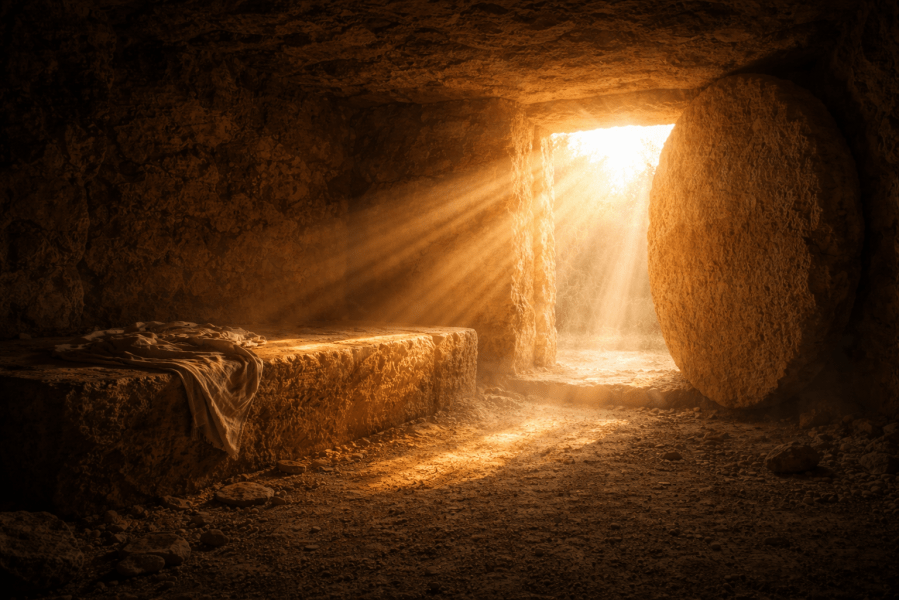
The enemies of Christianity were unable to produce a body, and did not deny that the tomb was empty. Instead, they attempted to make counterarguments to explain how the tomb was empty (cf. Matthew 28:13-15). The fact that they felt compelled to explain the empty tomb concedes the central truth that the tomb which once held Jesus’ body was now empty.
Meanwhile, the earliest Christians faced persecution and in many cases death, yet the threats to their lives did not deter them. Long-held Jewish ideas about one single general resurrection at the end of time were suddenly transformed into the belief that the resurrection would begin with one man in the middle of history. New theology about a crucified Messiah suddenly sprang onto the scene of history and spread like wildfire. Something caused this to happen.
The four gospel accounts, all written within the lifetime of eyewitnesses, all agree on the central facts of Jesus’ crucifixion and burial, the discovery of the empty tomb, and the numerous post-resurrection appearances. At the same time, they retain all the uniqueness you would expect of genuine independent witnesses. They quite clearly do not read like collusion.
If this much evidence existed for any other historical event – that is, any historical event that does not challenge our core identity and philosophical assumptions about the world – almost every historian would affirm it without hesitation. And this brings us back to the point made at the beginning of this series. The primary reason many reject the resurrection is not the lack of historical evidence.
The real reason many people reject the resurrection is their allegiance to a different worldview that is built on presupposed assumptions about the nature of reality. If one begins with a firm commitment to the idea that supernatural miracles cannot occur, that a dead man cannot rise from the dead under any circumstances, then the resurrection must be false. And if this is the case, some alternative explanation of the data is required, no matter how much that theory struggles to make sense of the data.
You may conclude that the Roman soldiers failed to fully execute Jesus, or that the disciples stole the body and fabricated the story, or that they were sincerely mistaken, or that a grand legend rapidly developed and was adopted by numerous people all throughout the Roman Empire. But each of those alternatives carries serious difficulties of their own. Ultimately these alternative theories must be maintained in spite of the historical evidence, and not because of it.
But what if that allegiance were to change? What if someone’s core identity were to shift, away from the secularism and materialism that is so prevalent in the world, and to turn toward a group of people who have sworn their allegiance to the one who gave up everything because of his love for others? What if they were to begin to walk in the way of mercy, grace, and love that was demonstrated on the cross? What if they were to place their hope in the one who defeated death itself? If someone were to change their core identity, and begin to think of the world through the lens of Christianity, they would find that the historical evidence all makes perfect sense.
No question in life is more important than this one. The resurrection is the foundational claim of Christianity. If the resurrection is false, then Christianity is false. But if Jesus truly rose from the dead, then He is exactly who the Christians recognize him to be. He is the Lord and Messiah, the Son of God in the flesh. His authority over the world is real, and His teachings matter. If the resurrection is true, then death has been defeated.
Everything hinges on this one question: Did Jesus really rise from the dead? Do not brush the question aside. Examine the evidence carefully. Set aside presuppositions and weigh it honestly. If the resurrection is true, then the only reasonable response is to reconsider where your allegiance belongs.
 The Christian Exile