
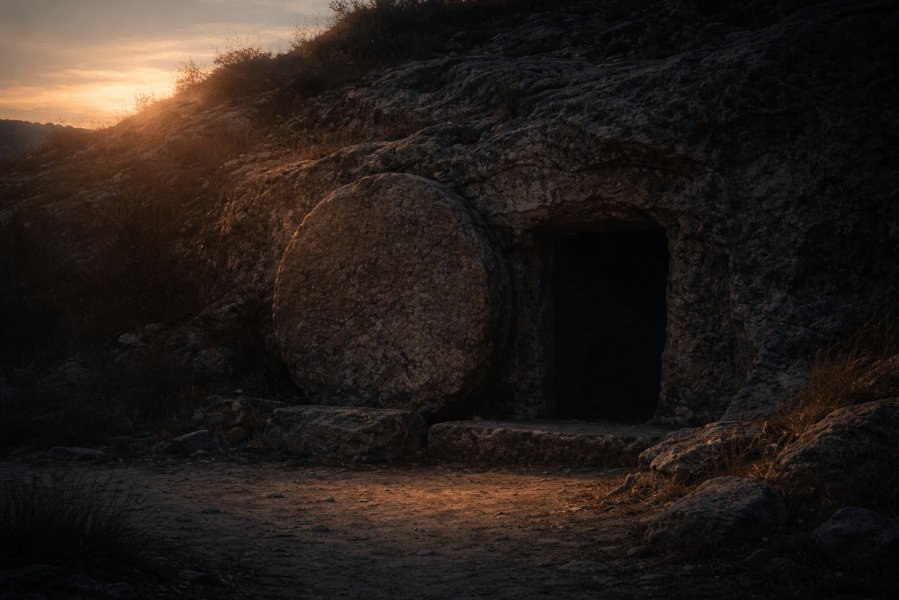
Few claims in history as are bold and seemingly unbelievable as the Christian proclamation that Jesus of Nazareth rose bodily from the dead. From the earliest days of Christianity, this claim has met resistance, skepticism, and dismissal. Yet much of that resistance has less to do with the historical evidence itself and more to do with assumptions about what can and cannot happen in the world.
In other words, the resurrection is frequently ruled out in advance. Not because the evidence is weak or incoherent, but because resurrection is considered impossible. Once that conclusion is reached, the question of Jesus’s resurrection is effectively dismissed before examination begins.
History or Philosophy – Which Comes First?
But history is not the place to begin with philosophical questions about what can or cannot happen. To study history is to ask what actually occurred. History weighs sources, eyewitness testimonies, examines motives, and traces consequences. It first examines evidence, and then draws conclusions about what happened, not the other way around.
If we begin with the assumption that reality is purely materialistic, only consisting of matter, energy, and blind natural processes, then the resurrection must either be proved as possible from a scientific perspective in order to even be considered as a possibility. Since true resurrection is universally understood to be scientifically impossible, the materialist will always require some alternative theory for Jesus’ supposed resurrection, no matter how strained or speculative that explanation may be.
But what happens when we first allow the evidence to speak for itself, and then force our philosophical assumptions to wrestle with the conclusions? Perhaps, if the evidence for the resurrection is strong enough, it must be reconsidered whether reality really is as purely materialistic as many have assumed. In this sense, the resurrection is a claim that serves to challenge even the deepest held assumptions about the world.
And yet for many, the resurrection is rarely examined as closely as it deserves. Instead of engaging the historical case directly, they often settle for any number of alternative theories, many of which are only briefly encountered and quickly accepted without critical examination.
Perhaps Jesus did not really die. Maybe the disciples hallucinated. Maybe the body was stolen, the tomb misidentified, or the story was reshaped over time by Jesus’s grieving disciples who simply could not accept the loss of their friend and supposed Messiah. Perhaps the resurrection is a legend or a myth that slowly evolved among the earliest Christians.
All kinds of variations on these theories exist. And on the surface, many of them sound somewhat plausible, or at least more plausible than the idea that a dead man literally rose again. As a result, many find even the mere existence of these theories as enough reason to avoid further investigation.
The question, however, is not whether these theories sound believable, but whether they actually account for the historical data once that data is examined closely.
The Enormous Implications of the Resurrection
But consider for a moment what the implications would be if Jesus really did rise from the dead. They are enormous.
First, the resurrection would mean that something, or Someone, from outside the materialistic world has acted upon this world. To be clear, Christians do not believe in the resurrection because they think resurrections are scientifically repeatable events within a purely natural system. Rather they have accepted that there must be more to reality, largely because of the resurrection.
Yet the implications do not stop with proving the supernatural. The resurrection also forces us to wrestle with the question of why. Why Jesus of Nazareth? Why this man, in this place, at that moment in history? What does the resurrection imply about His life, His teachings, and the claims He made about Himself?
It is the resurrection, more than anything else, that stamps Jesus as unique. If He rose from the dead, this gives tremendous credence to His words and claims about the world. It can even be said that His words carry divine authority. His words matter. His promises are trustworthy.
And if Jesus rose from the dead, suddenly the story of His ascension into heaven carries new weight. In other words, we must wrestle with His exaltation to a place of highest authority – authority that stands higher than any earthly governing power the world has ever known. If Jesus rose, then He is Lord. And if He is Lord, then His call to repentance and loyalty is not optional, and every human should seriously consider giving him their allegiance.
More than anything else, the resurrection stands at the very center of Christianity. If the resurrection is false, Christianity collapses. The apostles were either deceived or deceptive, the cross was a tragic failure, and the Christian faith is a empty of any value. But if the resurrection is true, then everything changes.
A Question That Cannot Be Dismissed
When the strength of the historical evidence is considered alongside the magnitude of the implications, one conclusion becomes unavoidable: the resurrection claim deserves serious and careful examination.
When that examination is actually undertaken, and the evidence is weighed rather than dismissed, something very interesting happens. All the popular theories begin to quickly unravel, because they quite simply do not offer reasonable explanations for the evidence. They do not make reasonable historical sense. But the claim of the resurrection of Jesus Christ remains standing as one arguably the most challenging and impactful event in all of human history, confirmed my numerous pieces of compelling evidence.
The reason I’m writing this series is simply lay out what, in my opinion, are the strongest pieces of evidence for the resurrection. All I ask is that you consider it carefully. If after looking at the evidence for yourself, you decided the resurrection is not a compelling explanation for what occurred, you’re welcome to draw that conclusion. But the question of whether or not the resurrection is history cannot be ignored. And for that reason, I hope you will take the time to read this series, and think carefully.
 The Christian Exile
Pingback: Did Jesus Really Rise From the Dead? Part 2: Why the Alternative Theories Fail – The Christian Exile
Pingback: Did Jesus Really Rise from the Dead? Part 3: The Earliest Christian Source – The Christian Exile