
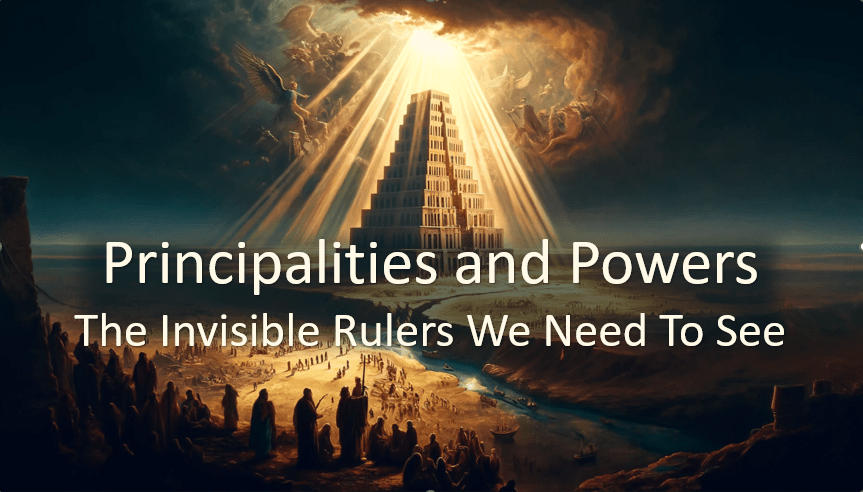
The story of Babel is familiar to many. After the flood, God commanded Noah’s family to multiply and fill the earth (Genesis 9:1). Instead, Noah’s descendants, led by Nimrod, settled in the plains of Shinar and set out to build a city and a tower reaching to heaven (Genesis 11:2-4). Desiring to make a name for themselves and avoid scattering, they defied God’s command and pridefully demonstrated independence from God.
God disrupted their rebellion by confusing their language and scattering them across the earth (Genesis 11:7-9). These events set the stage for God’s covenant with Abraham, through whom all the scattered and rebellious nations would be blessed (Genesis 12:1-3).
At least, that’s the version most people know. What this familiar summary of the story usually neglects, however, are the “principalities and powers.”
When telling any story, it is easy to focus on the main characters, whose actions most directly move the plot forward. We shouldn’t, however, overlook the background characters, without whom the story doesn’t make as much sense. Recognizing the role of the “principalities and powers” not only helps us see the significance of Babel, but is also key to understanding the broader theme of how God uses the principalities and powers to govern the unbelieving world.
Who Are the Principalities and Powers?
The phrase “principalities and powers” does not come from Genesis. It originates with Paul, who used the terms to describe both heavenly and earthly authorities.
Heavenly Powers
In a couple of places, it seems that Paul uses this language to refer to some sort of spiritual beings in heavenly realm with whom Christians must contend.
… that the manifold wisdom of God might be made known by the church to the principalities and powers in the heavenly places.
Ephesians 3:10
For we do not wrestle against flesh and blood, but against principalities, against powers, against the rulers of the darkness of this age, against spiritual hosts of wickedness in the heavenly places.
Ephesians 6:12
Earthly Authorities
In other instances, Paul uses the same terms to describe earthly political rulers. Interestingly, when used to refer to earthly rulers, translators tend to translate archon and exousia, as “rulers and authorities”, but these are the exact same Greek words elsewhere translated as “principalities and powers.”
Let every soul be subject to the governing authorities. For there is no authority except from God, and the authorities that exist are appointed by God… For rulers are not a terror to good works, but to evil.
Romans 13:1-3
Remind them to be subject to rulers and authorities, to obey, to be ready for every good work.
Titus 3:1
Both Realms Intertwined
Sometimes, the context does not make it entirely clear whether Paul is referring to spiritual authorities, earthly authorities, or perhaps both at the same time:
For I am persuaded that neither death nor life, nor angels nor principalities nor powers, nor things present nor things to come, nor height nor depth, nor any other created thing, shall be able to separate us from the love of God which is in Christ Jesus our Lord.
Romans 8:38-39
For by Him all things were created that are in heaven and that are on earth, visible and invisible, whether thrones or dominions or principalities or powers. All things were created through Him and for Him.
Colossians 1:16
Having disarmed the principalities and powers, He made a public spectacle of them, triumphing over them in it.
Colossians 2:15
The various and sometimes ambiguous ways Paul uses these terms blurs the line between spiritual and earthly rulers and raises some interesting questions. Who are these spiritual beings? What kind of authority do they have? Are the they somehow connected to earthly political rulers and authorities? What is God’s purpose for these spiritual beings? Do they continue to hold power and influence over the world today?
The Relationship Between Heavenly Powers and Earthly Authorities
While Scripture may not reveal the answer to every question we may have, there are some interesting Old Testament passages that likely helped shape Paul’s understanding of these principalities and powers. One example is Daniel 10:10-21, which vividly describes a heavenly struggle between spiritual entities, which he describes as the “Prince of Persia” and the “Prince of Greece.” These spiritual beings seem to correspond to the earthly kingdoms of Persia and Greece, indicating that their heavenly conflict somehow influenced, or was mirrored by, the affairs of earthly kingdoms.
Similarly, Psalm 82 presents a rebuke of rebellious spiritual beings, referred to as “gods” for their failure to govern justly. The failure of these “gods” are identified by their earthly impact, as the weak, fatherless, and needy are left afflicted, while the wicked are shown favoritism.
God has taken his place in the divine council;
Psalm 82:1-4
In the multitude of the gods he holds judgment:
How long will you judge unjustly
and show partiality to the wicked?
Give justice to the weak and fatherless;
Maintain the right of the afflicted and destitute.
Rescue the weak and needy;
Deliver them from the hand of the wicked.”
As in Daniel 10, Psalm 82 also shows that the corruption of these heavenly authorities is connected to corruption in earthly governance.
The interplay between heavenly and earthly powers is further emphasized in Isaiah 24:21-22, where both heavenly hosts and earthly kings are held accountable for their actions.
On that day the LORD will punish
the host of heaven, in heaven,
and the kings of the earth, on the earth.
They will be gathered together
as prisoners in a pit;
they will be shut up in a prison,
and after many days they will be punished.
Not only does Isaiah confirm the existence of both heavenly and earthly authorities, but their dual accountability underscores God’s sovereignty over both realms.
Principalities and Powers at Babel
Returning to Genesis we read of how God confused mankind’s language and scattered the nations across the earth, focusing on the immediate human rebellion and God’s response. While Genesis 11 does not explicitly mention the spiritual “principalities and powers,” the events at Babel serve as the backdrop to Deuteronomy 32:8-9, which reveals the spiritual dimension of this rebellion. Here we learn that in the aftermath of Babel, God fixed the borders of the scattered nations and assigned them to “the sons of God,” a phrase consistently used in Hebrew to refer to spiritual beings (e.g., Job 1:6; 2:1; 38:7; Genesis 6:1-4). In contrast to the other nations, God reserved Israel as His own special heritage, underscoring the unique covenant relationship He shared with them.
When the Most High gave the nations their inheritance,
Deuteronomy 32:8-9
when he divided mankind,
he fixed the borders of the peoples
according to the number of the sons of God.
But the LORD’s portion is his people,
Jacob is his allotted heritage.
This passage makes it clear that Babel was not only a moment of human rebellion, but it was also the moment when God assigned these newly scattered nations to the governance of other spiritual beings, while reserving Israel for Himself. That’s why the tower of Babel was such a critical moment in human history, and that’s why Paul places such a big emphasis on the presence and role of the “principalities and powers” throughout his writings.
Living as Exiles Under Principalities and Powers
For Christians, this understanding reshapes how we view the world. Earthly rulers, though instituted by God, operate within a realm where rebellious spiritual powers exert influence. Whether this is a direct influence, through idolatry and temptations, or an indirect influence, through cultural norms, ideologies, and philosophies, Scripture does not fully reveal. But the Bible does clearly affirm their existence and their opposition to God’s kingdom. These forces stand behind earthly political systems, but Christ’s victory on the cross has disarmed and defeated them (Colossians 2:15), ensuring that they cannot separate us from His love (Romans 8:38-39).
At its core, the gospel is a call to change allegiance, away from the rulers, principalities, and powers that dominate the unbelieving world, to the one true King, Jesus Christ (Colossians 1:13-14). To confess that “Jesus is Lord” (Romans 10:9) is to reject the lordship of any competing power, whether spiritual or earthly, that may wish to maintain authority for themselves.
The gospel is far more than a formula for getting to heaven after we die. It is an invitation to every tribe, tongue, and nation to forsake false gods and rulers, and to pledge their allegiance to the Lamb (Revelation 7:9-10). As citizens of God’s kingdom, we live as strangers and exiles in this world, seeking first His kingdom and His righteousness. Under Christ’s Lordship, we proclaim his reign in both word and deed, anticipating the day when every knee – whether in heaven, on earth, or under the earth, bows and confesses that Jesus is Lord (Philippians 2:10-11).
 The Christian Exile